• Email Us: [email protected]
  • Contact Us: +1 718 874 1545
  • Skip to main content
  • Skip to primary sidebar

Medical Market Report

  • Home
  • All Reports
  • About Us
  • Contact Us

JWST Shines New Light On 2500 Sources In Iconic Hubble Ultra Deep Field Image

August 4, 2025 by Deborah Bloomfield

Over 20 years ago, the Hubble Space Telescope looked at a little patch of sky for days, with this methodical approach catching the light of galaxies that existed when the universe was not even 1 billion years old. This was the Hubble Ultra Deep Field, a panorama of 10,000 galaxies that took 400 orbits of Hubble around the Earth to complete. A total exposure time of 271 hours and 12 minutes produced what, at the time, was a unique window into the earliest galaxies that ever existed.

JWST has now spent almost 100 hours, its longest extragalactic observation yet, looking at a portion of the Hubble Ultra Deep Field, containing around 2,500 sources. Combining the near and mid-instruments observations from JWST reveals important insights into the galaxies near and far (actually very far and very very far) that are captured in this newly released image. 

The JWST image is in false colors because the telescope studies the universe in infrared. The longer wavelengths are converted to red and orange, and tend to track the dust, star formation, and even the activity of supermassive black holes at the center of these distant galaxies. Lacking a sufficient amount of any of those things or a combination, the galaxies shine in the nearer infrared seen here in blue and cyan.

There is a third wavelength, though; everything that sits between the two is in white and green, middle wavelengths in the instrument capabilities. Those are the more distant galaxies in this image, whose light has been shifted to a redder version than usual, from the accelerated expansion of the universe. This process is known as redshift.
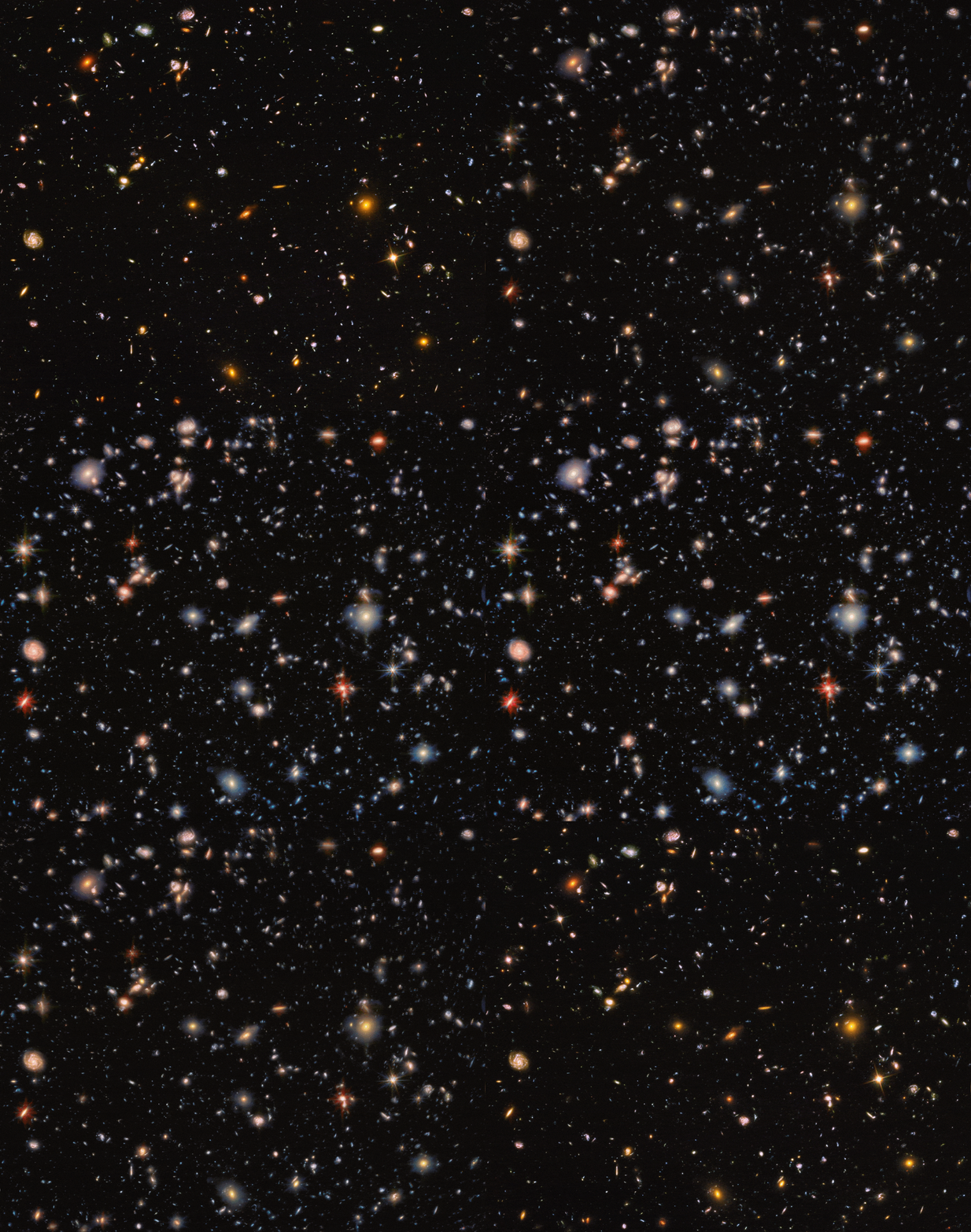
An area of deep space with thousands of galaxies in various shapes and sizes on a black background. Most are circles or ovals, with a few spirals. More distant galaxies are smaller, down to being mere dots, while closer galaxies are larger and some appear to be glowing. Red and orange galaxies contain more dust or more stellar activity. In the JWST verison everything is a lot brighter and a lot more galaxies are clearly visible.

A GIF showing the Hubble versus JWST view of this field.

Image credit: NASA, ESA, and S. Beckwith (STScI) and the HUDF Team/ESA/Webb, NASA & CSA, G. Östlin, P. G. Perez-Gonzalez, J. Melinder, the JADES Collaboration, M. Zamani (ESA/Webb); animated by IFLScience

The Hubble Ultra Deep Field image was a game-changer, and JWST shows with this work why it is a worthy successor to Hubble. It was designed to go beyond Hubble’s capabilities, and this is exactly what that means. Look at those distant galaxies pop from the darkness of the cosmos.

The original Hubble observations allowed researchers to better understand what was happening in the earlier eons of the universe. It was particularly crucial in allowing astronomers to understand what was going on with galaxies in particular early in the history of the cosmos. JWST is going to deliver even more insights.

The Hubble Ultra Deep Field is tiny. Hold a ballpoint pen in your hand and stretch out your arm. The tip of it is around 1 square millimeter, which is at one meter from your eye, roughly the apparent size of this area in the sky. Yet, in this tiny patch, there are hundreds of the most distant galaxies we have ever seen. Thanks to JWST, now we are seeing them even better than before.

Deborah Bloomfield
Deborah Bloomfield

Related posts:

  1. Russia moves Sukhoi Su-30 fighter jets to Belarus to patrol borders, Minsk says
  2. French senators to visit Taiwan amid soaring China tensions
  3. Thought Unicorns Don’t Exist? Turns Out They Live In A Chinese Cave
  4. Moon’s Magnetic Field Experienced Mysterious Resurgence 2.8 Billion Years Ago Before Disappearing

Source Link: JWST Shines New Light On 2500 Sources In Iconic Hubble Ultra Deep Field Image

Filed Under: News

Primary Sidebar

  • US Just Killed NASA’s Mars Sample Return Mission – So What Happens Now?
  • Art Sleuths May Have Recovered Traces Of Da Vinci’s DNA From One Of His Drawings
  • Countries With The Most Narcissists Identified By 45,000-Person Study, And The Results Might Surprise You
  • World’s Oldest Poison Arrows Were Used By Hunters 60,000 Years Ago
  • The Real Reason You Shouldn’t Eat (Most) Raw Cookie Dough
  • Antarctic Scientists Have Just Moved The South Pole – Literally
  • “What We Have Is A Very Good Candidate”: Has The Ancestor Of Homo Sapiens Finally Been Found In Africa?
  • Europe’s Missing Ceratopsian Dinosaurs Have Been Found And They’re Quite Diverse
  • Why Don’t Snorers Wake Themselves Up?
  • Endangered “Northern Native Cat” Captured On Camera For The First Time In 80 Years At Australian Sanctuary
  • Watch 25 Years Of A Supernova Expanding Into Space Squeezed Into This 40-Second NASA Video
  • “Diet Stacking” Trend Could Be Seriously Bad For Your Health
  • Meet The Psychedelic Earth Tiger, A Funky Addition To “10 Species To Watch” In 2026
  • The Weird Mystery Of The “Einstein Desert” In The Hunt For Rogue Planets
  • NASA Astronaut Charles Duke Left A Touching Photograph And Message On The Moon In 1972
  • How Multilingual Are You? This New Language Calculator Lets You Find Out In A Minute
  • Europa’s Seabed Might Be Too Quiet For Life: “The Energy Just Doesn’t Seem To Be There”
  • Amoebae: The Microscopic Health Threat Lurking In Our Water Supplies. Are We Taking Them Seriously?
  • The Last Dogs In Antarctica Were Kicked Out In April 1994 By An International Treaty
  • Interstellar Comet 3I/ATLAS Snapped By NASA’s Europa Mission: “We’re Still Scratching Our Heads About Some Of The Things We’re Seeing”
  • Business
  • Health
  • News
  • Science
  • Technology
  • +1 718 874 1545
  • +91 78878 22626
  • [email protected]
Office Address
Prudour Pvt. Ltd. 420 Lexington Avenue Suite 300 New York City, NY 10170.

Powered by Prudour Network

Copyrights © 2026 · Medical Market Report. All Rights Reserved.

Go to mobile version