• Email Us: [email protected]
  • Contact Us: +1 718 874 1545
  • Skip to main content
  • Skip to primary sidebar

Medical Market Report

  • Home
  • All Reports
  • About Us
  • Contact Us

JWST Spots Structures From The Early Universe Never Seen Before

October 27, 2022 by Deborah Bloomfield

Astronomers have announced a pretty cool discovery thanks to JWST, coming all the way from the very early universe. The space observatory has revealed that a far distant known galaxy is not a single object but two. The object is known as MACS0647-JD, and the light we can see today has been travelling since 400 million years after the Big Bang.

MACS0647 is a massive galaxy cluster. It is so big that it warps space-time, creating a gravitational lens. Objects located behind the cluster are magnified, so astronomers have been using it to see further back into the universe. That’s how they discovered MACS0647-JD with Hubble ten years ago, where it appeared as a single red object.

Advertisement

“Due to the gravitational lensing of the massive galaxy cluster MACS0647, it’s lensed into three images: JD1, JD2, and JD3. They’re magnified by factors of eight, five, and two, respectively,” discoverer Dan Coe, from Johns Hopkins University and the European Space Agency, said in a blog post from NASA.

JWST was able to resolve two objects. Either this is a merger between two galaxies, likely the most distant seen so far, or it is two clumps of stars within a single galaxy. Further observations from JWST might help shed light on this, but the team already has plenty to work on.
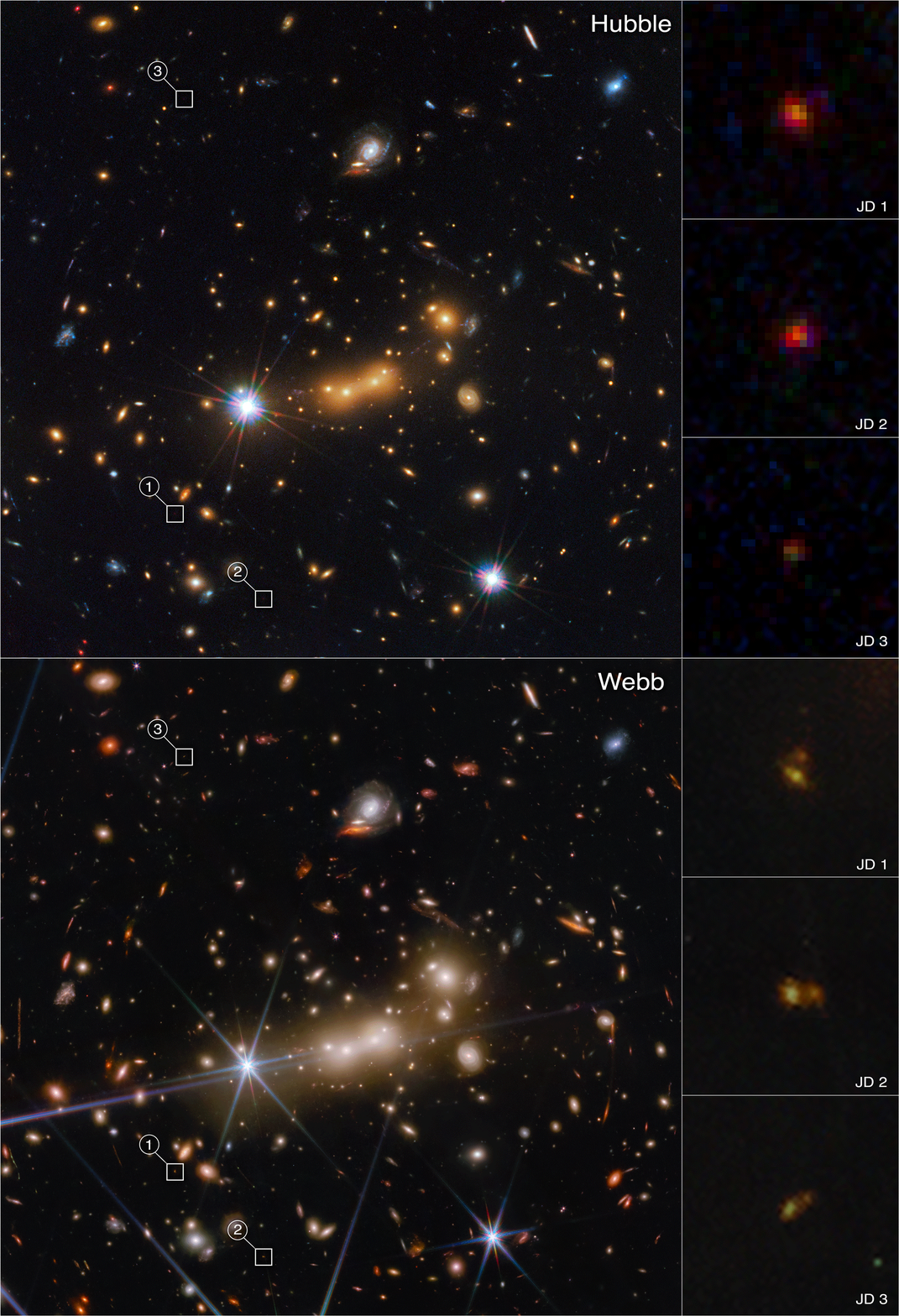
The comparison show how much better JWST is at resolving those distant galaxies.

Animated comparison between Hubble and JWST. Galaxy cluster MACS0647 with the three-lensed images of the distant galaxy highlighted. Image credit: NASA, ESA, CSA, STScI, and Tiger Hsiao (Johns Hopkins University). Image processing: Alyssa Pagan.

“You can also see that the colors between the two objects are so different. One’s bluer; the other one is redder. The blue gas and the red gas have different characteristics. The blue one actually has very young star formation and almost no dust, but the small, red object has more dust inside, and is older. And their stellar masses are also probably different,” explained lead author Tiger Yu-Yang Hsiao, also from Johns Hopkins University.

Advertisement

JWST is a revolutionary observatory. It’s studying the universe in infrared light, seeing further and in more detail compared to its predecessors such as Spitzer. Astronomers have been using it to study many different objects, and it’s living up to its potential.

“Up to this point, we haven’t really been able to study galaxies in the early universe in great detail,” co-author Rebecca Larson, from the University of Texas at Austin, added. “Studying them can help us understand how they evolved into the ones like the galaxy we live in today. And also, how the universe evolved throughout time.”

The current work is submitted to Nature and available to read on the online repository arXiv.

Deborah Bloomfield
Deborah Bloomfield

Related posts:

  1. Soccer – Poland level late to end England’s winning streak
  2. Mexico’s Kavak drives away with $700M in new funding, doubling its valuation to $8.7B
  3. Czech president Zeman to be released from hospital on Wednesday
  4. Stocks, dollar ease on growth, inflation concerns

Source Link: JWST Spots Structures From The Early Universe Never Seen Before

Filed Under: News

Primary Sidebar

  • US Just Killed NASA’s Mars Sample Return Mission – So What Happens Now?
  • Art Sleuths May Have Recovered Traces Of Da Vinci’s DNA From One Of His Drawings
  • Countries With The Most Narcissists Identified By 45,000-Person Study, And The Results Might Surprise You
  • World’s Oldest Poison Arrows Were Used By Hunters 60,000 Years Ago
  • The Real Reason You Shouldn’t Eat (Most) Raw Cookie Dough
  • Antarctic Scientists Have Just Moved The South Pole – Literally
  • “What We Have Is A Very Good Candidate”: Has The Ancestor Of Homo Sapiens Finally Been Found In Africa?
  • Europe’s Missing Ceratopsian Dinosaurs Have Been Found And They’re Quite Diverse
  • Why Don’t Snorers Wake Themselves Up?
  • Endangered “Northern Native Cat” Captured On Camera For The First Time In 80 Years At Australian Sanctuary
  • Watch 25 Years Of A Supernova Expanding Into Space Squeezed Into This 40-Second NASA Video
  • “Diet Stacking” Trend Could Be Seriously Bad For Your Health
  • Meet The Psychedelic Earth Tiger, A Funky Addition To “10 Species To Watch” In 2026
  • The Weird Mystery Of The “Einstein Desert” In The Hunt For Rogue Planets
  • NASA Astronaut Charles Duke Left A Touching Photograph And Message On The Moon In 1972
  • How Multilingual Are You? This New Language Calculator Lets You Find Out In A Minute
  • Europa’s Seabed Might Be Too Quiet For Life: “The Energy Just Doesn’t Seem To Be There”
  • Amoebae: The Microscopic Health Threat Lurking In Our Water Supplies. Are We Taking Them Seriously?
  • The Last Dogs In Antarctica Were Kicked Out In April 1994 By An International Treaty
  • Interstellar Comet 3I/ATLAS Snapped By NASA’s Europa Mission: “We’re Still Scratching Our Heads About Some Of The Things We’re Seeing”
  • Business
  • Health
  • News
  • Science
  • Technology
  • +1 718 874 1545
  • +91 78878 22626
  • [email protected]
Office Address
Prudour Pvt. Ltd. 420 Lexington Avenue Suite 300 New York City, NY 10170.

Powered by Prudour Network

Copyrights © 2026 · Medical Market Report. All Rights Reserved.

Go to mobile version