• Email Us: [email protected]
  • Contact Us: +1 718 874 1545
  • Skip to main content
  • Skip to primary sidebar

Medical Market Report

  • Home
  • All Reports
  • About Us
  • Contact Us

Keep An Eye Out For Aurorae This Week – This “Weak” Solar Flare Might Pack A Surprising Punch

August 7, 2025 by Deborah Bloomfield

The Sun is just past its peak of activity for this solar cycle, but that does not mean it is done with its fireworks. A relatively weak flare yesterday has caused a minor radio blackout, and it might lead to some aurorae on Friday as a large wave of plasma has left the Sun, speeding towards our planet.

Currently, the bulk of the coronal mass ejection will miss the planet, but there will be an increase in plasma density across Thursday and Friday, according to the current estimates. There are no updated forecasts for aurorae visibilities, but if you hope to catch some pretty lights in the night sky, keep an eye on the Space Weather Prediction Center.
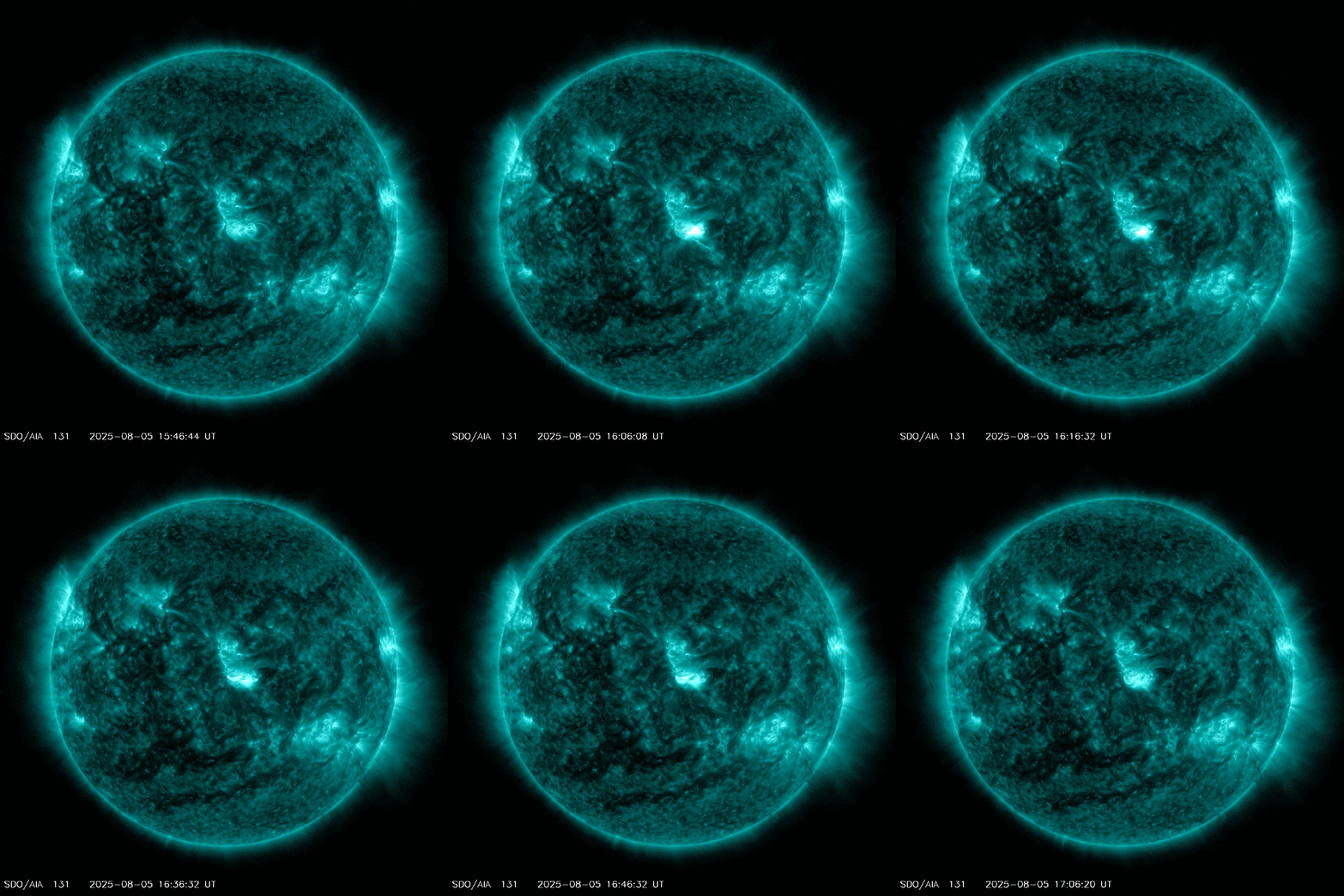
an animated gif of the sun flaring up

The M 4.4 flare that occurred on August 5.

Image credit: NASA/SDO/AIA

The flare was quite weak as flares go. It was a M4.4 – this is the medium-size class, which at most causes brief radio blackouts, mostly localized, and with minor radiation storms on occasion. There have been many bigger flares in the last few months than this. Still, the flare suggests that the sunspot 4168 is one to keep an eye on. It is fairly big and can be easily seen with small solar binoculars.

The activity of the sunspot was linked to a coronal mass ejection (CME), a rapid release of plasma that is coming to Earth in the next few days. Northern and southern lights are produced when these interplanetary charged particles get trapped in the Earth’s magnetic field and slam into the atmosphere.
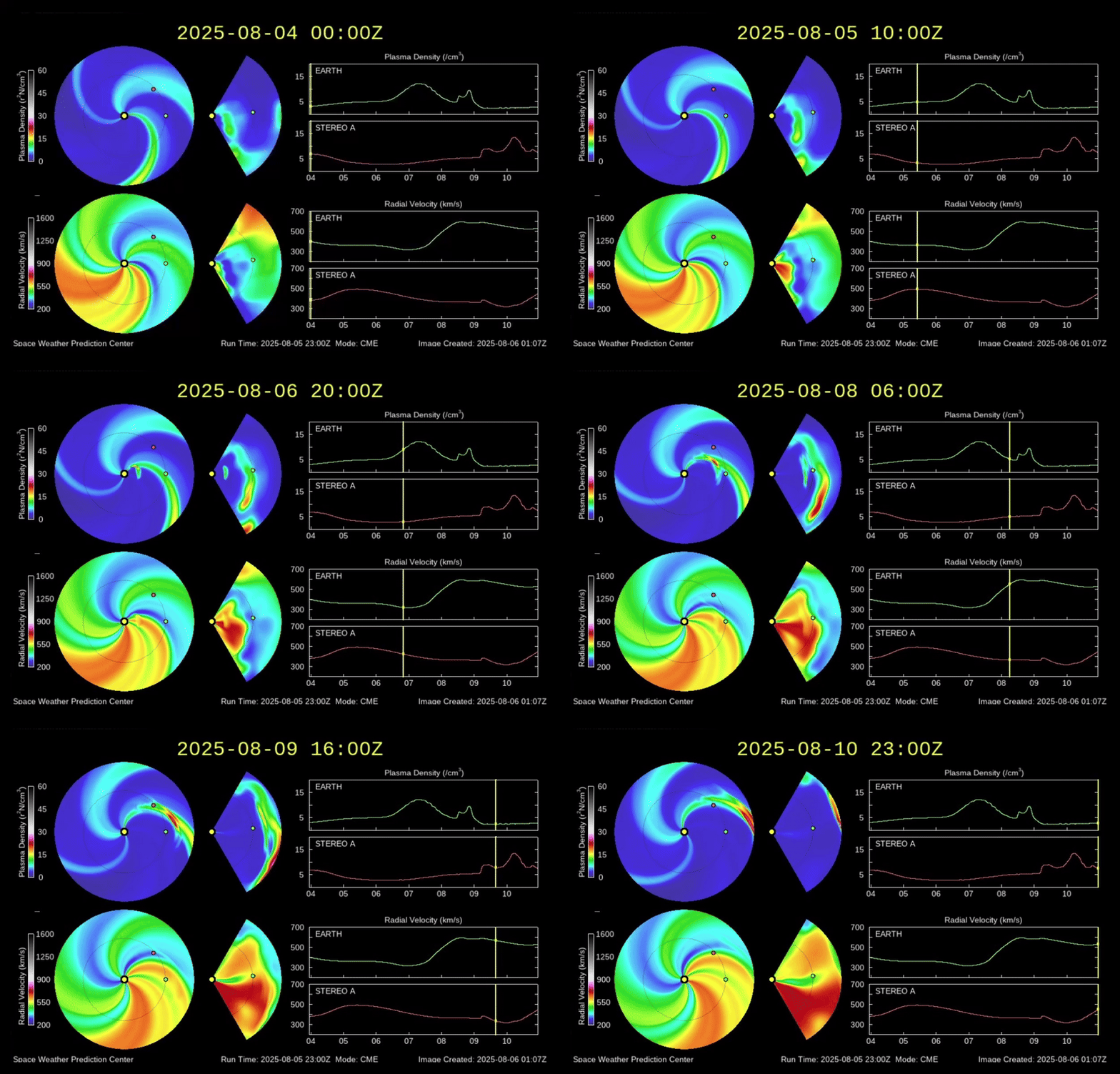
Two bird eye view of the sun show waves coming from the Sun, the CME is shown as an anomalous waves delivering a glancing blow to Earth

Model prediction of the plasma density around Earth (green dot) in the coming days.

Image credit: NOAA/SWPC

Depending on the energy and altitude, they might slam into different gases, producing different colors. This is due to atoms in our atmosphere becoming ionized (losing or shifting electrons) due to interaction with solar particles. The return to the status quo (regaining the electron, or the electron going back to the ground state) means that the atom loses energy, which is released as light.

This energy is always the same for the specific transition. So, most of the aurorae are green because that’s the color released by oxygen, which is easy enough to excite. If the Sun is particularly active, you can have a red one, either because of nitrogen (occasionally with hints of purple, blue, and pink) or, for the really energetic ones, a different oxygen excitation.

We will know more in the coming days if we have widespread aurorae. Regardless, August is spoiling us; the Perseids meteor shower is peaking next week, around two planetary conjunctions, a planetary alignment, and even the last Black Moon for two years. Enjoy the night!

Deborah Bloomfield
Deborah Bloomfield

Related posts:

  1. Russia moves Sukhoi Su-30 fighter jets to Belarus to patrol borders, Minsk says
  2. French senators to visit Taiwan amid soaring China tensions
  3. Thought Unicorns Don’t Exist? Turns Out They Live In A Chinese Cave
  4. Moon’s Magnetic Field Experienced Mysterious Resurgence 2.8 Billion Years Ago Before Disappearing

Source Link: Keep An Eye Out For Aurorae This Week – This "Weak" Solar Flare Might Pack A Surprising Punch

Filed Under: News

Primary Sidebar

  • Rare Core Samples Provide “Once In A Lifetime” Opportunity To Study The Giant Line That Slices Through Scotland
  • The “Special Regions” On Mars Where It Is Forbidden To Explore, For Good Reason
  • Do Animals Fall For Magic Tricks? Watch A Devastated Squirrel Monkey Prove That Yes, They Do
  • Google’s CEO Wants AI Data Centers In Space In 2027. There Is One Massive Problem
  • Live Seven-Arm Octopus Spotted In The Deep Sea – Only The Fourth Time It’s Been Seen In 40 Years
  • Uranus May Not Be So Weird After All – Voyager Just Caught It During An Unusual Gust Of Wind
  • “Exceptional” 5.5-Million-Light-Year-Long Cosmic Structure Appears To Be Rotating, Challenging Current Models Of The Universe
  • How A Mystery Volcano Sparked The Black Death In The 14th Century
  • A Strange New Species Of Bird Has Worrying Similarities To The Doomed Dodo
  • Darkest Fabric Ever Made – Inspired By Birds-Of-Paradise – Creates The Ultimate Little Black Dress
  • This Guy’s Head Was Bitten By A Lion 6,000 Years Ago – But He Survived
  • 12 Former FDA Heads Call Out FDA’s Leaked Memo Claiming COVID-19 Vaccines Killed Children In Bid To Change Policy
  • Hidden Features In Our Galaxy Discovered By Studying The Milky Way From The Inside Out
  • Why Does My Belly Button Smell?
  • 2,500-Year-Old Chronicle Is Oldest Known Record Of A Total Solar Eclipse And Reveals Some Surprises
  • RIP Claude: San Francisco’s Iconic Albino Alligator Dies Aged 30
  • Nitrous Oxide: Inhaling “Laughing Gas” Could Be Surprisingly Effective For Treating Severe Depression
  • JWST Discovers A Milky Way-Like Spiral Galaxy Where It Shouldn’t Exist
  • World’s Largest Dinosaur Tracksite Has At Least 16,600 Footprints And Sets Many World Records
  • Interstellar Comet 3I/ATLAS Will Make Its Closest Approach To Earth This Month, Just 270 Million Kilometers Away
  • Business
  • Health
  • News
  • Science
  • Technology
  • +1 718 874 1545
  • +91 78878 22626
  • [email protected]
Office Address
Prudour Pvt. Ltd. 420 Lexington Avenue Suite 300 New York City, NY 10170.

Powered by Prudour Network

Copyrights © 2025 · Medical Market Report. All Rights Reserved.

Go to mobile version