• Email Us: [email protected]
  • Contact Us: +1 718 874 1545
  • Skip to main content
  • Skip to primary sidebar

Medical Market Report

  • Home
  • All Reports
  • About Us
  • Contact Us

Largest Flare In This Solar Cycle Was Seen By Spacecraft From Mercury To Mars

June 19, 2024 by Deborah Bloomfield

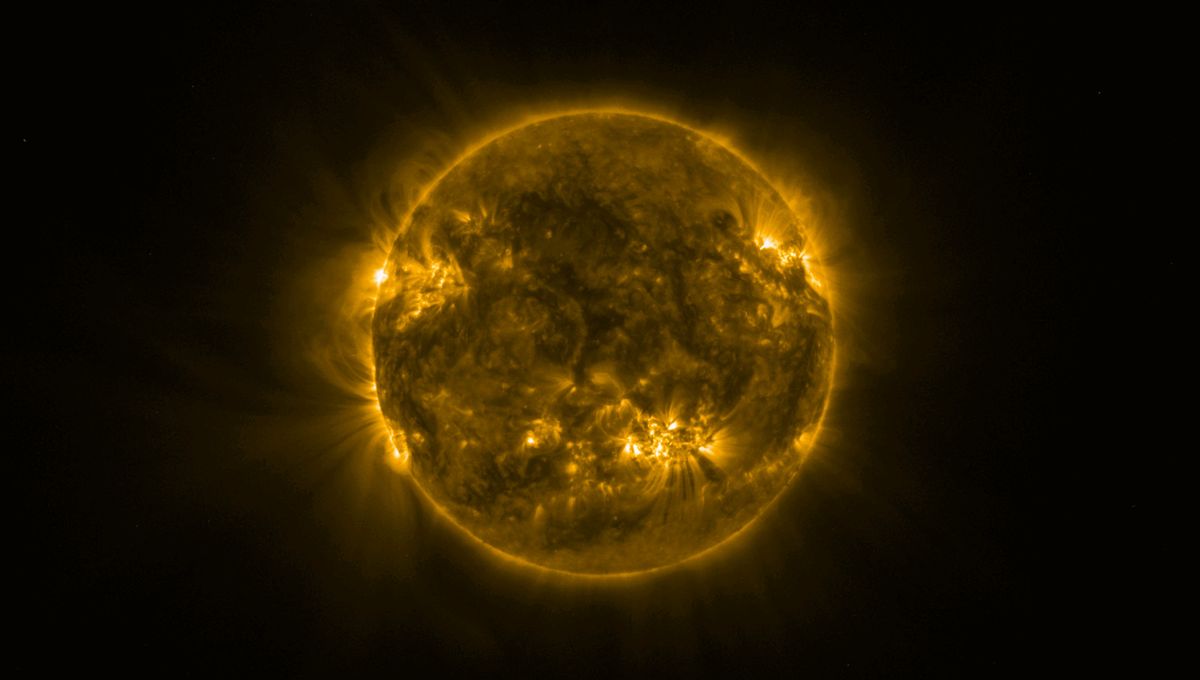
The whole inner Solar System was blasted with intense plasma back in May. Most of it came from a single extremely active sunspot called AR3664. This was responsible for a coronal mass ejection leading to spectacular auroral displays at lower latitudes than usual, and a solar flare that caused a significant radio blackout on Earth around May 14. But the best was yet to come.

Advertisement

The flare that hit the Earth was an X8.79, at the time the strongest in seven years. On May 20, once the spot had rotated to the other side of the Sun, it released an even stronger one. Solar Orbiter, which was located on that side of the Sun measured an X12 flare – the strongest in the cycle and possibly the strongest in 20 years.

Advertisement

“This makes it the strongest flare yet of the current solar cycle, and in the top ten flares since 1996,” European Space Agency (ESA) research fellow Laura Hayes said in a statement.

It was serendipitous that Solar Orbiter was at the right place at the right time. The spacecraft orbits around the Sun every six months, and as part of its primary mission, it won’t deliver this alignment many more times.


Advertisement

“Solar Orbiter’s position, in combination with other missions watching the Sun from Earth’s side, gives us a 360-degree view of the Sun for an extended period of time. This will only happen three more times in the future of Solar Orbiter, so we are in a unique situation to observe active regions on the far side that will then rotate into Earth’s view,” explained Daniel Müller, Solar Orbiter Project Scientist at ESA.

But it was not just Solar Orbiter on the path of the intense plasma release. The wave hit BepiColombo, the ESA and JAXA mission to Mercury, as well as the planet Mercury, despite the two not being very close to each other. Solar Orbiter was near Venus and both were showered with particles. NASA’s Parker Solar Probe was on the path too, so we will be getting some really cool science there as well. And then, there was Mars.  

“The reason why the X-class flare that happened on the other side of the Sun is really interesting is because it’s associated with particles that were on the path of BepiColombo as well as Mars Express,” Dr Miho Janvier, solar and space physicist at ESA, told IFLScience.


Advertisement

Both BepiColombo and Mars Express saw increased numbers of memory errors. NASA mission Curiosity saw “snow” in its images, and Mars Odyssey lost the use of its camera for about an hour. MAVEN had a great time though: one of its objectives is studying the aurorae on Mars.

AR3664 continues to be active; Solar Orbiter saw another flare from it on June 11. These observations show the importance of having a 360-degree view of the Sun. 

Deborah Bloomfield
Deborah Bloomfield

Related posts:

  1. Cricket-NZ players reach Dubai after ‘specific, credible threat’ derailed Pakistan tour
  2. Soccer-Liverpool’s Alexander-Arnold ruled out of Man City game
  3. Antikythera Mechanism: The True Story Of Indiana Jones’s “Dial Of Destiny”
  4. The Winter “Tripledemic”: Here’s What To Know

Source Link: Largest Flare In This Solar Cycle Was Seen By Spacecraft From Mercury To Mars

Filed Under: News

Primary Sidebar

  • “Exceptional” 5.5-Million-Light-Year-Long Cosmic Structure Appears To Be Rotating, Challenging Current Models Of The Universe
  • How A Mystery Volcano Sparked The Black Death In The 14th Century
  • A Strange New Species Of Bird Has Worrying Similarities To The Doomed Dodo
  • Darkest Fabric Ever Made – Inspired By Birds-Of-Paradise – Creates The Ultimate Little Black Dress
  • This Guy’s Head Was Bitten By A Lion 6,000 Years Ago – But He Survived
  • 12 Former FDA Heads Call Out FDA’s Leaked Memo Claiming COVID-19 Vaccines Killed Children In Bid To Change Policy
  • Hidden Features In Our Galaxy Discovered By Studying The Milky Way From The Inside Out
  • Why Does My Belly Button Smell?
  • 2,500-Year-Old Chronicle Is Oldest Known Record Of A Total Solar Eclipse And Reveals Some Surprises
  • RIP Claude: San Francisco’s Iconic Albino Alligator Dies Aged 30
  • Nitrous Oxide: Inhaling “Laughing Gas” Could Be Surprisingly Effective For Treating Severe Depression
  • JWST Discovers A Milky Way-Like Spiral Galaxy Where It Shouldn’t Exist
  • World’s Largest Dinosaur Tracksite Has At Least 16,600 Footprints And Sets Many World Records
  • Interstellar Comet 3I/ATLAS Will Make Its Closest Approach To Earth This Month, Just 270 Million Kilometers Away
  • How Does Time Pass On Mars? For The First Time, We Have A Precise Answer
  • Is This How The Voynich Manuscript Was Made? A New Cipher Offers Fascinating Clues
  • An Extremely Rare And Beautiful “Meat-Eating” Plant Has Been Found Miles From Its Known Home
  • Scheerer Phenomenon: Those White Structures You See When You Look At The Sky May Not Be “Floaters”
  • The Science Of Magic At CURIOUS Live: Psychologist Dr Gustav Kuhn On Using Magic To Study The Human Mind
  • Around 5 Percent Of Cancers Are Of “Unknown Primary”. Could A New Blood Test Track Them Down?
  • Business
  • Health
  • News
  • Science
  • Technology
  • +1 718 874 1545
  • +91 78878 22626
  • [email protected]
Office Address
Prudour Pvt. Ltd. 420 Lexington Avenue Suite 300 New York City, NY 10170.

Powered by Prudour Network

Copyrights © 2025 · Medical Market Report. All Rights Reserved.

Go to mobile version