• Email Us: [email protected]
  • Contact Us: +1 718 874 1545
  • Skip to main content
  • Skip to primary sidebar

Medical Market Report

  • Home
  • All Reports
  • About Us
  • Contact Us

Largest Rare Earth Elements Deposit In Europe Discovered By Swedish Mining Company

January 31, 2023 by Deborah Bloomfield

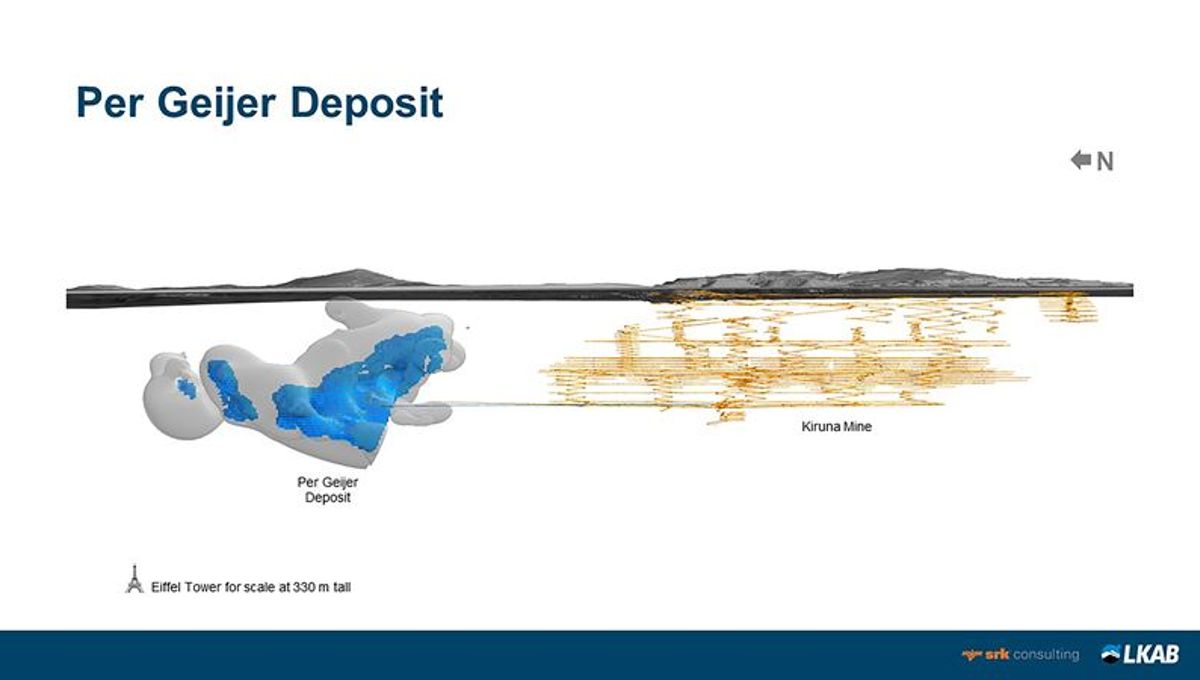
A Swedish mining company has announced the discovery of the largest rare earth oxides deposit in Europe, with 1 million tonnes of metal found beneath the ground in north Sweden. The state-owned company, LKAB, is in luck as the deposit is very close to its Kiruna iron mine, which is the largest of its kind.  

Spokespeople for LKAB said it is not just good news for their profits, but good news for the world’s goal of becoming net zero. 

Advertisement

“This is good news, not only for LKAB, the region and the Swedish people, but also for Europe and the climate,” said Jan Moström, President and Group CEO of LKAB, in a statement.

“This is the largest known deposit of rare earth elements in our part of the world, and it could become a significant building block for producing the critical raw materials that are absolutely crucial to enable the green transition. We face a supply problem. Without mines, there can be no electric vehicles.”  

Rare earth oxides is a collective term for 17 different soft heavy metals that have integral roles in electronics, magnetic materials, and (more recently) renewable energy generation. As such, demand for these metals has skyrocketed in recent years, as electronic chipmakers struggle to meet it and the generation of electricity from wind and solar attempts to catch up to fossil fuels. 

Despite the demand, Europe has no rare earth mineral mines and China continues to be the predominant supplier globally. In keeping with the European Union’s desire to be independent from China, LKAB believes the mine will ensure Europe becomes more self-sustainable. 

Advertisement

While the prospect is exciting, creating a huge mine is not a quick task, even when positioned next to an existing one. LKAB has already created a large drift over the deposit and will continue probing to understand the extent of it, in the hopes of submitting an application to mine in 2023. 

“We are already investing heavily to move forward, and we expect that it will take several years to investigate the deposit and the conditions for profitably and sustainably mining it. We are humbled by the challenges surrounding land use and impacts that exist to develop this into a mine and that will need to be analysed to see how to avoid, minimize and compensate for it. Only then can we proceed with an environmental review application and apply for a permit,” continued Moström. 

“If we look at how other permit processes have worked within our industry, it will be at least 10-15 years before we can actually begin mining and deliver raw materials to the market.” 

Deborah Bloomfield
Deborah Bloomfield

Related posts:

  1. Death toll from Indonesia jail blaze at 44 amid focus on overcrowding
  2. Software supply chain platform Cloudsmith raises $15M Series A led by Tiger Global
  3. U.S.’ Blinken to convene foreign ministers on COVID-19 commitments before year’s end
  4. China’s property sector default woes deepen amid Evergrande disquiet

Source Link: Largest Rare Earth Elements Deposit In Europe Discovered By Swedish Mining Company

Filed Under: News

Primary Sidebar

  • These Hognose Snakes Have The Most Dramatic Defense Technique You’ve Ever Seen
  • Titan, Saturn’s Biggest Moon, Might Not Have A Secret Ocean After All
  • The World’s Oldest Individual Animal Was Born In 1499 CE. In 2006, Humans Accidentally Killed It.
  • What Is Glaze Ice? The Strange (And Deadly) Frozen Phenomenon That Locks Plants Inside Icicles
  • Has Anyone Ever Actually Been Swallowed By A Whale?
  • First-Known Instance Of Bees Laying Eggs In Fossilized Tooth Sockets Discovered In 20,000-Year-Old Bones
  • Polar Bear Mom Adopts Cub – Only The 13th Known Case Of Adoption In 45 Years Of Study At Hudson Bay
  • The Longest-Running Evolution Experiment Has Been Going For 80,000 Generations
  • From Shrink Rays And Simulated Universes To Medical Mishaps And More: The Stories That Made The Vault In 2025
  • Fastest Cretaceous Theropod Yet Discovered In 120-Million-Year-Old Dinosaur Trackway
  • What’s The Moon Made Of?
  • First Hubble View Of The Crab Nebula In 24 Years Is A Thing Of Beauty… With Mysterious “Knots”
  • “Orbital House Of Cards”: One Solar Storm And 2.8 Days Could End In Disaster For Earth And Its Satellites
  • Astronomical Winter Vs. Meteorological Winter: What’s The Difference?
  • Do Any Animal Species Actively Hunt Humans As Prey?
  • “What The Heck Is This?”: JWST Reveals Bizarre Exoplanet With Inexplicable Composition
  • The Animal With The Strongest Bite Chomps Down With A Force Of Over 16,000 Newtons
  • The Eschatian Hypothesis: Why Our First Contact From Aliens May Be Particularly Bleak, And Nothing Like The Movies
  • The Great Mountain Meltdown Is Coming: We Could Reach “Peak Glacier Extinction” By 2041
  • Comet 3I/ATLAS Is Experiencing A Non-Gravitational Acceleration – What Does That Mean?
  • Business
  • Health
  • News
  • Science
  • Technology
  • +1 718 874 1545
  • +91 78878 22626
  • [email protected]
Office Address
Prudour Pvt. Ltd. 420 Lexington Avenue Suite 300 New York City, NY 10170.

Powered by Prudour Network

Copyrights © 2025 · Medical Market Report. All Rights Reserved.

Go to mobile version