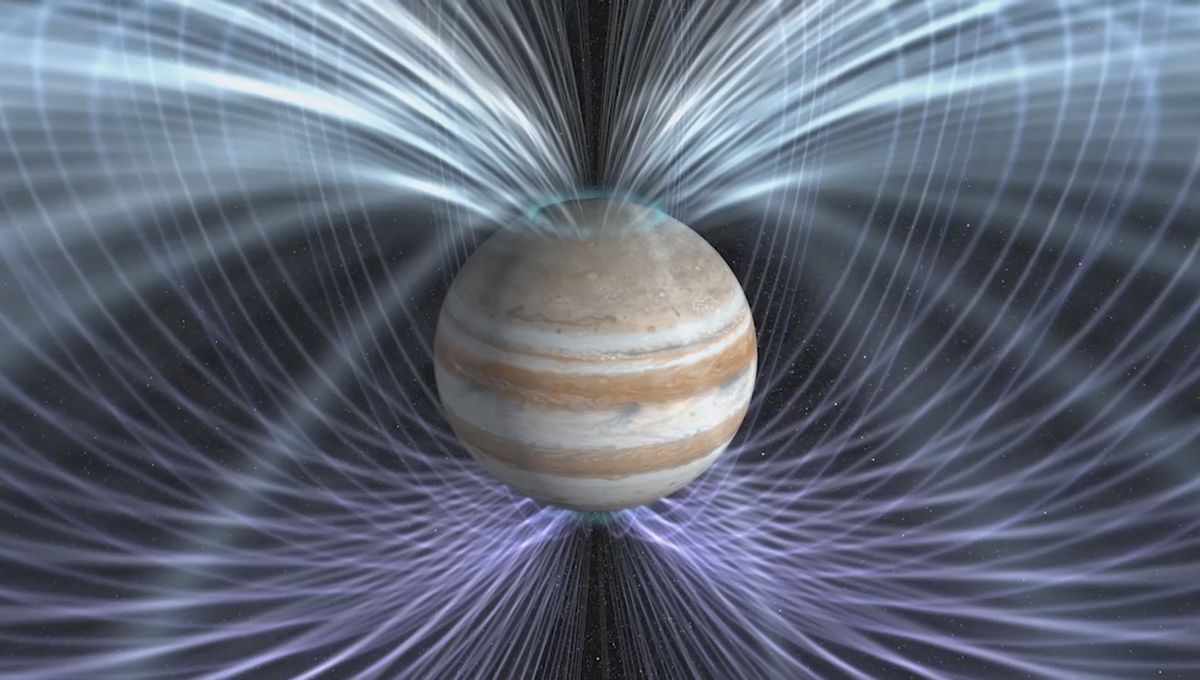
Forty-six years after it was first recorded, the magnetic data collected by Voyager 1 as it sailed past Jupiter, crossing its bow shock, continues to be hauntingly beautiful. You don’t need to know anything about particles, magnetic fields, bow shocks, or anything else to appreciate the weirdness of it and how the fateful crossing shifts the interpreted sound, but knowing the science behind it will make you appreciate the sounds even more. You can even compare the modern version captured by Juno.
If a planet has a magnetic field, it will generate a magnetosphere, the region of interplanetary space where this field dominates. While magnetic fields can extend to infinity, at least in theory, every planet is fighting for magnetic real estate against the solar wind, the stream of electrically charged particles that come from the Sun.
As they encounter a magnetosphere, these particles are stopped like a rock diverts the flow of water in a river. The solar wind plasma goes from moving at about 400 kilometers per second (900,000 miles per hour) to being diverted and slowed down. Where the solar wind hits the planet’s magnetosphere is known as the bow shock and is analogous to a sonic boom in Earth’s atmosphere created by a supersonic aircraft.
And when it comes to the largest planet in the Solar System, everything is bigger on Jupiter.
Inside Jupiter, hydrogen is pressurized to such a high value that it enters its metallic state. As it swirls, powerful electrical currents are generated, which are in turn responsible for an enormous magnetic field. It is between 16 and 54 times stronger than Earth’s own, and is also the largest continuous structure in the Solar System apart from the sphere of influence of the Sun. It varies with the intensity of the solar wind, but it can extend for over 3 million kilometers (2 million miles) in a sunward direction, and away from the Sun reaches almost to the orbit of Saturn.
In 1974, Pioneer 10 and 11, the first probes to encounter Jupiter, also met with the bow shock. During their encounter, it was at its largest. When it was Voyager 1’s turn in 1979, the mission was ready to study it like never before, thanks to the knowledge from the Pioneers. Surprisingly, they found the magnetosphere was much smaller, due to the more intense solar wind. As it expands and compresses, the magnetosphere can create massive heat, warming up regions up to about a quarter of the planet. We recently discovered it can actually do that multiple times a month.
Jupiter is an extreme world, and understanding its magnetic behavior is fundamental to understanding more of the planet and of many other worlds across the universe. As the Voyager probes learned from the Pioneers, so has Juno learned from all the missions that came before. Juno crossed Jupiter’s bow shock in 2016 and discovered the boundary structure was even more complex than we had realized.
“If Jupiter’s magnetosphere glowed in visible light, it would be twice the size of the full Moon as seen from Earth,” said William Kurth of the University of Iowa, lead co-investigator for the Waves investigation, at the time. And that was just the shorter end of the structure. The part extending behind Jupiter had a length about five times the distance between Earth and the Sun, around 745 million kilometers (465 million miles).
We may understand a lot more about Jupiter in those 46 years since Voyager 1 visited, but new insights, such as new types of plasma waves, continue to surprise us.

Source Link: Listen To The Eerie Plasma Recording By Voyager 1 As It Crossed The Bow Shock Of Jupiter
