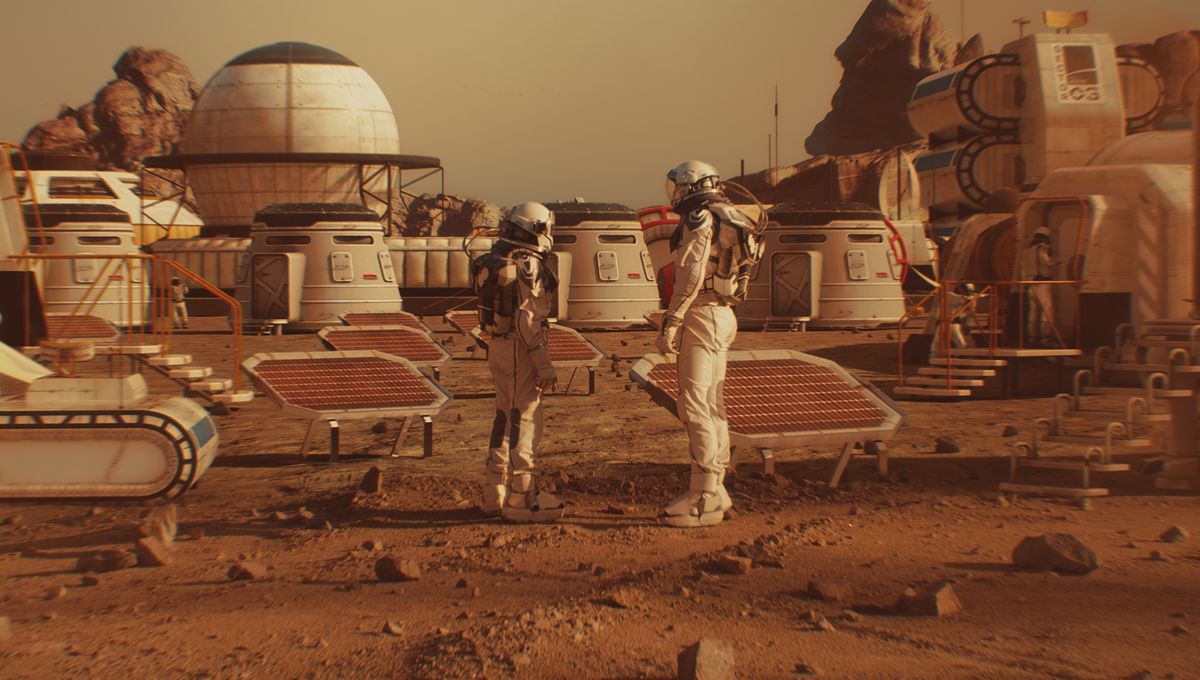
Many people expect that the future of humanity will involve Mars. The Red Planet is close enough and not immediately deadly like Venus. That makes it a good enough candidate for future human exploration, and maybe even settling the place. But good enough doesn’t make it good.
Unlike Milton’s Lucifer, we can not make a heaven out of hell when it comes to Mars. The Red Planet might not have an atmosphere that melts lead and crushes you into a patty like Venus, but it is a more extreme environment than any we have on Earth. And there’s no way to simply fix it.
Let’s assume, for the sake of argument, that the bombastic plans of Elon Musk by some miracle actually happen. Within a few decades, humanity will have settled on Mars with a million people living there. Those people won’t be an independent nation, even if we think that laws might allow that to be the case. Their survival is linked to Earth; there cannot be any independence there.
Terraforming Mars can’t be done now
Would things be different if Mars were Earth-like? Possibly, up to certain points. The problem is that it cannot be done. Mars has a terrain full of toxic chemicals; it has no magnetic field, so it gets plenty of cosmic radiation; it also has an extremely cold climate and an atmosphere that is extremely thin, just 1 percent of ours. A lot of chat about terraforming is about getting the atmosphere nice and thick, filled with carbon dioxide to create a runaway greenhouse effect. Two out of four major problems is not bad.
Years back, Musk wanted to nuke Mars to liberate the carbon dioxide that might be trapped in the ground, but research has shown that there is simply not enough CO2 to liberate, and it would be too much of an undertaking to make it happen.
“Too much of the carbon dioxide has been lost to space, and that which remains is very hard to mobilize and put into the atmosphere. While terraforming Mars still could be done by manufacturing greenhouse gases such as freon, that is way beyond the capabilities of our present technology and is not something that could be carried out soon,” lead author of that study, Professor Bruce Jakosky from the University of Colorado Boulder, told IFLScience at the time.
Nukes also would not work; you’d simply end up with still frigid but more radioactive rock to deal with. Some bold alternatives have been proposed, including peppering Mars with aluminum or iron glitter to bring forth this slightly warmer planet.
What would humans be like in those Martian settlements?
The toxic compounds will have to be dealt with before the soil can be used for agriculture. There’s also the matter of the increased radiation, which could be solved with some shielding. Those are major challenges that need to be sorted before we can have permanent settlement on the Red Planet.
Then there is the gravity. With only one-third of our planet’s gravity, it will be a lot easier to move, jump, and lift things on Mars. The gravity might bring changes to Martians in just a few generations, while deeper differences will take longer than that, but they would be coming.
“We would expect people who are living on Mars to adapt to the conditions on Mars – which of course are very different to the conditions here on Earth – and they would start to maybe look different. Maybe have some different aspects of their biology, of their genes, and other things. I think it would lead to a big change in our evolutionary future,” Scott Solomon, author and professor of bioscience at Rice University, explained in an episode of IFLScience The Big Questions.
Taller, more sinuous people, with more fragile bones, are to be expected. Some cancer resistance, maybe, to deal with the increased cosmic radiation? But only after many people died earlier because of an increased risk of cancer. There are many unknowns and unconsidered variables.
The question of whether Mars is a certainty for the future of humanity is a complex one that goes beyond the technical. It is social, political, biological, and even ethical. But from the technical side of things, we can see it wouldn’t be an easy destination.

Source Link: Little Air And Dramatic Evolutionary Changes Await Future Humans On Mars
