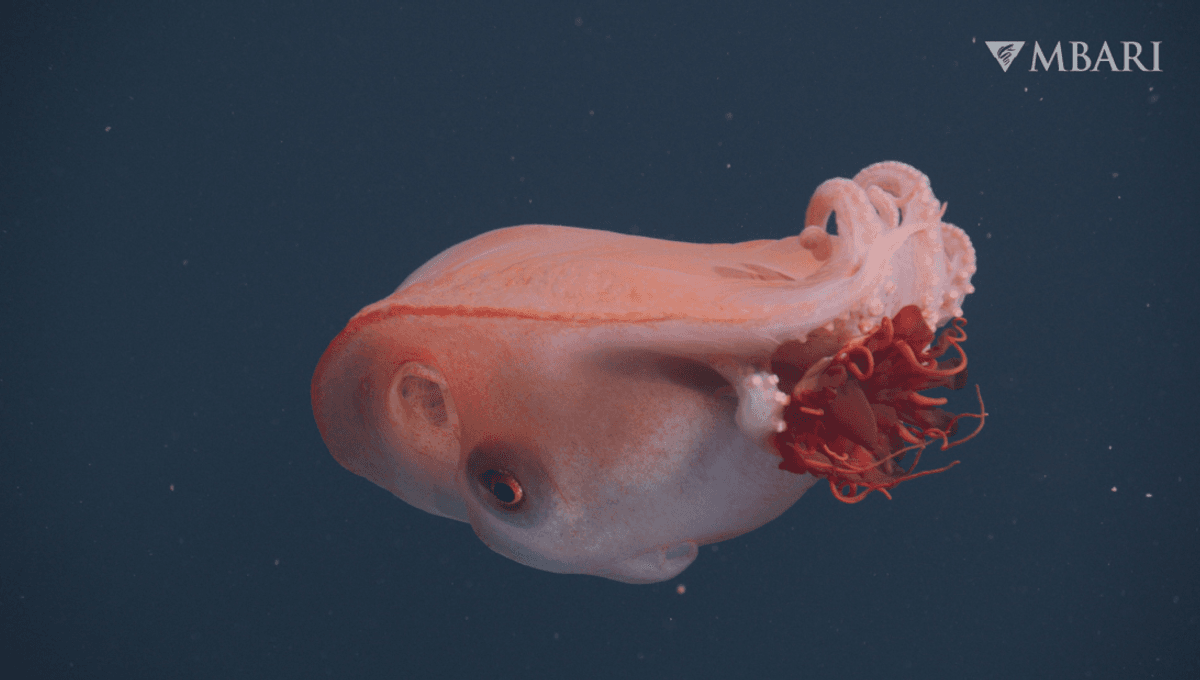
It’s no secret the deep sea is home to some strange-looking animals, so might we introduce you to yet another weirdo: the seven-arm octopus, AKA “the blob octopus”. This ocean giant can weigh up to 75 kilograms (165 pounds), but despite its huge size, it’s rarely been seen alive.
The rest of this article is behind a paywall. Please sign in or subscribe to access the full content.
Now, a recent sighting by the ocean experts over at the Monterey Bay Aquarium and Research Institute (MBARI) has yielded some incredible footage. It marks just the fourth time they’ve encountered this animal in 40 years of ocean exploration.
It was spotted via a remote operated vehicle (ROV) known as Ventana, which was cruising in Monterey Bay as part of a research expedition last month. On that day, Senior Scientist Steven Haddock and researchers from MBARI’s Biodiversity and Biooptics Team were treated to a rare sight at approximately 700 meters (2,300 feet) deep – a seven-arm octopus in all its blob-like glory.
Known to science as Haliphron atlanticus, these octopuses do in fact have eight arms, but they’re known as seven-arm octopuses because of a curious behavior seen in the males. During mating, the male will rip off a specialized arm known as a hectocotylus to use as a tool for transferring sperm. Most of the time this arm is tucked up beneath one of its eyes, so the males look as if they only have seven arms.
You might wonder what the significantly larger female octopuses would have to say about this (they can reach around 4 meters [13.1 feet], the males just 21 centimeters [8 inches]). As Jack Ashby points out in Nature’s Memory, it’s often the male of the species that takes center stage in museums, and evidently this trend can bleed into species naming, too.
However many arms it’s packing, it’s a rare and remarkable thing to see one of these octopuses alive. The media recently got very excited about the discovery of a seven-arm octopus arm on a beach in Aberdeenshire, UK (which, to be fair, is an odd place for such an arm to turn up), but we can learn all sorts from seeing them in motion.
A 2017 sighting of a living seven-arm octopus led to a paper by Haddock and MBARI collaborator Henk-Jan Hoving, which was the first to reveal that seven-arm octopuses like to feed on gelatinous animals (and may use their stingers to hunt). That certainly seems to track in this latest footage.
“Using a 4K camera specially developed by MBARI engineers for deep-sea exploration, the team collected detailed observations of the animal’s appearance and behavior,” MBARI wrote on YouTube. “This extraordinary octopus was clutching a crimson red helmet jelly (Periphylla periphylla).”
“This new sighting underscores the complexity of deep-sea food webs and their surprising connections.”

Source Link: Live Seven-Arm Octopus Spotted In The Deep Sea – Only The Fourth Time It’s Been Seen In 40 Years
