• Email Us: [email protected]
  • Contact Us: +1 718 874 1545
  • Skip to main content
  • Skip to primary sidebar

Medical Market Report

  • Home
  • All Reports
  • About Us
  • Contact Us

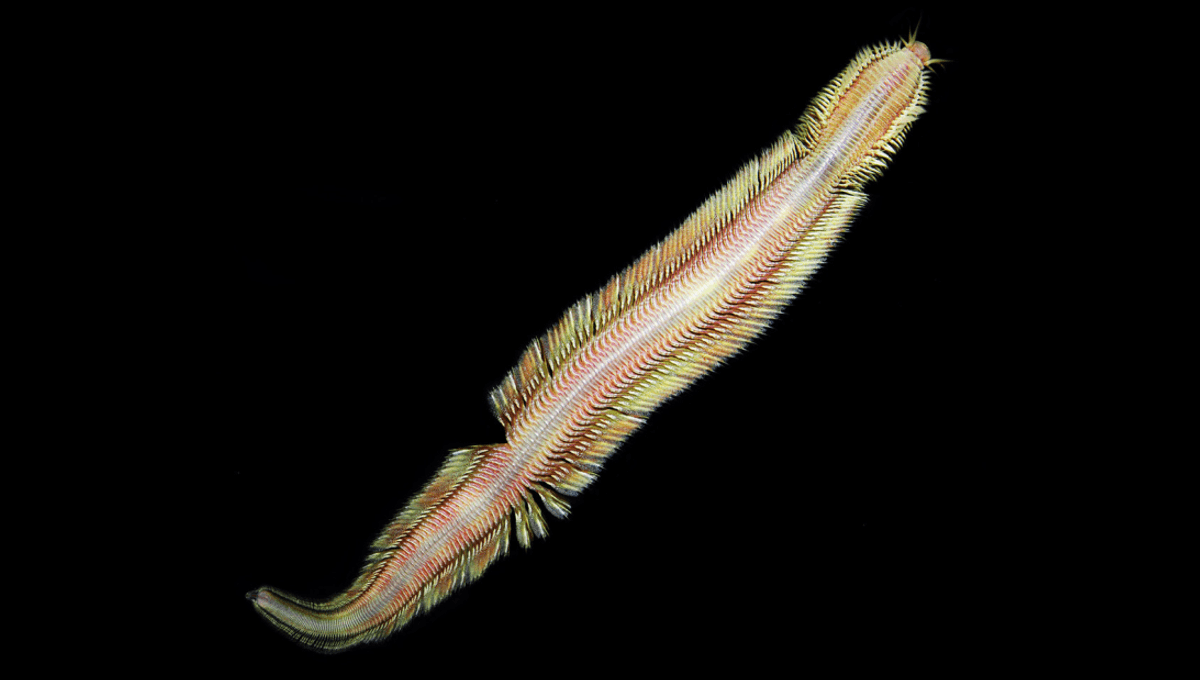
“Living Flying Carpet” Found In The Deep Sea Is A Shiny New Worm Species

March 7, 2024 by Deborah Bloomfield

A new-to-science worm has been found in the deep sea near a methane seep off the coast of Costa Rica. If that’s not enough buzzwords to get your chops around, it also has massive jaws, feathery gill-carrying appendages, and has been described by its namesake as a “living magic carpet”.

The deep-sea worm has been officially named Pectinereis strickrotti after Woods Hole Oceanographic Institution’s Bruce Strickrott, lead pilot for the famed deep-sea submersible Alvin. Stickrott was riding in Alvin at a depth of 1,000 meters (3,280 feet) with Greg Rouse, a marine biologist at UC San Diego’s Scripps Institution of Oceanography, back in 2009 when they first spotted the worm.

Advertisement

“We saw two worms near each other about a sub’s length away swimming just off the bottom,” said Strickrott in a statement. “We couldn’t see them well and tried to creep in for a closer look, but it’s hard to creep in a submarine and we spooked them.”

The worms were undulating around Costa Rica’s methane seeps, sections of the seafloor where gas bubbles up from the rocky bed. They’re not especially hot, like hydrothermal vents, but the animal life is unusual as it subsists on chemical energy, rather than needing sunlight.


The animals here have overcome the lack of light thanks to microbes that evolved to eat methane, forming the base of a food web that ranges from mussels and crabs to soft-bodied worms like our dazzling P. stickrotti.

The species remained elusive until 2018 when a return dive to the same mound where the worms were first sighted turned up six more individuals. Using a piece of kit affectionately known as the “slurp gun,” they were able to suck up some specimens and finally give it a formal name. 

Advertisement

“The way this thing moved was so graceful, I thought it looked like a living magic carpet,” added Stickrott. “I’m honored that Greg [Rouse] saw fit to name this species after me, it means a lot.”

The worm’s elongated body is lined by feathery, gill-tipped appendages known as parapodia. It has a sinuous swimming technique that reminded Rouse of a snake and also packs impressively large jaws, though exactly what it’s eating remains a mystery for now.

The discovery of P. stickrotti raises the number of new species found in this seemingly inhospitable environment to 48, and the team hopes to return to the water in search of deep-sea discoveries, this time at methane seeps off the coasts of Alaska and Chile.

The study is published in PLOS ONE.

Deborah Bloomfield
Deborah Bloomfield

Related posts:

  1. Exclusive-Ericsson CEO to double down on China as 5G tussle rumbles on
  2. African genomics startup 54gene raises $25M to expand precision medicine capabilities
  3. How To Stop Hiccups: The Science Of Hiccups And What Causes Them
  4. Even Under Incredible Pressures, Iron Atoms At Earth’s Core Can Shift Places

Source Link: “Living Flying Carpet” Found In The Deep Sea Is A Shiny New Worm Species

Filed Under: News

Primary Sidebar

  • Descartes Thought The Pineal Gland Was “The Seat Of The Soul” – And Some People Still Do
  • Want To Know What The Last 2 Minutes Before Being Swallowed By A Volcanic Eruption Look Like? Now You Can
  • The Three Norths Are Moving On: A Once-In-A-Lifetime Alignment Shifts This Weekend
  • Spectacular Photo Captures Two Rare Atmospheric Phenomena At The Same Time
  • How America’s Aerospace Defense Came To Track Santa Claus For 70 Years
  • 3200 Phaethon: Parent Body Of Geminids Meteor Shower Is One Of The Strangest Objects We Know Of
  • Does Sleeping On A Problem Actually Help? Yes – It’s Science-Approved
  • Scientists Find A “Unique Group” Of Polar Bears Evolving To Survive The Modern World
  • Politics May Have Just Killed Our Chances To See A Tom Cruise Movie Actually Shot In Space
  • Why Is The Head On Beer Often White, When Beer Itself Isn’t?
  • Fabric Painted With Dye Made From Bacteria Could Protect Astronauts From Radiation On Moon
  • There Used To Be 27 Letters In The English Alphabet, Until One Mysteriously Vanished
  • Why You Need To Stop Chucking That “Liquid Gold” Down Your Kitchen Sink
  • Youngest Mammoth Fossils Ever Found Turn Out To Be Whales… 400 Kilometers From The Coast
  • The First Wheelchair User To Travel To Space Is About To Make History
  • “It Was Bigger Than A Killer Whale”: 66 Million-Year-Old Tooth Suggests Mosasaurs Were Hunting In Rivers, Not Just Seas
  • Killer Whales And Dolphins Team Up In First-Ever Footage Of Cooperative Hunting
  • Why Does Chocolate In Advent Calendars Taste Different From Normal Chocolate?
  • Why Do Sheep And Goats Have Rectangular Pupils?
  • What Kind Of Parents Were Dinosaurs?
  • Business
  • Health
  • News
  • Science
  • Technology
  • +1 718 874 1545
  • +91 78878 22626
  • [email protected]
Office Address
Prudour Pvt. Ltd. 420 Lexington Avenue Suite 300 New York City, NY 10170.

Powered by Prudour Network

Copyrights © 2025 · Medical Market Report. All Rights Reserved.

Go to mobile version