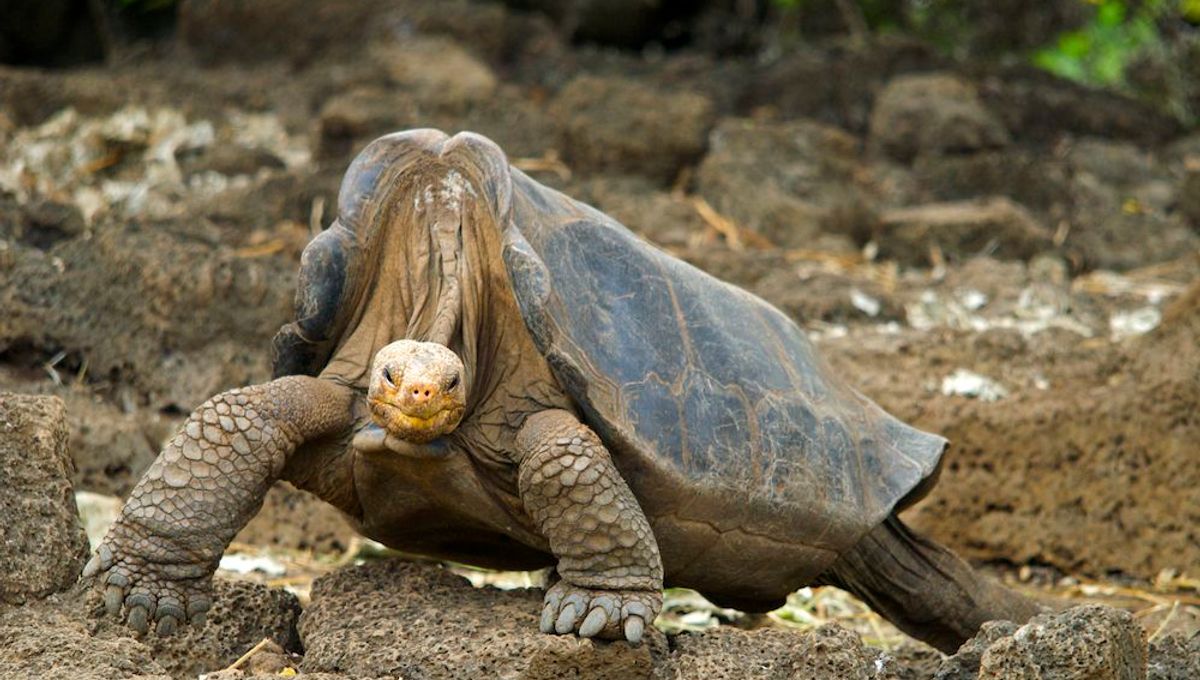
Lonesome George was an endling, the last of a rare subspecies native to a far-flung island in the Pacific. When he died, the subspecies died with him, but his legacy still lives on (and not just in the form of his stuffed taxidermized body).
This truly unique animal was a Pinta Island tortoise (Chelonoidis niger abingdonii), a subspecies of the giant tortoises of the Galápagos Islands, a volcanic Pacific archipelago that helped to inspire Charles Darwin’s ideas.
As his name suggests, George hailed specifically from Pinta Island. It’s believed his ancestors traveled here from the nearby island of Española about 300,000 years ago, although it’s a complete mystery how these unwieldy, non-aquatic animals completed this massive migration across the water.
Most believed the subspecies was already extinct by the early 20th century, largely due to whalers and sealers who were drawn to the region in the 19th century and developed a taste for the slow-moving, easy-to-hunt reptiles.
For decades, Pinta remained relatively untouched, but that changed in 1959 when fishermen released three goats on the island. Left unchecked, the goat population exploded to an estimated 40,000 individuals by 1970. The land was stripped of vegetation, reinforcing suspicions that the Pinta Island tortoise was a goner.
Then, in 1971, Hungarian scientist József Vágvölgyi travelled to the island to study another shelled creature (snails) and stumbled upon a remarkable sight: a giant tortoise roaming around by itself. Against the odds, Lonesome George had survived.
Realizing they had come across something very special, park rangers took him to the Charles Darwin Research Station on Santa Cruz Island in the spring of 1972. They hoped to find a female Pinta tortoise, perhaps on the island or elsewhere in the zoo, but she was never found.
The origin of his nickname is uncertain. Some believe he was named after Saint George, while others say it came from the American comedian George Gobel, who became known as “Lonesome George.” Either way, the name stuck and the public quickly became infatuated with the gentle giant’s sad story.
Over the years, he was introduced to several different subspecies that scientists believed were closely related, perhaps closely related enough to mate and produce offspring. This included two Española tortoises, although Lonesome George didn’t ever produce any offspring.
On the morning of June 24, 2012, Lonesome George passed away at the Galápagos National Park, aged just over 100 years old. One of the last people to visit him, funnily enough, was none other than Sir David Attenborough, whose team filmed him just 14 days before his passing.
But George’s death did not stop scientists’ attempts to keep the subspecies alive. In the hours following his demise, researchers rushed to collect and preserve samples of his tissues with the hopes they could eventually be used to generate stem cells and sex cells, or in reproductive cloning.
While we’re not closer to a Lonesome George clone, researchers have sequenced his genome from a blood sample, and further analysis suggests there are still tortoises with very similar genetics to the one-of-a-kind tortoise.
“Studies like this demonstrate why preserving biodiversity is so important,” Scott Glaberman, a Galápagos giant tortoise expert involved in studying the genetics of George, said in 2021.
“Extreme species like Galápagos giant tortoises probably hold many secrets for dealing with major human challenges like aging and cancer, and even climate change. Our study also shows that even within turtles, different species look, act and function differently, and losing any species to extinction means that a piece of unique biology will be lost to the world forever.”
Lonesome George still resides in the Galápagos, albeit in taxidermized form. Shortly after his death, his giant, shelled body was placed in a cooled room to slowly then shipped over to New York to be preserved by expert taxidermists. Completed in 2014, he briefly appeared at the American Museum of Natural History before returning to his homeland in the Galápagos Islands in 2017, where he remains on display as a symbol of conservation and the fragility of life.
“George symbolized the precarious state of biodiversity around the world. He was a catalyst for extraordinary efforts of the Ecuadorian government and an international network of scientists and conservationists who have undertaken efforts restore tortoise populations and to improve the status of other endangered and threatened species in the archipelago,” said Johannah Barry, Galápagos Conservancy’s President.
“He also became a symbol of the tremendous advances that can be made when science, conservation expertise and political will are aligned on a common cause.”

Source Link: Lonesome George: The Giant Tortoise Who Was The Very Last Of His Kind
