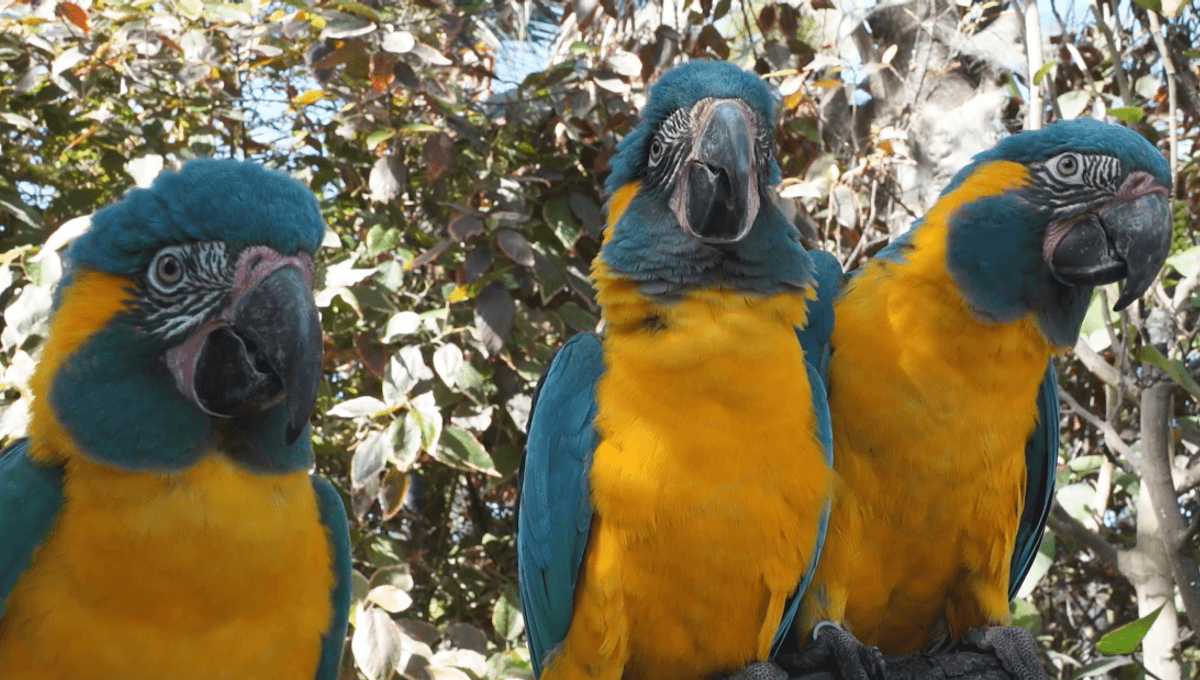
When trying to fit in, it’s not uncommon for humans to watch other humans interacting to get an idea of how they themselves should behave. This is what’s known as third-party imitation, and it’s something we used to think was unique to humans. Now, it’s been identified in another animal for the first time. Yes, it’s those agents of chaos, the macaws.
The rest of this article is behind a paywall. Please sign in or subscribe to access the full content.
A new study put blue-throated macaws to the test in completing challenges while in view of another macaw completing the same challenge. The macaws were able to watch and learn from how the other macaw was interacting, and used that information to complete their task faster and more efficiently.
“Third-party imitation for so long was considered a human-specific trait,” said study co-author Esha Haldar of the Max-Planck-Institute for Biological Intelligence, Germany, to IFLScience. “In previous experiments, companion dogs had failed to learn intransitive actions through passive observation, without prior training. This initially made us skeptical about the macaws’ capacity for third-party imitation.”
“However, we were thrilled to see their efficient responses that immediately suggested that the macaws may have evolved an imitation ability comparable to humans, particularly for intransitive, goalless actions, that may represent a rudimentary form of culture of gestures in the wild.”
Third-party imitation is different to learning from demonstrations (that’s known as second-party imitation) because it’s a means of passively gaining information by observing and putting yourself in the context of another individual. We’ve identified second-party imitation in several animals, including quail, but this is the first time science has recognized third-party imitation in a non-human species.
Macaws are a famously rambunctious lot, with spirited vocalizations and remarkable social intelligence. For all their shenanigans, it seems they’re gifted when it comes to putting themselves in others’ shoes and adjusting their own behavior accordingly, and it’s likely there are many other social animals that share this skill.
“Macaws learn not only actions but also the appropriate contexts in which to perform them simply by observing interactions between others,” said Haldar. “This ability, known as third-party imitation, previously reported only in human children, is likely to exist in other social animals like the blue-throated macaws, and is suggestive of a capacity for perspective taking that allows them to place themselves in another’s position and acquire context-appropriate behaviours.”
The study is published in the journal Scientific Reports.

Source Link: Macaws Learn From Watching Other Macaws Interact – A Kind Of Imitation We Thought Was Unique To Humans
