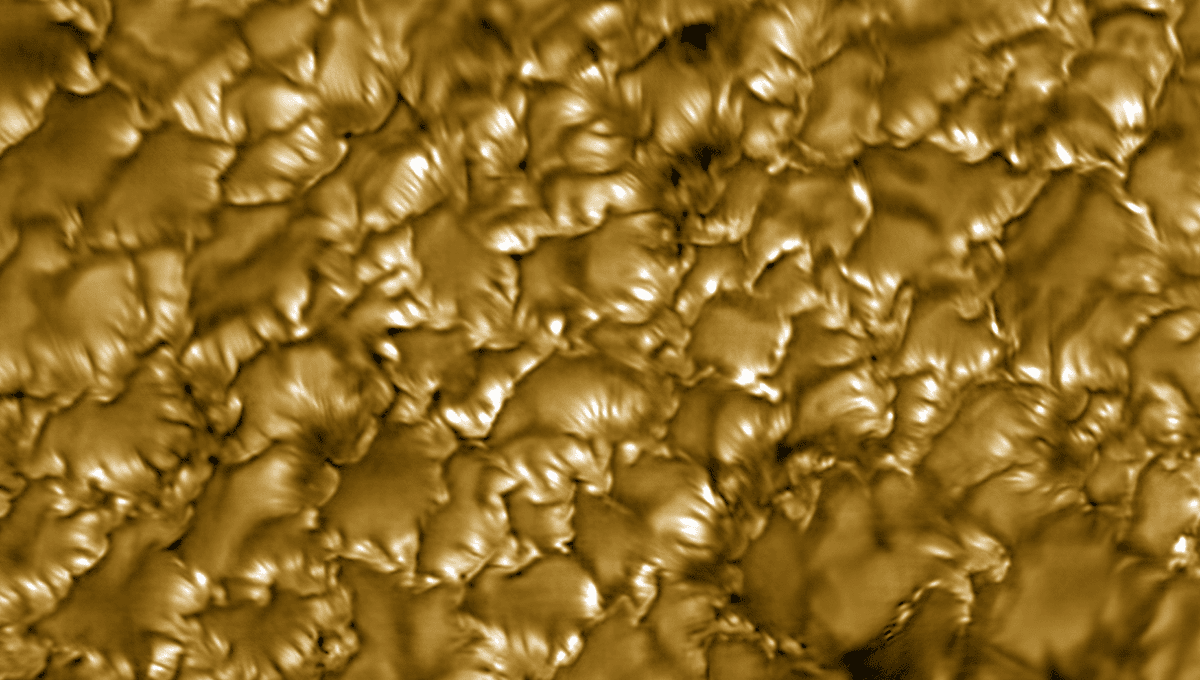
For the first time, solar astronomers have been able to observe striations on the surface of the Sun at an unprecedented resolution. Thanks to the Daniel K. Inouye Solar Telescope, located in Hawai’i, astronomers have snapped images of these “magnetic curtains” at a scale of 20 kilometers (12.4 miles). We had never before seen details on the Sun at such a scale.
The striations are stripe-like features that form on the edges of granules, the solar convection cells that appear on the Sun’s surface. They behave a bit like curtains blowing in the wind, but their motion is dictated by the magnetic fields interacting around the granules. We can see the curtains because the light from the granule is affected by the magnetic fields in specific ways.
If the field in the striation is stronger than in its surroundings, then the light from the granules will get a boost, making a brighter striation. If it is weaker, the striation will appear a darker color. The alternation of these magnetic intensities gives rise to the stripey pattern visible across the image.
“In this work, we investigate the fine-scale structure of the solar surface for the first time with an unprecedented spatial resolution of just about 20 kilometers, or the length of Manhattan Island,” lead author Dr David Kuridze, from the National Solar Observatory (NSO), said in a statement. “These striations are the fingerprints of fine-scale magnetic field variations.”
The Sun’s magnetic field is stronger than Earth’s own, and in certain variable regions it can be thousands of times stronger. A refrigerator magnet is actually much stronger than the Earth’s magnetic field, and the Sun’s in a quiet state. These striations tend to have a similar strength to that, but their effect spans vast regions.
“Magnetism is a fundamental phenomenon in the universe, and similar magnetically induced stripes have also been observed in more distant astrophysical objects, such as molecular clouds,” added NSO scientist and co-author of the study Dr Han Uitenbroek. “Inouye’s high resolution, in combination with simulations, allows us to better characterize the behavior of magnetic fields in a broad astrophysical context.”
The researchers stated that they had not anticipated seeing these structures at this resolution, and it is truly a testament to the incredible ability of the Inouye telescope. It has been a great few weeks for solar astronomy with major breakthroughs in resolution and adaptive optics from different observatories, as well as Inouye, which will allow us to study the Sun like never before.
“This is just one of many firsts for the Inouye, demonstrating how it continues to push the frontier of solar research,” stated NSO Associate Director for the NSF Inouye Solar Telescope, Dr David Boboltz. “It also underscores Inouye’s vital role in understanding the small-scale physics that drive space weather events that impact our increasingly technological society here on Earth.”
The study is published in The Astrophysical Journal Letters.

Source Link: Magnetic Curtains As Wide As A City Seen On The Sun In Unexpected Findings
