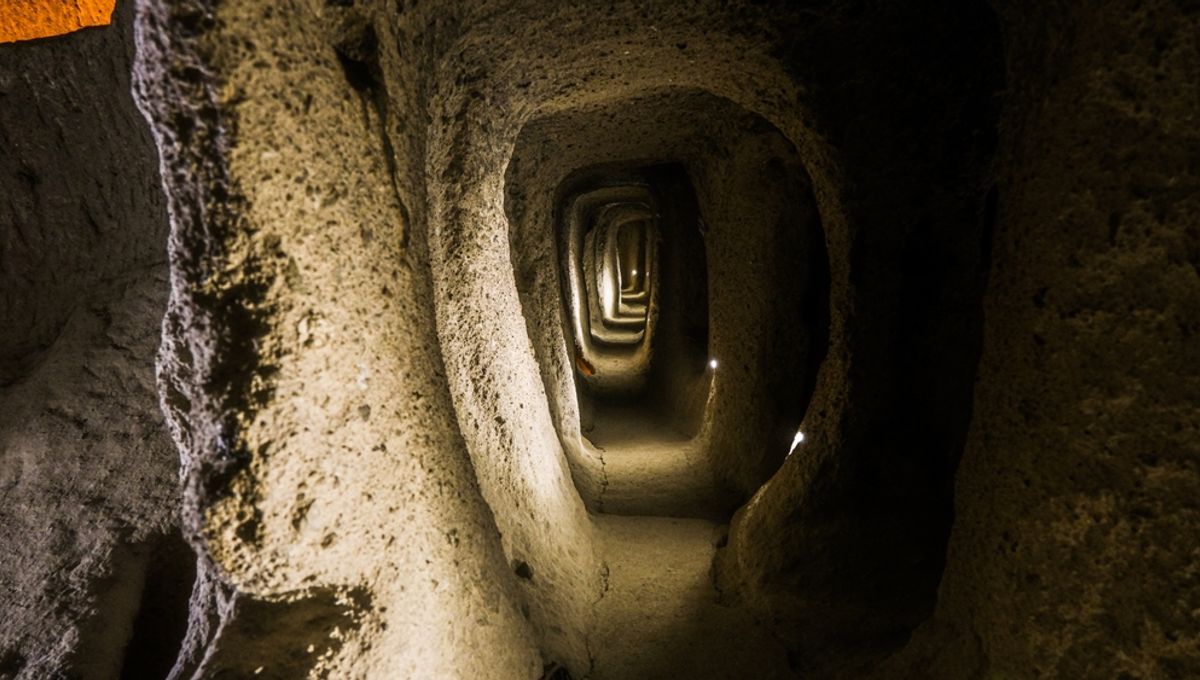
In 1963, a man in Turkey’s Nevşehir Province broke through a basement wall and uncovered a massive underground city.
The man (not named in reports from the time) sledgehammered his wall and found a tunnel behind it, and beyond that, more tunnels. Exploration would later reveal it was an underground city up to 18 stories deep, complete with chapels, schools, and stables.
Known as Derinkuyu, the city had been abandoned for centuries, probably much to the relief of the man who’d just hammered his way in. Work on the city, estimated to hold up to 20,000 people, may have begun as far back as the 8th–7th centuries BCE, according to archaeologists at the Turkish Department of Culture.
Despite the rock – formed by volcanic ash deposits – being soft, the Phrygians who began the build didn’t get very far with it. A manuscript from around 370 BCE which possibly describes Derinkuyu mentions that the underground dwellings were about big enough for a family, domestic animals, and food.
The city came to its peak in the Byzantine period (about 395 CE to 1453 CE), when it was made into a labyrinth of tunnels, chambers, and rooms, covering 445 kilometers² (172 miles²). The network of tunnels and passageways contained concealed entrances, ventilation shafts (for not dying in your mole cave), and wells and water channels.
It was likely that people of the area first used the soft rock for storage purposes, keeping food at cool and stable temperatures. However, the cities they became were likely due to how useful they are for defense.
Those living on the bottom levels, for example, were able to cut off the water supply to the upper and ground levels, preventing enemies from poisoning the supply. The tunnels could be blocked from the inside with round rolling stone doors, and the passageways themselves were narrow to force any invaders to line up one at a time – an attack system so dire it is only seen in movies whenever the good guy gets surrounded.
Different people sheltered in the city over many centuries. Early Christians lived there, fleeing persecution from the Romans, while Muslims used it for protection during the Arab-Byzantine wars of 780 and 1180.
Caves similar to this were also used to shelter from danger, as recently as 1909 – Derinkuyu is not even the largest underground city.
“When the news came of the recent massacres at Adana, a great part of the population at Axo took refuge in these underground chambers, and for some nights did not venture to sleep above ground,” Cambridge linguist Richard MacGillivray Dawkins wrote of his time visiting Greece.
“It appears […] that until recently the people lived entirely in these subterranean dwellings, without any houses above ground.”
An earlier version of this story was published in May 2022.

Source Link: Man Broke Down Wall In His Basement And Discovered An Ancient Underground City That Once Housed 20,000 People
