• Email Us: [email protected]
  • Contact Us: +1 718 874 1545
  • Skip to main content
  • Skip to primary sidebar

Medical Market Report

  • Home
  • All Reports
  • About Us
  • Contact Us

Mars Is Unrecognizable In These Ultraviolet Observations

June 30, 2023 by Deborah Bloomfield

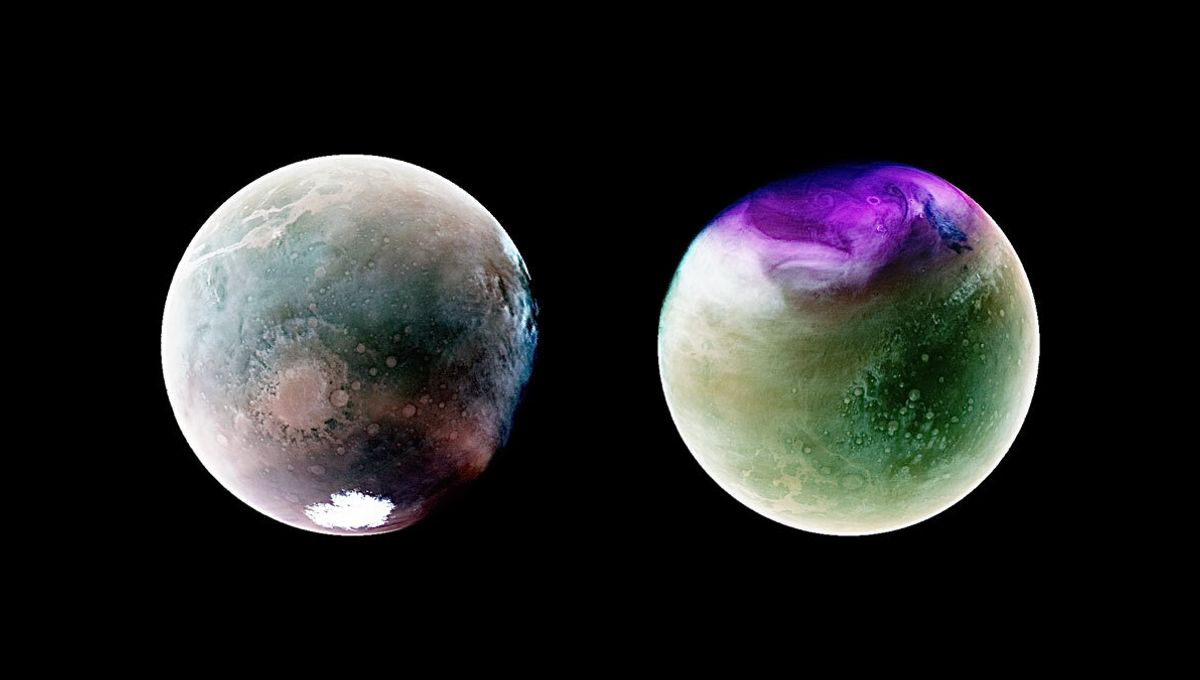
NASA’s MAVEN (Mars Atmosphere and Volatile EvolutioN) has been studying the Red Planet for several years. Its suite of instruments has provided numerous insights into the Martian atmosphere, including the peculiar ultraviolet aurorae that happen there. Now, NASA has provided us with a full global version of Mars in ultraviolet. And by Ares, it is weird and wonderful!

MAVEN’s Imaging Ultraviolet Spectrograph (IUVS) sees wavelengths between 110 and 340 nanometers, beyond the blue side of the visible spectrum. In the images, these wavelengths are shifted to colors we can see, so it is possible for us to understand what we are seeing.

Advertisement

And we are seeing some pretty interesting stuff. Ozone is present on Mars but in very small quantities compared to Earth’s famous layer. And yet, it can be spotted, especially over the polar regions in purple. Clouds and hazes around the planet are in blue or white, and the ground can appear greenish or tan. The images are also optimized to show the contrasts so do not think they are a perfect translation of what a human being capable of seeing ultraviolet light would be seeing.

The images were taken at two different points throughout the Martian year. The snap on the left shows the Southern Pole cap as a prominent feature as well as Argyre Basin, one of Mars’ deepest craters. A pink haze is visible inside it. It was taken in July 2022.

The picture on the right was taken instead in January 2023 and shows activity going on at the North Pole, with clouds and a lot of ozone (well, relatively) being released. The change is due to seasonal variations on the planet. Mars has seasons like Earth, but they are about twice as long given that a Martian year is about twice as long as Earth.

These spectacular images of Mars fit perfectly with MAVEN’s mission. The spacecraft, for the last nine years, has been exploring the planet’s upper atmosphere as well as its ionosphere, the place where the tenuous layer of air interacts with the Sun and solar wind.

Advertisement

The goal is to understand how Mars loses its atmosphere to space. This is important for many reasons. The Martian atmosphere might have been denser in the past, creating a more cozy climate (maybe even habitable), which would explain how water was able to flow on the Red Planet billions of years ago.

Deborah Bloomfield
Deborah Bloomfield

Related posts:

  1. Tunisia’s president indicates he will amend constitution
  2. Nasdaq short interest down 0.07% in mid-September
  3. German Social Democrats upbeat about three-way coalition talks
  4. Adding Gold To Wine Could Be The Key To Making It Taste Better

Source Link: Mars Is Unrecognizable In These Ultraviolet Observations

Filed Under: News

Primary Sidebar

  • US Just Killed NASA’s Mars Sample Return Mission – So What Happens Now?
  • Art Sleuths May Have Recovered Traces Of Da Vinci’s DNA From One Of His Drawings
  • Countries With The Most Narcissists Identified By 45,000-Person Study, And The Results Might Surprise You
  • World’s Oldest Poison Arrows Were Used By Hunters 60,000 Years Ago
  • The Real Reason You Shouldn’t Eat (Most) Raw Cookie Dough
  • Antarctic Scientists Have Just Moved The South Pole – Literally
  • “What We Have Is A Very Good Candidate”: Has The Ancestor Of Homo Sapiens Finally Been Found In Africa?
  • Europe’s Missing Ceratopsian Dinosaurs Have Been Found And They’re Quite Diverse
  • Why Don’t Snorers Wake Themselves Up?
  • Endangered “Northern Native Cat” Captured On Camera For The First Time In 80 Years At Australian Sanctuary
  • Watch 25 Years Of A Supernova Expanding Into Space Squeezed Into This 40-Second NASA Video
  • “Diet Stacking” Trend Could Be Seriously Bad For Your Health
  • Meet The Psychedelic Earth Tiger, A Funky Addition To “10 Species To Watch” In 2026
  • The Weird Mystery Of The “Einstein Desert” In The Hunt For Rogue Planets
  • NASA Astronaut Charles Duke Left A Touching Photograph And Message On The Moon In 1972
  • How Multilingual Are You? This New Language Calculator Lets You Find Out In A Minute
  • Europa’s Seabed Might Be Too Quiet For Life: “The Energy Just Doesn’t Seem To Be There”
  • Amoebae: The Microscopic Health Threat Lurking In Our Water Supplies. Are We Taking Them Seriously?
  • The Last Dogs In Antarctica Were Kicked Out In April 1994 By An International Treaty
  • Interstellar Comet 3I/ATLAS Snapped By NASA’s Europa Mission: “We’re Still Scratching Our Heads About Some Of The Things We’re Seeing”
  • Business
  • Health
  • News
  • Science
  • Technology
  • +1 718 874 1545
  • +91 78878 22626
  • [email protected]
Office Address
Prudour Pvt. Ltd. 420 Lexington Avenue Suite 300 New York City, NY 10170.

Powered by Prudour Network

Copyrights © 2026 · Medical Market Report. All Rights Reserved.

Go to mobile version