• Email Us: [email protected]
  • Contact Us: +1 718 874 1545
  • Skip to main content
  • Skip to primary sidebar

Medical Market Report

  • Home
  • All Reports
  • About Us
  • Contact Us

Mars Is Unrecognizable In These Ultraviolet Observations

June 30, 2023 by Deborah Bloomfield

NASA’s MAVEN (Mars Atmosphere and Volatile EvolutioN) has been studying the Red Planet for several years. Its suite of instruments has provided numerous insights into the Martian atmosphere, including the peculiar ultraviolet aurorae that happen there. Now, NASA has provided us with a full global version of Mars in ultraviolet. And by Ares, it is weird and wonderful!

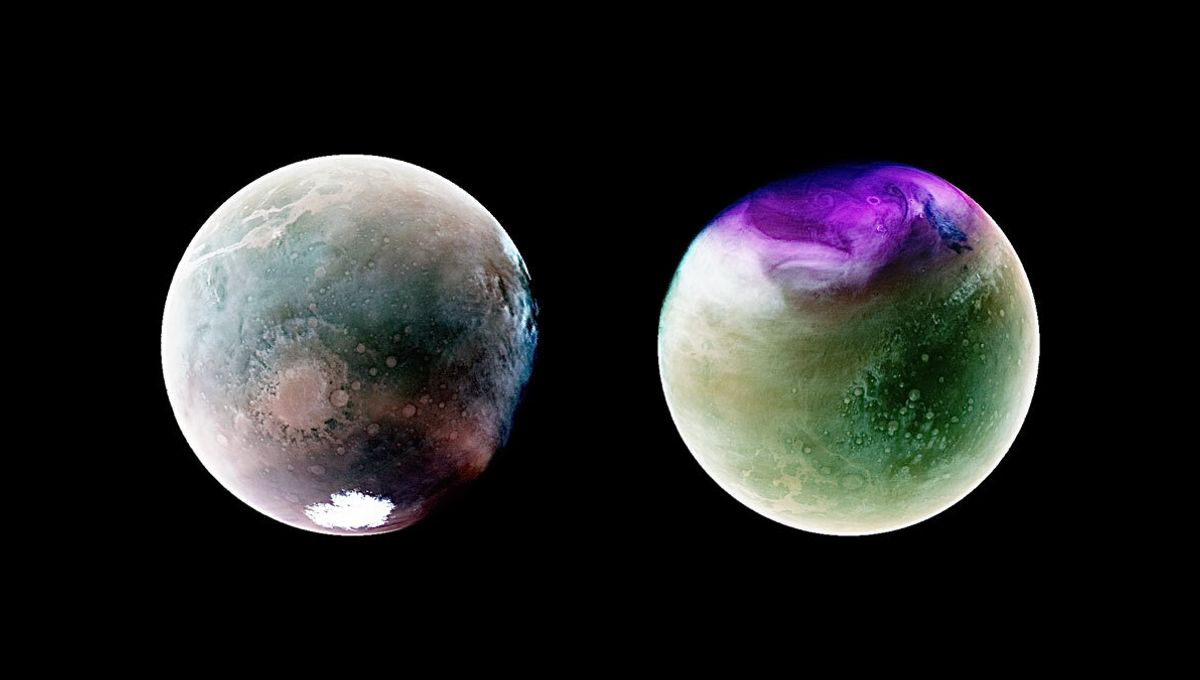
MAVEN’s Imaging Ultraviolet Spectrograph (IUVS) sees wavelengths between 110 and 340 nanometers, beyond the blue side of the visible spectrum. In the images, these wavelengths are shifted to colors we can see, so it is possible for us to understand what we are seeing.

Advertisement

And we are seeing some pretty interesting stuff. Ozone is present on Mars but in very small quantities compared to Earth’s famous layer. And yet, it can be spotted, especially over the polar regions in purple. Clouds and hazes around the planet are in blue or white, and the ground can appear greenish or tan. The images are also optimized to show the contrasts so do not think they are a perfect translation of what a human being capable of seeing ultraviolet light would be seeing.

The images were taken at two different points throughout the Martian year. The snap on the left shows the Southern Pole cap as a prominent feature as well as Argyre Basin, one of Mars’ deepest craters. A pink haze is visible inside it. It was taken in July 2022.

The picture on the right was taken instead in January 2023 and shows activity going on at the North Pole, with clouds and a lot of ozone (well, relatively) being released. The change is due to seasonal variations on the planet. Mars has seasons like Earth, but they are about twice as long given that a Martian year is about twice as long as Earth.

These spectacular images of Mars fit perfectly with MAVEN’s mission. The spacecraft, for the last nine years, has been exploring the planet’s upper atmosphere as well as its ionosphere, the place where the tenuous layer of air interacts with the Sun and solar wind.

Advertisement

The goal is to understand how Mars loses its atmosphere to space. This is important for many reasons. The Martian atmosphere might have been denser in the past, creating a more cozy climate (maybe even habitable), which would explain how water was able to flow on the Red Planet billions of years ago.

Deborah Bloomfield
Deborah Bloomfield

Related posts:

  1. Tunisia’s president indicates he will amend constitution
  2. Nasdaq short interest down 0.07% in mid-September
  3. German Social Democrats upbeat about three-way coalition talks
  4. Adding Gold To Wine Could Be The Key To Making It Taste Better

Source Link: Mars Is Unrecognizable In These Ultraviolet Observations

Filed Under: News

Primary Sidebar

  • What Killed One Of The World’s Biggest Crocs? A Necropsy Of Cassisus Suggests A Hidden Killer
  • Avi Loeb Says Interstellar Object 3I/ATLAS Is “Most Likely Natural” As It Heads Away From Earth
  • For The First Time, Moths Have Been Captured On Camera Feeding On Moose Tears
  • USGS Camera Catches A “Dirty Eruption” At Yellowstone’s Black Diamond Pool
  • This Is Why You Shouldn’t Soak Your Dishes In The Sink Overnight
  • With The Powerful Vera Rubin Observatory, We Could Find Up To 50 Interstellar Objects Like Comet 3I/ATLAS
  • First Evidence For Maternal Care In Plants Reveals Placenta-Like Structure That Sustains Their Offspring
  • “Dragon Man” And “Big-Headed Man” Co-Existed In Prehistoric China 150,000 Years Ago, New Dating Reveals
  • Space Astronomy Is Under Threat As New Paper “Raises Important Concerns” About Megaconstellations
  • New Study Says Cheese Can Protect Against Dementia – Is It Too Good To Be True?
  • Faraday’s Enigma Of Premelted Ice Finally Explained After 166 Years
  • What Is The Smelliest Thing In The World?
  • IFLScience We Have Questions: How Did Frogs Become A Pregnancy Test For Humans?
  • Could One Drill A Hole From One Side Of The Earth And Come Out The Other Side?
  • Africa Is Splitting Into Two Continents And A Vast New Ocean Could Eventually Open Up
  • Which Is Better: Hot Or Cold Showers?
  • Is Gustave The Killer Croc Dead? Notorious Crocodile Accused Of 300 Deaths Is Surrounded By Legend
  • Why Do We Have Two Nostrils, Instead Of One Big Nose Hole?
  • Humans Have Accidentally Created A Barrier Around The Earth
  • Something Just Crashed Into The Moon, First-Known Instance Of Prehistoric Bees Nesting In Fossil Skulls, And Much More This Week
  • Business
  • Health
  • News
  • Science
  • Technology
  • +1 718 874 1545
  • +91 78878 22626
  • [email protected]
Office Address
Prudour Pvt. Ltd. 420 Lexington Avenue Suite 300 New York City, NY 10170.

Powered by Prudour Network

Copyrights © 2025 · Medical Market Report. All Rights Reserved.

Go to mobile version