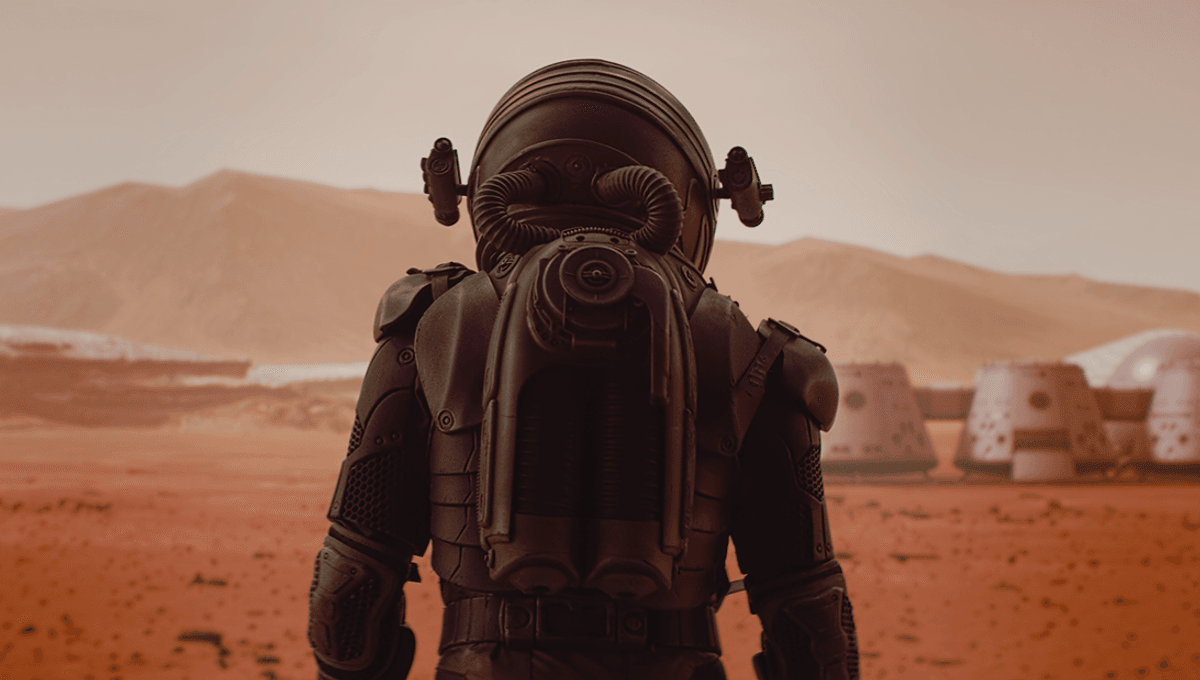
A new study has run simulations of colonies on Mars to determine the ideal number of Martian residents needed for such a settlement to survive, also finding that certain personality types should probably steer clear of such a mission.
Should humans ever decide to create a permanent outpost on another planet (and remember, humans have been continuously living in space since 2000, so it’s not out of the realms of possibility) we will face a lot of unknowns. New research published on pre-print server arXiv, yet to be peer-reviewed, attempts to limit some of those unknowns, running multiple 28-year simulations to determine what size a colony created the best chance of survival.
Previous studies have attempted to answer this question. In 2020, one determined that 110 was the number of people needed to fulfill all duties necessary for their survival without exceeding the work capacity of the colonists. Inspired by that paper, this new team made slightly different assumptions about life on the Red Planet, including that the colony had already been constructed and food, air, and water can be produced locally, and that power was being generated on the planet too.
One major difference is that they modeled that the colony would receive regular supplies from Earth, assuming that it would be more cost-effective to send re-supplies than it is to send humans to expand the size of the colony.
The agent simulation essentially assigns attributes to agents (think setting up your characters in The Sims) and then simulates working days for the colonists as well as interactions with other teammates (think The Sims but without the usual psychological torture).
“Each agent is granted skills associated with their civilian and military occupational specialties consistent with NASA’s Human Factors and Behavioral Performance Element research,” the team explained in their paper, “which analyzed the abilities that are generalizable across circumstances and crew roles and those that will be required by all crew members during a 30-month expedition to Mars.”
The team also tried to factor personality into their agent simulation, giving the agents these different personality types: Agreeables, who were low on competitiveness and aggression; Socials, who are extroverted and need social interaction; Reactives, who have a “competitive interpersonal orientation” and are “fixated on stringent routines”; and Neurotics, who are highly competitive and aggressive and are unable to cope with boredom and change to routine.
Each agent had a life bar that could deplete, killing them. Resupplies of new Martians, with their own personalities, would happen periodically to fill the dead space shoes. The simulations were run for 28 years and with different numbers of people starting the colonies, ranging from 10-170. They found that the lowest number necessary required to sustain a colony was 22, far lower than the previous study which had not assumed regular re-supply missions.
What they weren’t expecting was the death rate among neurotics.
“The primary observed emergent phenomenon occurs in the decline of the Martian population,” the team wrote. “While the members of the settlement have an equal probability of being affected by lack of settlement resources, habitat accidents, or earth shipping disasters, Martians with the ‘neurotic’ psychology die at a much higher rate than those of other psychologies.”
“Once their population reaches a low enough level, the settlement population stabilizes.”
The team notes that neurotic personalities suffered during life on the colony, and the colony improved when fewer people of that personality type were there.
“Martians with the neurotic psychology and a high coping capacity benefit the least from interaction with other Martians, and are penalized the most if they have a low coping capacity. Our results suggest that this effect is a driver of the Martian population decline, and once minimized or removed, can produce a stable settlement.”
Human interactions are of course less simple than in these models which simplify things to attempt to find trends. Real-life simulations are taking place, shutting residents inside fake Mars habitats and simulating life on the planet, and all the problems that could come with it.
“The analog is critical for testing solutions to meet the complex needs of living on the Martian surface,” Grace Douglas, lead scientist for NASA’s Advanced Food Technology research effort at NASA’s Johnson Space Center in Houston, said in a 2021 statement. “Simulations on Earth will help us understand and counter the physical and mental challenges astronauts will face before they go.”
The study is available on pre-print server arXiv.

Source Link: Mars Simulation Finds One Personality Type Should Probably Not Colonize The Red Planet
