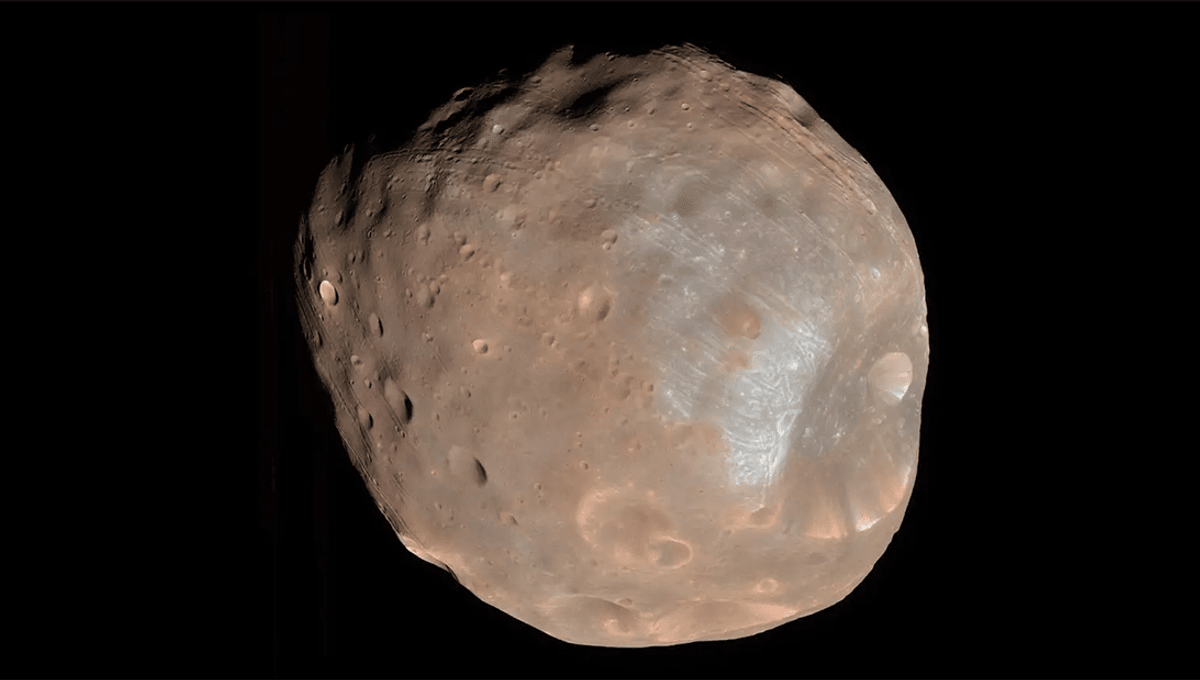
A team of researchers analyzing previously unpublished images of Mars’s moon Phobos have found hints that the unusual moon is not what we once thought.
Mars’s moons Phobos and Deimos are a little different from the other moons of the solar system. While not as strange as the Earth’s possible “ghost moon” (aka a Kordylewski cloud), the moons are tiny in comparison to their host planet, are covered in craters, and are surprisingly low-density. Phobos is sometimes called a “doomed moon“, as it is set to potentially crash into Mars.
As well as this, close-up images of the moons show Phobos has peculiar 1-kilometer (0.6-mile) long grooves running across its surface, as well as being covered in loose regolith (rock and dust). There are a few theories about how these moons formed, though there are a few problems with both. According to one idea, the moons were created when a large object collided with Mars, creating a debris disk around Mars that slowly coalesced into the objects. Another suggests that the Moons are captured D-type asteroids, usually found in the outer asteroid belt, or with Jupiter’s trojan asteroids.
While the asteroid hypothesis might explain their apparent composition, it isn’t so great at explaining their almost circular orbit. Meanwhile, the debris disk hypothesis might explain the circular orbit, but doesn’t account well for the moons’ composition.
We may soon have answers – or at least better data from which to draw conclusions – with Japan Aerospace Exploration Agency’s (JAXA) Martian Moons eXploration (MMX) mission launching in 2026, and aiming to return samples of Phobos to Earth after three years of observations.
However, ahead of the mission, researchers from France and Germany came across previously unpublished photos of Phobos taken by the European Space Agency’s (ESA) Mars Express spacecraft and found that the moon has properties that don’t fit either hypothesis. Analyzing the photographs, the team found that the moon does not reflect light uniformly, but appears brighter when the Sun is directly overhead, something which is seen in comets.
“Overall, our photometric analysis has shown that Phobos photometric properties show a close resemblance to those of comet 67P: both have a red spectrum, a high surface porosity, and similar opposition effect values,” the team wrote in their study, adding that the moon could be a bilobated comet (i.e. comets with two distinct lobes) or a binary comet (composed of two bodies that have come together through gravitation).
“When comparing the phase integral and geometric albedo of Phobos with those of other dark Solar System bodies, it appears once more that Phobos has photometric properties similar to those of Jupiter family comets, which originate from the Kuiper belt,” the team added. “Phobos’ phase integral is also very close to that of Phoebe, which is supposed to be a Kuiper belt object captured by Saturn. Additionally, we also found that the opposition effect of Phobos is very similar in shape and parameters to the one of comet 67P, and it has a similar high surface porosity.”
It’s a cool hypothesis, as thus far we have not discovered any comet moons, making Phobos a potential first. Thanks to the upcoming JAXA mission, we won’t have too long to wait before we can find out.
The study is accepted for publication in Astronomy and Astrophysics and is posted to pre-print server arXiv.

Source Link: Mars's Doomed Moon Phobos Might Not Be What We Thought
