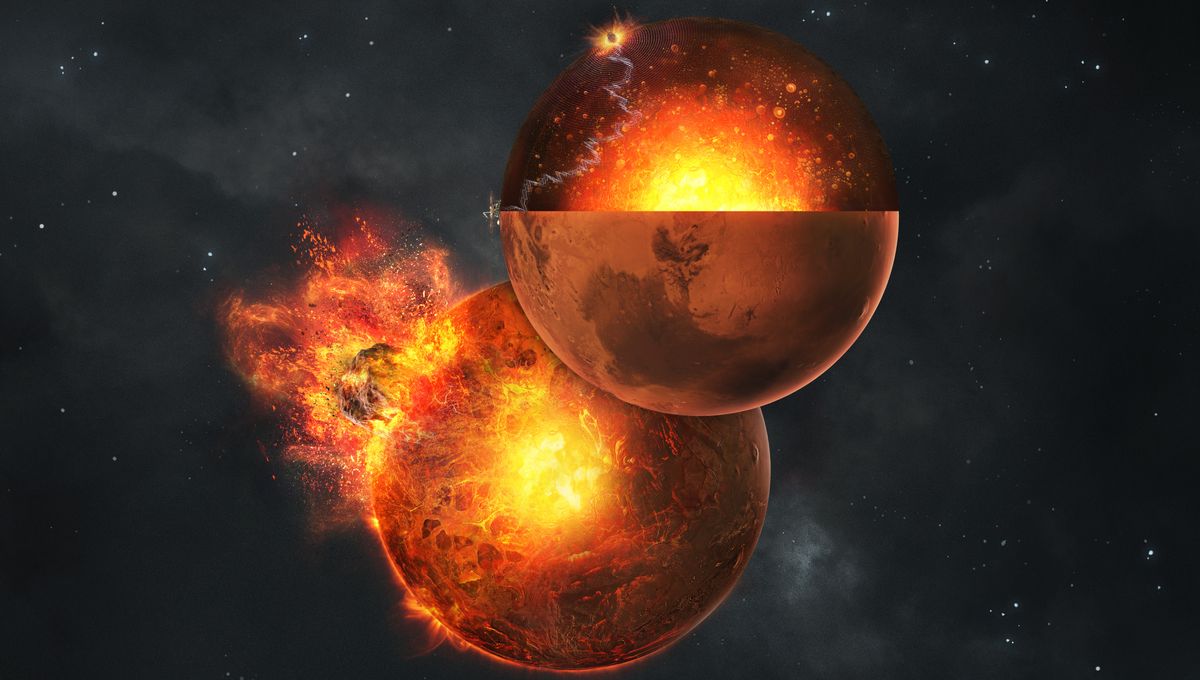
An international team of researchers has provided new insights into the interior of Mars. The Earth is moderately well divided. It has a crust, a mantle, and an outer and inner core. The crust, mantle, and core division is present on the Red Planet as well, but unlike the mostly smooth mantle of Earth, Mars is rather clumpy. Those clumps are actually incredibly significant.
The discovery was possible thanks to NASA’s InSight mission, which for four years was on Mars collecting data, including over 1,000 marsquakes. Almost all the strongest among those were caused by meteorite impacts, and their craters were spotted by orbiting missions. The impacts sent seismic waves deep into the planet and were recorded by the InSight seismometer. The data painted a radically different picture than expected.
“We saw that the Martian interior, the mantle, was not as smooth or uniform as we expected. It was highly heterogeneous or lumpy. There was this chaotic mixture of possibly primordial debris,” lead author Dr Constantinos Charalambous, from Imperial College London, told IFLScience.
Mars, like any other body in the early Solar System, sustained major impacts. The collisions likely melted portions of the planet, as well as injecting a lot of heat into the interior. Fragments from the impactor bodies, as well as pieces of the ancient crust, might have been pushed into the mantle.
Something similar is believed to have happened to Earth with the Theia impact that formed the Moon. Theia, a planetary object the size of Mars, fused partly with Earth. Beyond the Moon itself, the interior evidence that there was such an impact is two regions around the core. There are no other clumps, simply because the mantle on Earth is well mixed and more fluid due to the presence of water.
On Mars, these elements never blended together, and as the planet cooled down, the lumpiness remained within the mantle. The data from InSight doesn’t map the interior of the planet but provides a statistical picture of what’s under the wheels and legs of rovers and landers on the Red Planet. A smooth interior doesn’t match observations.
Like a plate or a cup breaking into pieces of different sizes, the impactors and primordial crust have been fragmented, with a few as large as 4 kilometers (2.5 miles) and many more smaller than that.
“These are geological clues of Mars’s early history. We are seeing this first draft that was written on Mars, whereas on Earth, we don’t have these early clues,” co-author Professor Tom Pike, also from Imperial College London, told IFLScience.
As we said, with a single seismometer in a single mission, the team cannot possibly map the inside of Mars. Still, we were curious: If we were to pepper the surface of Mars with seismometers, could we actually map the clumpy interior of Mars and work out what those fragments came from?
That’s what InSight was about, that was the sales pitch. We’re going to a time capsule. And this work actually finally delivers!
Professor Tom Pike
The researchers helpfully point out that getting multiple missions with seismometers would be only half the battle. Earth has thousands of seismometers, but thanks to plate tectonics (which is, as far as we know, exclusive to our planet), there are a lot of quakes. Mars doesn’t have a lot of quakes, and the most powerful don’t come to the planet itself, but from meteorite impacts.
“You need the sweet spot of marsquakes large enough, strong enough, and located at the right place so that the seismic waves will probe deep enough into [the area] around the core-mantle boundary,” Dr Charalambous told IFLScience.
Even if we were to send many seismometers to Mars, there is still the element of luck in actually getting those impacts. One of them is believed to have been the largest in decades, and it actually happened during the extended mission.
“We were designed to last for one Martian year. We lasted for two – for four Earth years – and all of these impacts came beyond the expected lifetime of the mission: in the second-half, the extended mission. If we had died, kind of as expected, we would not have seen these bigger impacts,” Professor Pike told IFLScience.
These findings about Mars might apply to other stagnant-lid planets in the solar system, such as Mercury (which does have some activity: it is shrinking).
“We are seeing this geological time capsule here; Mars being this geological time capsule because it sealed up early on. It’s possibly a template for other rocky worlds that are also stagnant-lid planets. It’s giving us clues into [planetary] formation and what might have gone wrong,” Dr Charalambous told IFLScience.
“If you want to understand what happened in the early Solar System, you really need to go to see the signs of what happened in an early Solar System on another planet,” Professor Pike added. “That’s what InSight was about, that was the sales pitch. We’re going to a time capsule. And this work actually finally delivers!”
The study is published in the journal Science.

Source Link: Mars’s Interior Still Has Evidence Of Ancient Impact, Dead NASA Mission Tells Us
