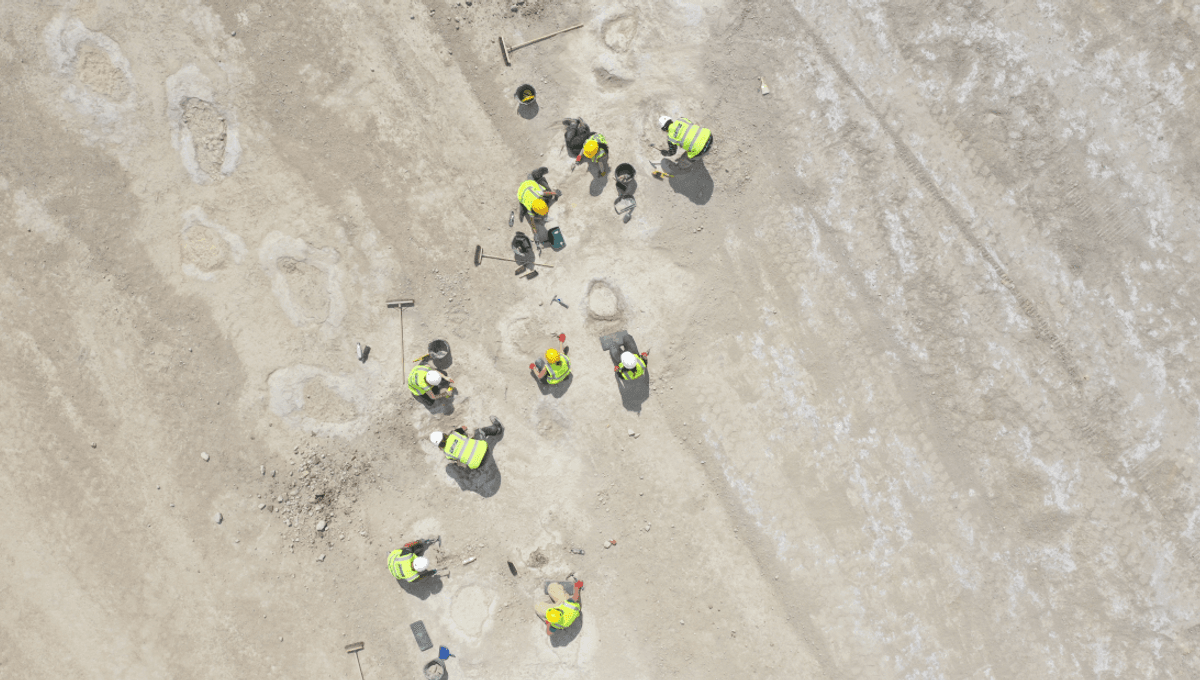
In 2025, diggers returned to Dewars Farm near Bicester, UK, in search of the footprints of giants. Known as Oxfordshire’s “dinosaur highway”, the site is home to hundreds of footprints dating back 166 million years.
The rest of this article is behind a paywall. Please sign in or subscribe to access the full content.
Now, scientists have scooped a new discovery as they uncovered the longest dinosaur trackway in Europe made by an individual sauropod dinosaur. It measures about 220 meters (722 feet) from the first footprint to the last.
The highway dates back to the Middle Jurassic Period, a time when visitors to the region included the first-ever named dinosaur, Megalosaurus, who left an impressive stamp for ichnologists to get excited about. As a recap, ichnology is an area of science that looks for trace fossils of dinosaurs like footprints (and the occasional butt drag).
A quarry worker was the first to spot that there was something interesting in the ground here when they noticed “unusual bumps” beneath the site’s clay surface. It became one of the most significant collections of dinosaur footprints in the world.
Easy to understand, then, why it was that BBC Two’s Digging For Britain wanted to excavate the region this summer in search of what else was hiding beneath the earth. They gathered a team of scientists co-led by Oxford University Museum of Natural History (OUMNH) and University of Birmingham and got digging.
There were over 100 people working on the week-long dig, during which time they battled against drier and tougher surface conditions than previous excavations had encountered. It was so hot, in fact, that the surface was baked until it was almost as tough as concrete.
This prevented the teams from fully excavating, but they were still rewarded with hundreds of new footprints. The most exciting find was a trackway of large prints – each one about 1 meter (3.2 feet) long – that ran north to south across the entire site. They were able to excavate around 80 of them, and this is what formed the longest-known sauropod trackway in Europe (the longest in the world is in the United States, and you can see it in the video below).
The teams also discovered fossils of marine invertebrates, plants, and a crocodile jaw. Clearly there’s lots left to find along Oxfordshire’s dinosaur highway, and though the weather may have held back the 2025 dig, there’ll be plenty more to come.
“What is most exciting about this site is the sheer size and number of footprints,” said Dr Duncan Murdock, Earth Scientist at OUMNH in a statement. “We now have evidence of tens of individuals moving through this area at around the same time, perhaps as a herd.”
“Through these excavations and analyses, we are building a more and more complete picture of what Oxfordshire was like when dinosaurs roamed here 166 million years ago.”

Source Link: Massive 166-Million-Year-Old Sauropod Footprints Become The Longest Dinosaur Trackway In Europe
