• Email Us: [email protected]
  • Contact Us: +1 718 874 1545
  • Skip to main content
  • Skip to primary sidebar

Medical Market Report

  • Home
  • All Reports
  • About Us
  • Contact Us

Massive Comet-Like Tail Stretching Over 500,000 Kilometers Discovered On Far-Away World

January 10, 2024 by Deborah Bloomfield

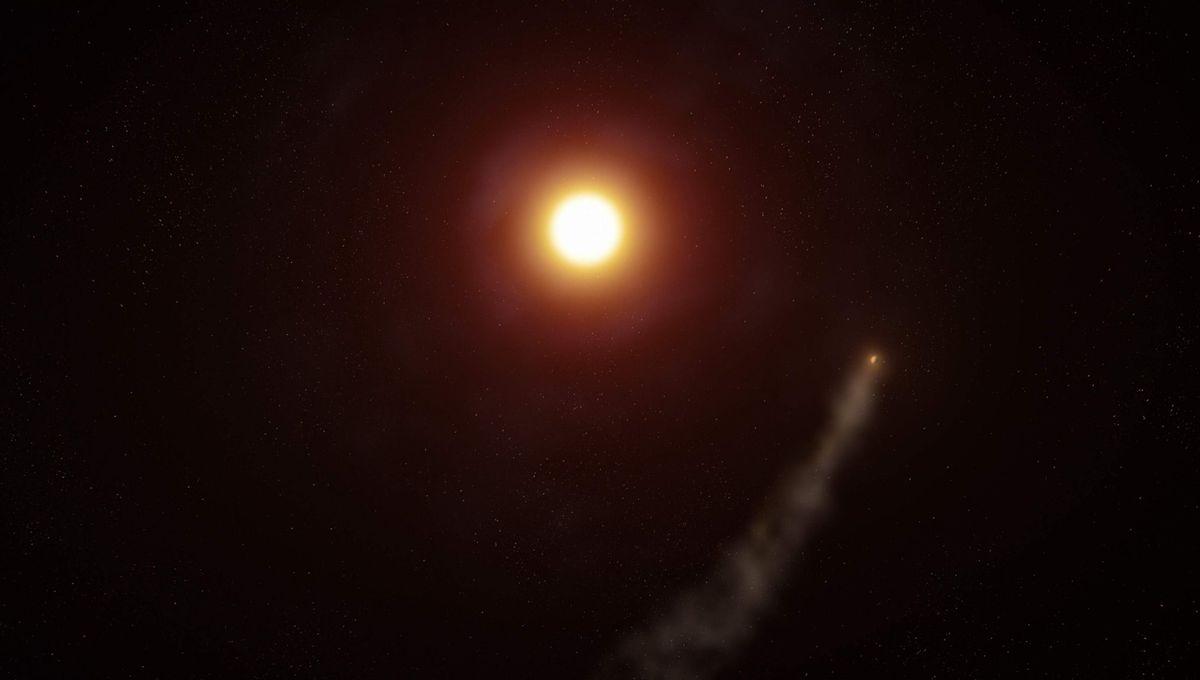
WASP-69b is an exoplanet that has just 30 percent of Jupiter’s mass, but is 10 percent larger. This world is dramatically puffed-up because it orbits very close to its star, completing an orbit in just 3.9 days. And its inflated layers are not staying put – the stellar wind is eroding them, creating a comet-like tail. The latest observations suggest that it is much longer than scientists had expected.

The tail extends for at least 580,000 kilometers (360,000 miles). It is composed mainly of helium, which the astronomers tracked with the Keck Observatory. The stellar wind sculpted the atmosphere escaping the planet into a long, wispy tail that can be seen clearly in infrared light.

Advertisement

“Previous observations suggested that WASP-69b had a modest tail, or no tail at all,” Dakotah Tyler, astrophysics doctoral candidate at UCLA and first author of the study, said in a statement. “However, we have been able to definitively show that this planet’s helium tail extends at least seven times the radius of the giant planet itself.”

The star WASP-69 is slightly smaller and cooler than the Sun, not that this is enough to stop it affecting the planet. The planet’s being cooked, and losing about one Earth’s worth of mass every billion years or so. These kinds of planets are very common in space and even planets in our Solar System, like Mars, experience atmospheric loss from the solar wind.

“The WASP-69b system is a gem because we are able to study its atmospheric mass-loss in real-time,” says co-author, Erik Petigura, associate professor of astronomy and astrophysics at UCLA. “This makes for a rare opportunity to understand the critical physics that shapes thousands of other planets.”

“These comet-like tails are really valuable because they form when the escaping atmosphere of the planet rams into the stellar wind, which causes the gas to be swept back. Observing such an extended tail allows us to study these interactions in great detail,” Petigura continued.

Advertisement

WASP- 69b has a dense and hazy atmosphere that is partially clouded. It is an extreme example of atmospheric loss and a tailed planet, but it won’t just evaporate away. The planet has 90 Earth’s worth of mass, so the star will destroy it by becoming a red giant in several billion years, rather than making it evaporate away.

The study is published in The Astrophysical Journal and was presented at the 243rd meeting of the American Astronomical Society.

Deborah Bloomfield
Deborah Bloomfield

Related posts:

  1. Paris ramps up security as jihadist attacks trial starts
  2. Cricket-‘Western bloc’ has let Pakistan down, board chief says
  3. Ancient Bison Found In Permafrost Is So Well Preserved Scientists Want To Clone It
  4. Where Inside Us Do We Feel Love?

Source Link: Massive Comet-Like Tail Stretching Over 500,000 Kilometers Discovered On Far-Away World

Filed Under: News

Primary Sidebar

  • Countries With The Most Narcissists Identified By 45,000-Person Study, And The Results Might Surprise You
  • World’s Oldest Poison Arrows Were Used By Hunters 60,000 Years Ago
  • The Real Reason You Shouldn’t Eat (Most) Raw Cookie Dough
  • Antarctic Scientists Have Just Moved The South Pole – Literally
  • “What We Have Is A Very Good Candidate”: Has The Ancestor Of Homo Sapiens Finally Been Found In Africa?
  • Europe’s Missing Ceratopsian Dinosaurs Have Been Found And They’re Quite Diverse
  • Why Don’t Snorers Wake Themselves Up?
  • Endangered “Northern Native Cat” Captured On Camera For The First Time In 80 Years At Australian Sanctuary
  • Watch 25 Years Of A Supernova Expanding Into Space Squeezed Into This 40-Second NASA Video
  • “Diet Stacking” Trend Could Be Seriously Bad For Your Health
  • Meet The Psychedelic Earth Tiger, A Funky Addition To “10 Species To Watch” In 2026
  • The Weird Mystery Of The “Einstein Desert” In The Hunt For Rogue Planets
  • NASA Astronaut Charles Duke Left A Touching Photograph And Message On The Moon In 1972
  • How Multilingual Are You? This New Language Calculator Lets You Find Out In A Minute
  • Europa’s Seabed Might Be Too Quiet For Life: “The Energy Just Doesn’t Seem To Be There”
  • Amoebae: The Microscopic Health Threat Lurking In Our Water Supplies. Are We Taking Them Seriously?
  • The Last Dogs In Antarctica Were Kicked Out In April 1994 By An International Treaty
  • Interstellar Comet 3I/ATLAS Snapped By NASA’s Europa Mission: “We’re Still Scratching Our Heads About Some Of The Things We’re Seeing”
  • New Record For Longest-Ever Observation Of One Of The Most Active Solar Regions In 20 Years
  • Large Igneous Provinces: The Volcanic Eruptions That Make Yellowstone Look Like A Hiccup
  • Business
  • Health
  • News
  • Science
  • Technology
  • +1 718 874 1545
  • +91 78878 22626
  • [email protected]
Office Address
Prudour Pvt. Ltd. 420 Lexington Avenue Suite 300 New York City, NY 10170.

Powered by Prudour Network

Copyrights © 2026 · Medical Market Report. All Rights Reserved.

Go to mobile version