• Email Us: [email protected]
  • Contact Us: +1 718 874 1545
  • Skip to main content
  • Skip to primary sidebar

Medical Market Report

  • Home
  • All Reports
  • About Us
  • Contact Us

Meet The Amami Rabbit, A Goth Bunny That’s Also A Living Fossil

December 31, 2025 by Deborah Bloomfield

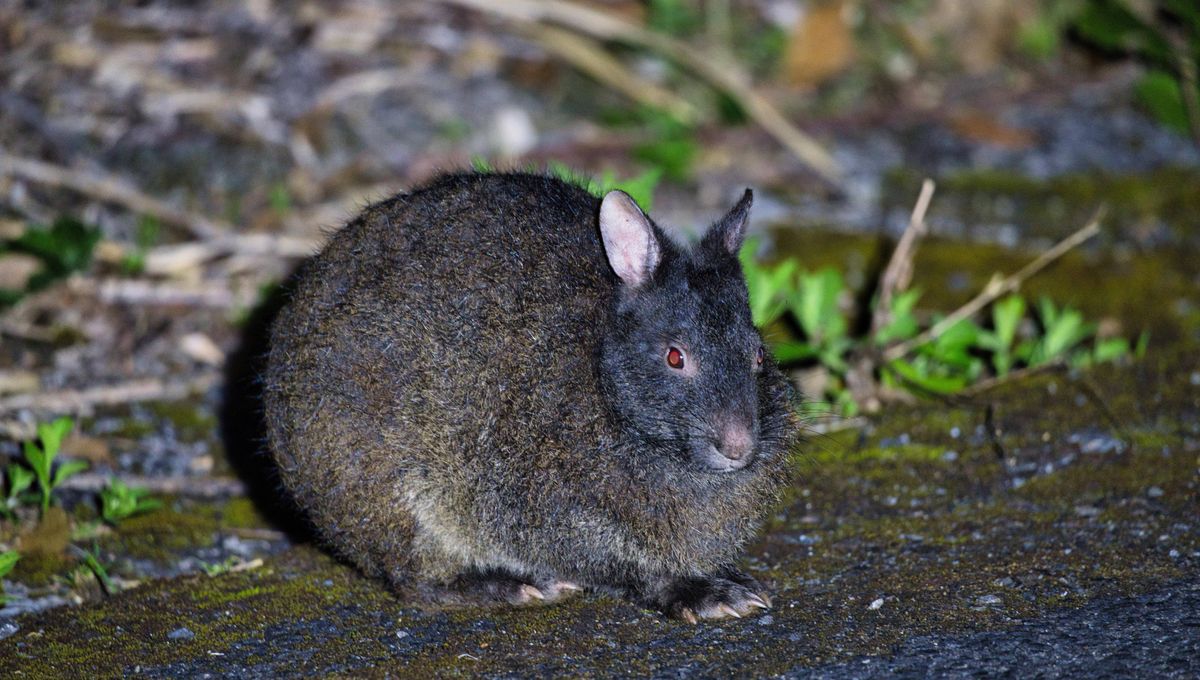
On the relatively remote Japanese islands of Amami Ōshima and Tokunoshima, hops a very unusual bunny. The Amami rabbit (Pentalagus furnessi), a dark-furred and ancient-looking animal, is unique to these islands and is a veritable living fossil.

The rest of this article is behind a paywall. Please sign in or subscribe to access the full content.

Otherwise known as the Ryukyu rabbit, this creature has unusually small ears, a very stocky, squat body, small eyes, and a shaggy, coarse coat that is almost black in color, with reddish hues. Taken at a glance, you might think it’s the outcome of a particularly fruity night between a rabbit and a badger, given its odd looks. 

But in reality, this animal resembles more primitive rabbits that are thought to have lived millions of years ago. It is potentially a descendant of Pliopentalagus, an extinct genus of ancient rabbit that appeared in Asia some 6 million years ago and went extinct near the end of the Pleistocene.


If its dark fur wasn’t enough to make this rabbit look like some gothic imagining, it is also completely nocturnal, living in the dark forests where it forages for food (in the form of grasses and ferns during the summer, and nuts and acorns in the winter months). It is also armed with unusually long, straight, and strong claws that it uses to dig burrows in the hillsides.

Although the rabbit has a few natural predators, including snakes and mongooses, it has also suffered from hunting and trapping by humans. This reached a particular height before the 1920s, which caused their numbers to decline. However, in 1921, Japan recognized the rabbit as a natural monument, providing it with protection. This was updated in 1963, when they were declared a “special natural monument”, an upgraded designation that prevented them from being trapped too.

Despite these efforts, the rabbits are also vulnerable to habitat loss caused by forest clearing, commercial logging, agriculture, and residential building. Their unique existence has made them vulnerable to changes, especially as they thrive best in a mix of young and mature forests, struggling to survive in either alone.

P. furnessi is considered endangered by the International Union for Conservation of Nature (IUCN)’s Red List. Their current population size is estimated to be around 2,000 to 4,800 animals on Amami Ōshima and only around 400 on Tokunoshima. 

Deborah Bloomfield
Deborah Bloomfield

Related posts:

  1. Hai Robotics picks up $200M for its warehouse robot
  2. Garcia jumps back into action after Ryder Cup letdown
  3. Nuclear Football: Who Actually Has The Nuclear Launch Codes?
  4. 87 Satellites Sent To Space In The Last 24 Hours – Space Is Becoming Ever More Crowded

Source Link: Meet The Amami Rabbit, A Goth Bunny That’s Also A Living Fossil

Filed Under: News

Primary Sidebar

  • Facial Disfiguration: Why Has The Face Been The Target Of Punishment Across Time?
  • The World’s Largest Living Reptile Can “Surf” Over 10 Kilometers To Get Between Islands
  • In 1962, A Geologist Went Into A Cave. 2 Months Later, He’d Accidentally Invented A New Field Of Biology.
  • The Ancient Remains Of A 3-Ton Shark Indicate A New Point Of Origin For Gigantic Lamniform Sharks
  • The Biggest Landslide In Recorded History Happened Quite Recently And Pretty Close To Home
  • Meet The Amami Rabbit, A Goth Bunny That’s Also A Living Fossil
  • The Largest Native Terrestrial Animal In Antarctica Is Both Smaller And Tougher Than You’d Expect
  • The Freaky Reason Why You Should Never Store Tomatoes And Potatoes Together
  • Hominin Vs. Hominid: What’s The Difference?
  • Experimental Alzheimer’s Drug Could Have The Power To Halt Disease Before Symptoms Even Start
  • Al Naslaa: What Made This Enormous Boulder In Saudi Arabia Split In Two? Nobody’s Quite Sure
  • The Amazon Is Entering A “Hypertropical” Climate For The First Time In 10 Million Years
  • What Scientists Saw When They Peered Inside 190-Million-Year-Old Eggs And Recreated Some Of The World’s Oldest Dinosaur Embryos
  • Is 1 Dog Year Really The Same As 7 Human Years?
  • Were Dinosaur Eggs Soft Like A Reptile’s, Or Hard Like A Bird’s?
  • What Causes All The Symptoms Of Long COVID And ME/CFS? The Brainstem Could Be The Key
  • The Only Bugs In Antarctica Are Already Eating Microplastics
  • Like Mars, Europa Has A Spider Shape, And Now We Might Know Why
  • How Did Ancient Wolves Get Onto This Remote Island 5,000 Years Ago?
  • World-First Footage Of Amur Tigress With 5 Cubs Marks Huge Conservation Win
  • Business
  • Health
  • News
  • Science
  • Technology
  • +1 718 874 1545
  • +91 78878 22626
  • [email protected]
Office Address
Prudour Pvt. Ltd. 420 Lexington Avenue Suite 300 New York City, NY 10170.

Powered by Prudour Network

Copyrights © 2025 · Medical Market Report. All Rights Reserved.

Go to mobile version