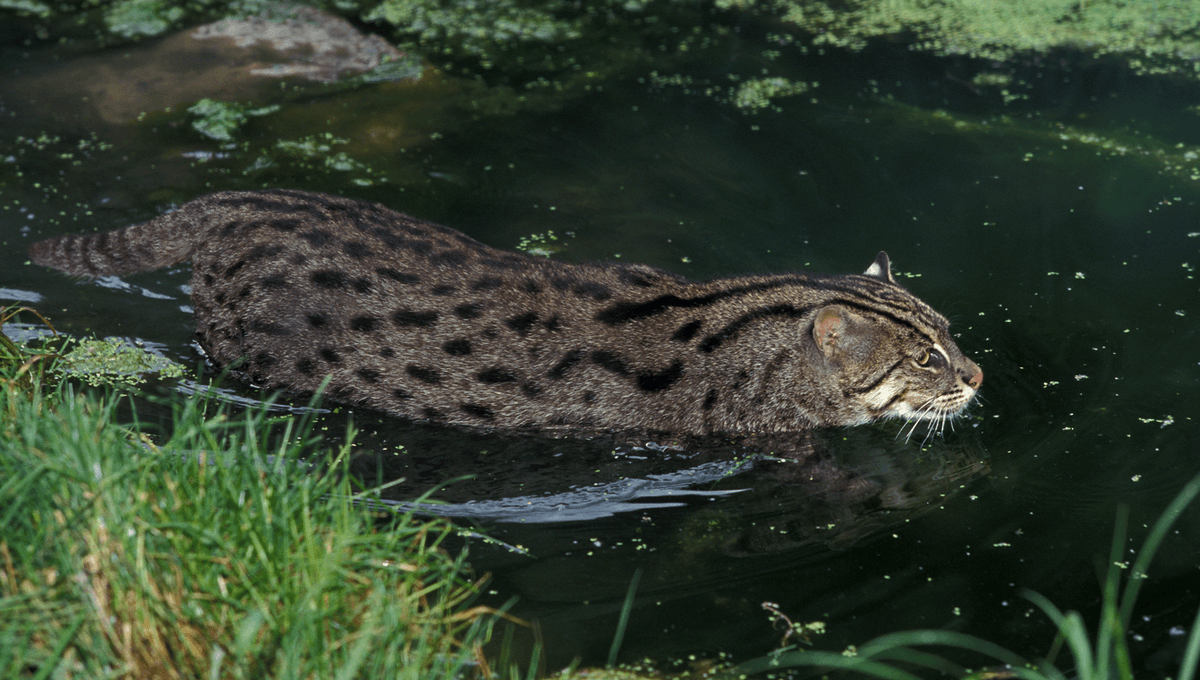
Along with vacuum cleaners and nail clippers, water is a notorious enemy of the domestic cat – but for one medium-sized feline, rivers, wetlands, and mangroves are home turf. The fishing cat has made aquatic environments its niche, earning its name from its remarkable ability to swim long distances and chase prey underwater.
A bit larger than a domestic cat, the fishing cat has evolved numerous features that help it take to the water, including a significantly chunkier build, shorter legs, a stubbier tail, and semi-webbed forepaws. Its double-layered coat helps it thrive in the water, featuring a dense undercoat that keeps it warm and dry, while a layer of long guard hairs gives the cat its coloration and distinctive spotted pattern.
Its vocalizations are just as curious as its habits, described as chuckles, gargles, barks, and even duck-like quacks. Perhaps these felines have been taking notes from their waterfowl neighbors.
Where Do Fishing Cats Live?
The fishing cat (Prionailurus viverrinus) is a species of semi-aquatic wild cat native to South and Southeast Asia, with known strongholds in Sri Lanka, Bangladesh, West Bengal in India, and the Terai-Duar belt of the Himalayan foothills in India and Nepal.
What Do Fishing Cats Eat?
Approximately three-quarters of their diet is comprised of fish, although they’re also known to dine on shellfish, birds, amphibians, small reptiles, rodents, and, in rare cases, calves.
A few other felines, such as tigers, lions, and panthers, are known to take the occasional dip, but fishing cats are true masters of the semi-aquatic wetland terrains in South and Southeast Asia. They’re renowned as highly adept swimmers, readily traveling long distances through water and even diving to chase prey beneath the surface.
However, watery landscapes are not their only domain. A 2024 study found that the species is also skilled at scaling trees, climbing up 8-meter-tall (26-foot) trees to raid the nests of waterbirds and eat their chicks. It’s believed they switch to this method of hunting during the wet seasons when intense monsoons make fishing difficult, dangerous, or impossible.
Are Fishing Cats Under Threat?
Because of their close ties to water, fishing cats are threatened by the loss of wetlands, swamps, and mangrove habitats. The IUCN Red List categorizes the species as “vulnerable” to extinction and notes their global population is declining.
They also come into direct conflict with people. Known as voracious predators that can skillfully hunt both fish and birds alike, these wild felines are often driven out or killed by communities that rely on the wetland and its fauna.
“Monitoring of media reports on human–fishing cat conflicts suggests that a fresh conflict is happening in the country every two weeks. Conservation efforts targeting fishing cats should thus be prioritized and all options for effective mitigation scientifically assessed,” Muntasir Akash, Assistant Professor at the University of Dhaka in Bangladesh and author of the 2024 study, said in a statement.
“A stable population of wetland bird colonies might be a win-win for the wetland, fishing cats, and the local people who depend on the wetlands.”

Source Link: Meet The Fishing Cat: The World's Most Aquatic Feline Has Evolved To Master The Wetlands
