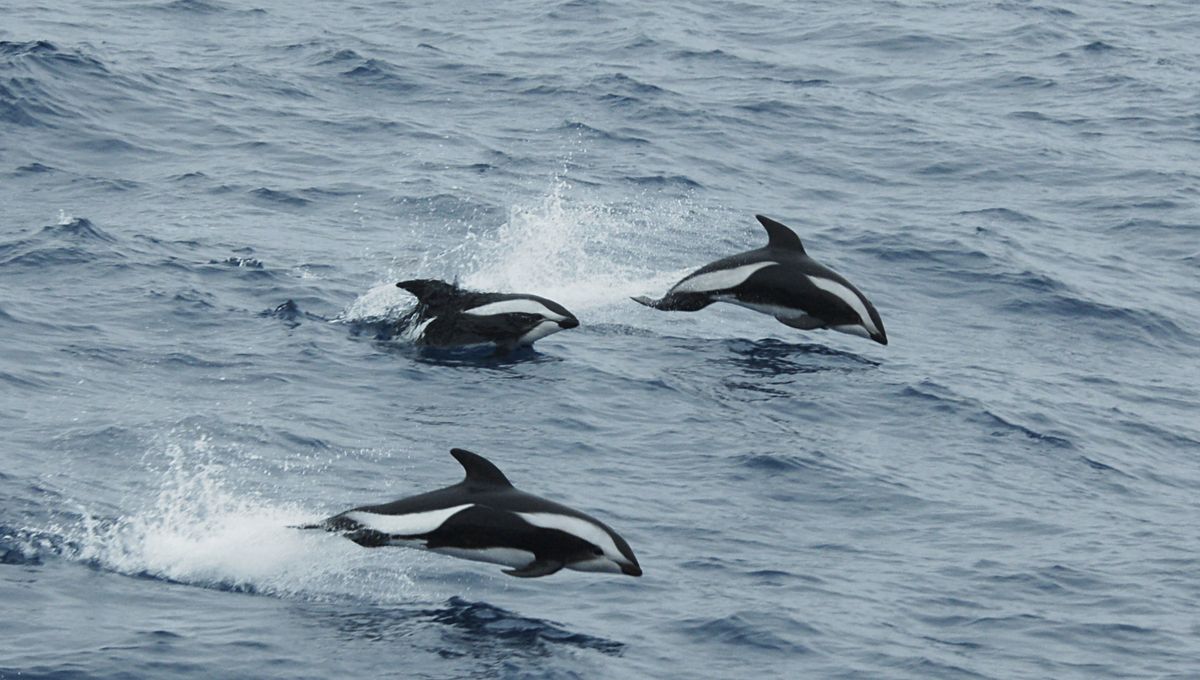
While most dolphins prefer warmer waters, there’s one species in particular that’s no stranger to cooler climes – in fact, the most likely place to find one is south of the Antarctic Convergence. The name of this remote and rarely seen marine mammal? The hourglass dolphin.
A striking Southern Ocean resident
Just look at a picture of an hourglass dolphin (Lagenorhynchus cruciger) and it’s easy to see where they got their name from. Their bodies have a black base (besides a white belly), but on both sides, they feature white stripes that narrow near the dorsal fin, creating an hourglass shape – a much fancier interpretation of the black-and-white color scheme than orcas’, we’d argue.
Compared to their cetacean relatives, however, hourglass dolphins are much smaller and stockier, clocking in at a maximum of 120 kilograms (265 pounds) in weight and 1.9 meters (6.2 feet) in body length. They also have tall, hooked dorsal fins, which can even appear to bend back towards the body in what are presumed to be adult males.
Little else is known about the biology of hourglass dolphins – for reasons that we’ll go into shortly – but scientists have been able to determine that they have a range that extends around the deeper waters of the Southern Ocean, mostly sticking to its boundary.
There, they tend to travel and socialize in relatively small pods – roughly seven per group on average, though they’ve been seen in groups up to 100-wide – and are believed to chow down on small fish, squid, and crustaceans.
How rare are hourglass dolphins?
Hourglass dolphins are notoriously elusive, and evidence speaking to that goes all the way back to when they were first deemed a species. When French naturalists Jean René Constant Quoy and Joseph Paul Gaimard did so back in 1824, it was on the basis of drawings of the animal, rather than specimens, as is normally the case.
Fast forward 200 years and getting the chance to examine an hourglass dolphin specimen is still something only a select few have experienced. Most recently, researchers from Massey University in New Zealand had the opportunity to conduct a necropsy on one that had washed up on a South Island Beach.
“We’ve got a privilege, a rare privilege, to get an insight to the biology and to the life history of a species which is rarely ever been examined globally,” Professor Karen Stockin, a marine mammal ecologist at Massey University, told 1 NEWS at the time.
But despite the difficulty in studying them, hourglass dolphins aren’t actually as rare as might be assumed; it’s estimated that there are over 144,000 of them and they’re considered to be in the “Least Concern” category by the IUCN Red List.
From that number, it seems like we should be seeing more of them, but then again, these dolphins just so happen to live in one of the most remote regions of the world.
Where’s the best place to see an hourglass dolphin?
Your best bet at catching a glimpse of an hourglass dolphin requires you to have a strong stomach; the highest concentration of these animals is in the notoriously choppy Drake Passage.
For those lucky enough to see one, or even a group, quite the show is in store. Hourglass dolphins are well known for their love of bow-riding, and as fast swimmers that reach speeds of 22 kilometers per hour (13.7 miles per hour), can generate a significant amount of spray as they come up to the surface.

Source Link: Meet The Hourglass Dolphin: Small, Speedy, And Super Elusive
