Microplastics seem to be everywhere in 2024, with new studies revealing the tiny contaminants in human brains, penises, and even human placentas. Now, new research has looked at the impact of microplastics on free-ranging dolphins in the USA and has found that even these intelligent cetaceans are not able to escape, with their breath found to contain microscopic plastic fragments.
By studying wild bottlenose dolphins (Tursiops truncatus) in an urban estuary in Sarasota Bay, Florida, and a more rural environment in Barataria Bay, Louisiana, the team was able to collect breath samples from individuals to discover more about the presence of microplastics, both within these areas and within the dolphins themselves.
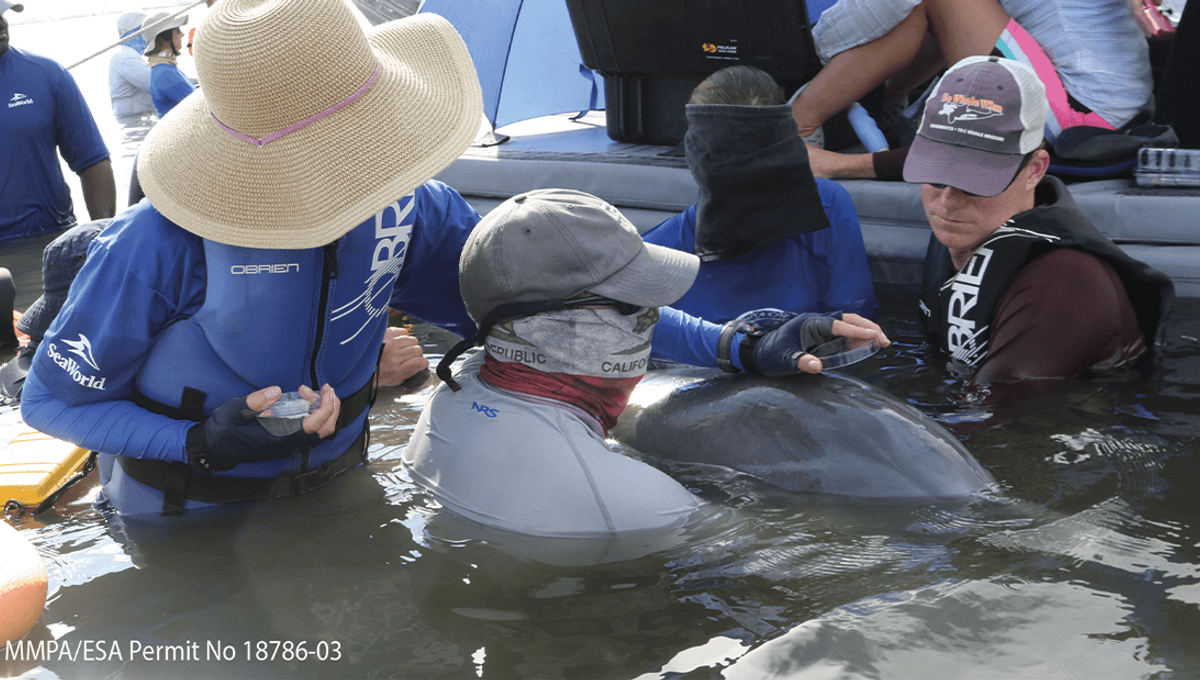
To take breath samples the team collected exhaled air from the blowholes of 11 dolphins: five from Sarasota and six from Barataria Bay. The collections were conducted during catch-and-release health assessments on the dolphins and the samples of breath were done via a petri dish held over the dolphin.
“During these brief permitted health assessments, we held a petri dish or a customized spirometer (which is a device that measures lung function) above the dolphin’s blowhole to collect samples of exhaled breath.” Miranda Dziobak of the College of Charleston in South Carolina told IFLScience.
“To analyze our samples, we used a microscope in our colleague’s laboratory at The Citadel to look for particles that looked like plastic based on color, surface texture, and shape. To confirm that they were plastic, our colleague at Virginia Tech examined them using Raman spectroscopy.”
The researchers also collected samples from the surrounding air, to allow them to compare samples and find out if microplastics were just present in the natural atmosphere or if they were coming directly from the dolphins exhaled breaths.
“Plastic exposure in humans has been extensively studied, revealing inhalation as a primary route of exposure. Building off this body of research, we wanted to explore inhalation as a possible exposure mechanism for dolphins. We have also been studying microplastic ingestion in dolphins, and we saw differences between the particle types ingested and the particles we suspect to be inhaled,” explained Dziobak.
The results showed that all 11 dolphins had at least one microplastic particle in their breath. The team was able to conduct further research to explore what type of plastics they were and found a mixture of fibers and fragments, including polyethylene terephthalate (PET), which is used to produce textiles and fabrics. Polyethylene (PE) was also found, which is associated with clothing production and is often found in wastewater.
It is still unclear exactly how the presence of microplastics might impact the dolphins’ health.
“What we know from human studies is that inhaling microplastics can lead to lung inflammation and other respiratory problems. Since we observed similar particles in the exhaled breath of dolphins as have been reported in humans, dolphins might also be at risk for lung problems,” continued Dziobak.
The researchers hope that these findings will alert people to the persistence of microplastics and that it will encourage the public to reduce their plastic consumption, for both their own health and the health of the dolphins.
The study is published in PLoS ONE.

Source Link: Microplastics Detected in Wild Dolphin Breath For The First Time
