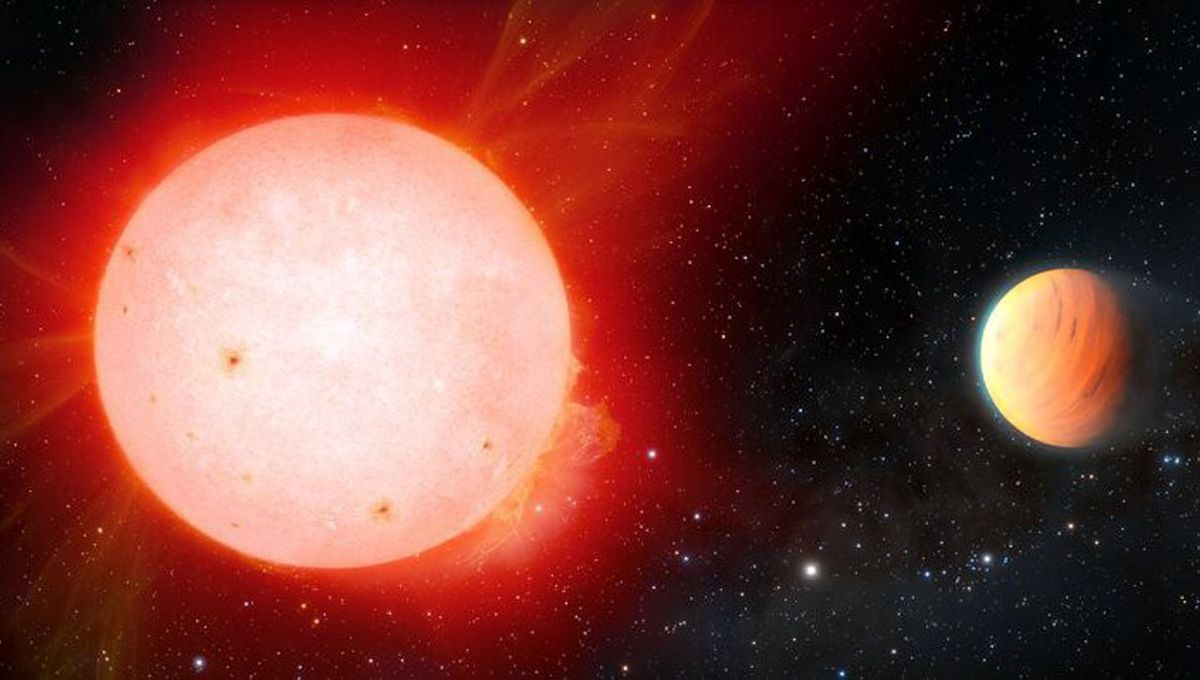
The question of the habitability of planets in the cosmos is a tricky one. Based on the one example we have, which is Earth, you want the planet to be neither too close nor too far away from its star. This is commonly known as the Goldilocks zone. New work shows that it is not as simple as staying in it, unfortunately – it also depends on the shape of a planet’s orbit.
Researchers looked at the most common type of star in the galaxy, the M-dwarf. These stars are smaller and cooler than the Sun, and their Goldilocks zone is much closer to them than the one in our solar system. In fact, it is close enough that their tidal forces play a significant role in the heat a planet experiences if it is not in a circular orbit.
The more oval an orbit is, the more eccentric it is. A circle has an eccentricity of zero, while for an ellipse this is greater than zero but less than one. The greatest eccentricity for planets in the solar system is seen with Mercury, at slightly over 0.2. That means that the short axis of the elliptical orbit of Mercury is about 98 percent as long as its long axis.
This might seem like a small difference, but it has big consequences when you are very close to a big gravitational body like a star. Getting closer and further away as the result of an eccentric orbit creates tidal heating, making those worlds dangerously hotter. An Earth-like planet orbiting a star one-quarter of the mass of our Sun with an eccentricity e > 0.2 in its habitable zone could experience what’s called a “tidal Venus” catastrophe. The tidal heating would be enough to evaporate a water ocean, turning an Earth-like world into a deadly hell like Venus.
“It’s only for these small stars that the zone of habitability is close enough for these tidal forces to be relevant,” senior author professor Sarah Ballard, from the University of Florida, said in a statement.
The work looked at a sample of 163 planets around 101 systems that have been observed by NASA’s Kepler mission. Modeling of the orbits suggests that the eccentricity of about two-thirds of planets around these stars is too high for them to have a temperature considered suitable for life. Most likely, those were in systems with only one planet.
One-third of exoplanets around these stars would have a much more stable temperature, though – and that still translates to hundreds of millions of promising planets in our own galaxy. Temperature alone doesn’t translate to life for sure, but it is an encouraging factor.
“I think this result is really important for the next decade of exoplanet research, because eyes are shifting toward this population of stars,” explained first author Sheila Sagear, graduate researcher also at the University of Florida. “These stars are excellent targets to look for small planets in an orbit where it’s conceivable that water might be liquid and therefore the planet might be habitable.”
The study is published in the Proceedings of the National Academy of Sciences.

Source Link: Millions Of Exoplanets May Have Experienced A “Tidal Venus” Catastrophe
