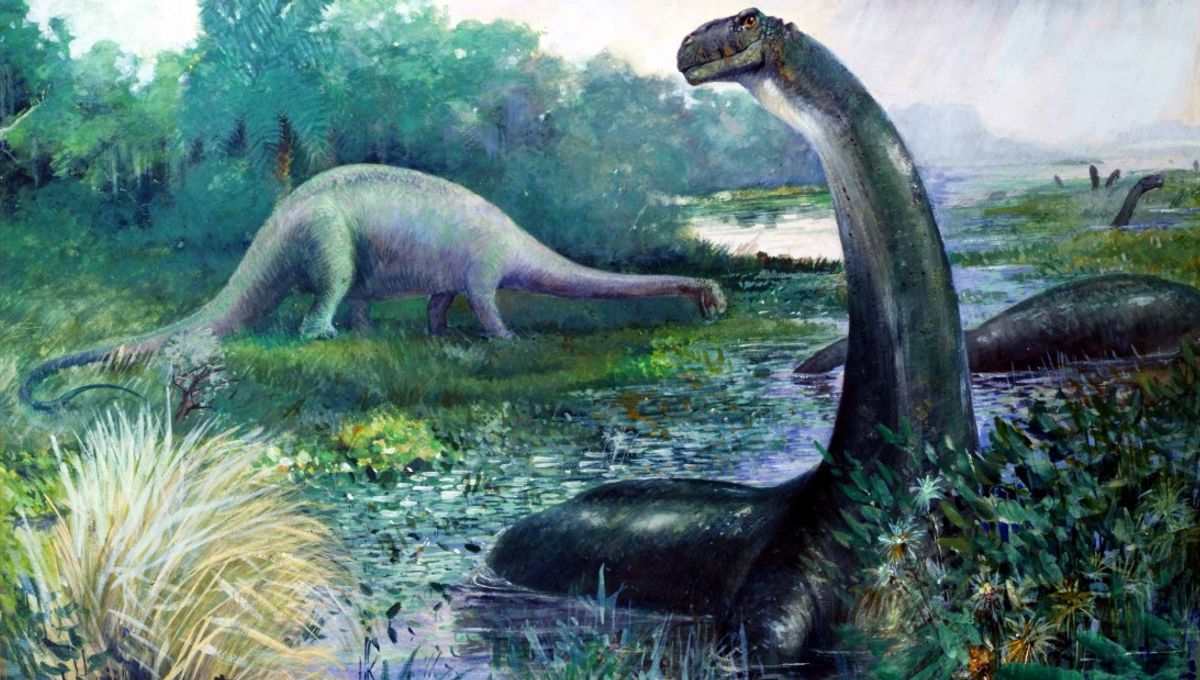
Do sauropods live in the Congo? No, but that didn’t stop the idea from circulating in the not-so-distant past. The “dinosaur” in question was said to be a long-necked rotund sauropod-like herbivore that waded through swamps and rivers. It’s big in the cryptozoology circles, but its origins, like many cryptids, are murky.
The mysterious animal is known as emeula ntouka in the Bomitaba dialect of the northern Congo basin, meaning “eater of the top palms”. It also goes by the name Mokele-Mbembe which translates to “one who stops the flow of rivers” in Lingala, a Central Bantu language that belongs to the Niger-Congo, which is the largest African languages phylum according to the National African Language Resource Center. A fitting name for a water-dwelling behemoth, and one that’s become one of the best-known mystery beasts from the African continent, but where did it come from?
One angle is that it was spurred by first-person accounts of animals that might look similar from a distance. In the same way that an especially large eel has been considered an explanation for the Loch Ness Monster, Mokele-Mbembe could be argued to exhibit some traits of native wildlife in the region such as elephants and hippos that – it must be said – have a lot of river-flow-stopping potential. Furthermore, it wouldn’t be the first time that Western science has overlooked the insights of Indigenous people, but while reports of a mysterious beast are one thing, Westerners may also have been behind the leap to dinosaurs.
The idea that Sauropods like Dippy The Diplodocus lived on in countries in Africa may have been spurred on by false attitudes held by some Westerners in the 1900s, a time when “dino-mania” went viral. It was the view of too many that the continent had experienced a kind of arrested development that meant it had moved on little since the time of the dinosaurs. If that were true, where better for a giant water-dwelling beast like Mokele-Mbembe to hang out?
It was, of course, untrue – but as zoologist, Prehistoric Planet lead consultant, and cryptozoology expert Dr Darren Naish discovered, that didn’t stop the idea from spreading far and wide. To name a few publications that featured Mokele-mbembe and Africa’s “living dinosaurs”, there was animal dealer Carl Hagenbeck’s Beasts and Men (1909), and Roy Mackal’s A Living Dinosaur? In Search Of Mokele-Mbembe (1987).
A description of the beast from Mackal’s writings certainly sounds impressive, if not a little similar to a trunked elephant with long nails.
“The witnesses described animals that were 15 to 30 feet long, mostly head, neck and tail,” the Institute for Creation Research quotes Mackal’s book. “The head was distinctly snake-like, a long thin tail, and a body approximating the size of an elephant, or at least that of a hippopotamus. The legs are short, with the hind legs possessing three claws. The animals are a reddish brown in color, and have a rooster-like frill running from the top of the head down the back of the neck.”
Mackal was by trade a biochemist at the University of Chicago, but, as UChicago Magazine explains, he felt trapped in the confines of his lab where he studied viruses. However, going in search of bigger, greater, more made-up things came at a cost.
His cryptid hunts across Africa didn’t get Mackal fired, as he was protected by tenure, but he was scorned by his colleagues and allegedly became the inspiration for a villainous character in Disney’s 1985 Baby: Secret Of The Lost Legend, in which a ruthless professor tries to claim a paleontologist’s credit for discovering a family of Brontosaurus in the Ivory Coast.
It seems a classic combo of dinosaur fever, obscure observations, and a peppering of gross stereotyping likely explain the momentum Mokele-mbembe gathered as Africa’s last living dinosaur. For now, at least, we’ll have to make do with birds, but what about if we changed the order of things…
Can we bring back dinosaurs? And is anyone trying?

Source Link: Mokele-Mbembe: The "Living Dinosaurs" People Thought Lived In The Congo
