• Email Us: [email protected]
  • Contact Us: +1 718 874 1545
  • Skip to main content
  • Skip to primary sidebar

Medical Market Report

  • Home
  • All Reports
  • About Us
  • Contact Us

Monochrome Rainbows: In The Right Circumstances, Rainbows Can Look Very Strange Indeed

August 27, 2025 by Deborah Bloomfield

You probably all know how rainbows form, if not from being told as a child, then from having to explain it to a child as an adult. But here’s the basic version anyway in case you, uh, forgot.

The rest of this article is behind a paywall. Please sign in or subscribe to access the full content.

Light in a vacuum – as far as our best theories and experiments suggest – zips along at a constant speed C. But as it enters or leaves a medium, such as air or water, it slows down and changes direction, known as refraction. This is why it can sometimes look like people’s legs / heads have been ripped clean off in a pool.


Sunlight contains many different wavelengths of light, which are slowed by different amounts as the sunlight enters a medium. Violet – the shortest wavelength in the visible spectrum – slows and refracts more than the longest wavelength, red. 

As sunlight passes through water droplets in the air at the right angles, some of that light is reflected internally at the back of the liquid drop, before being refracted again as it leaves the droplet, now traveling in a new direction. 

“An observer standing in the right place will see the dispersed sunlight reflected back towards them. Light scattered by many drops reaching the observer’s eye will appear as a colourful rainbow,” the UK Met Office explains.  “Different colours exit the droplets at angles varying by around two degrees from red to violet. The red light seen by an observer comes from drops slightly higher in the atmosphere than the drops that scatter violet light towards the observer.”


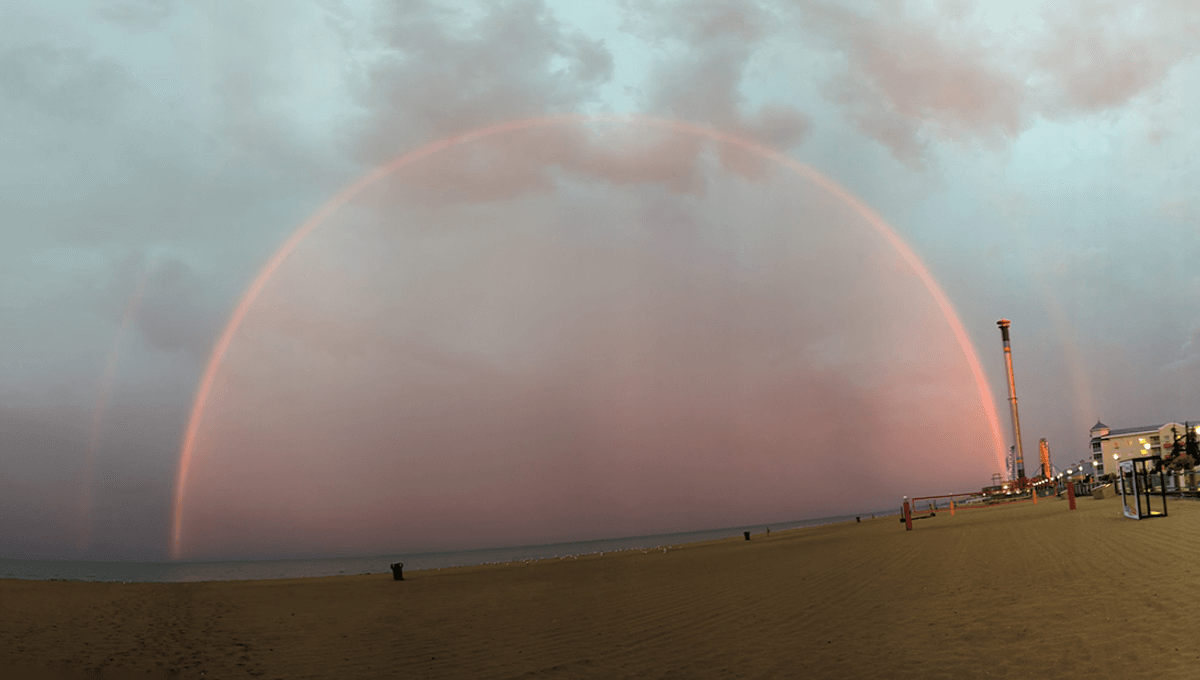
But there is also another phenomenon known as “monochrome rainbows” or “red rainbows”. In certain circumstances, you can be greeted with a big red rainbow

ⓘ IFLScience is not responsible for content shared from external sites.

So, what causes these beautiful freaks of nature?

When the Sun hits our atmosphere, light in the blue spectrum is scattered more efficiently than red light by particles within it. With less blue light hitting your eyes, you will perceive the Sun as tinted slightly yellow. The more atmosphere the light has to travel through – say at sunrise and sunset – the more blue light gets scattered, making the Sun appear redder.

Monochrome rainbows are simply rainbows that occur in the same manner outlined above, but when the light refracted by the water droplets is predominantly red from a rising or setting sun.

Deborah Bloomfield
Deborah Bloomfield

Related posts:

  1. Audi launches its newest EV, the 2022 Q4 e-tron SUV
  2. Dinosaur Prints Found Under Restaurant Table Confirmed As 100 Million Years Old
  3. Archax: Japanese Engineers Make Transformer Robot That Actually Works
  4. How Do We Know There Is Anything Beyond The Observable Universe?

Source Link: Monochrome Rainbows: In The Right Circumstances, Rainbows Can Look Very Strange Indeed

Filed Under: News

Primary Sidebar

  • Ambitious Iguana “Love Island” For Near-Extinct Reptiles Becomes Epic Conservation Success Story
  • Sol 1,540: NASA Releases Video Of Perseverance Rover’s Record-Breaking Drive On Mars
  • Why Carl Sagan Was Way Ahead Of His Time And The Legacy He Left Behind
  • Why Were Pompeii Victims All Wearing Thick Woolly Cloaks In August?
  • We May Finally Know What Causes These Bizarre Bright Blue Cosmic Flashes
  • What’s The Biggest Rock In The World?
  • There Is A Very Simple Test To See If You Have Aphantasia
  • Bringing Extinct Animals To Life: Is Artificial Intelligence Helping Or Harming Palaeoart?
  • This Brilliant Map Has 3D Models Of Nearly Every Single Building In The World – All 2.75 Billion Of Them
  • These Hognose Snakes Have The Most Dramatic Defense Technique You’ve Ever Seen
  • Titan, Saturn’s Biggest Moon, Might Not Have A Secret Ocean After All
  • The World’s Oldest Individual Animal Was Born In 1499 CE. In 2006, Humans Accidentally Killed It.
  • What Is Glaze Ice? The Strange (And Deadly) Frozen Phenomenon That Locks Plants Inside Icicles
  • Has Anyone Ever Actually Been Swallowed By A Whale?
  • First-Known Instance Of Bees Laying Eggs In Fossilized Tooth Sockets Discovered In 20,000-Year-Old Bones
  • Polar Bear Mom Adopts Cub – Only The 13th Known Case Of Adoption In 45 Years Of Study At Hudson Bay
  • The Longest-Running Evolution Experiment Has Been Going For 80,000 Generations
  • From Shrink Rays And Simulated Universes To Medical Mishaps And More: The Stories That Made The Vault In 2025
  • Fastest Cretaceous Theropod Yet Discovered In 120-Million-Year-Old Dinosaur Trackway
  • What’s The Moon Made Of?
  • Business
  • Health
  • News
  • Science
  • Technology
  • +1 718 874 1545
  • +91 78878 22626
  • [email protected]
Office Address
Prudour Pvt. Ltd. 420 Lexington Avenue Suite 300 New York City, NY 10170.

Powered by Prudour Network

Copyrights © 2025 · Medical Market Report. All Rights Reserved.

Go to mobile version