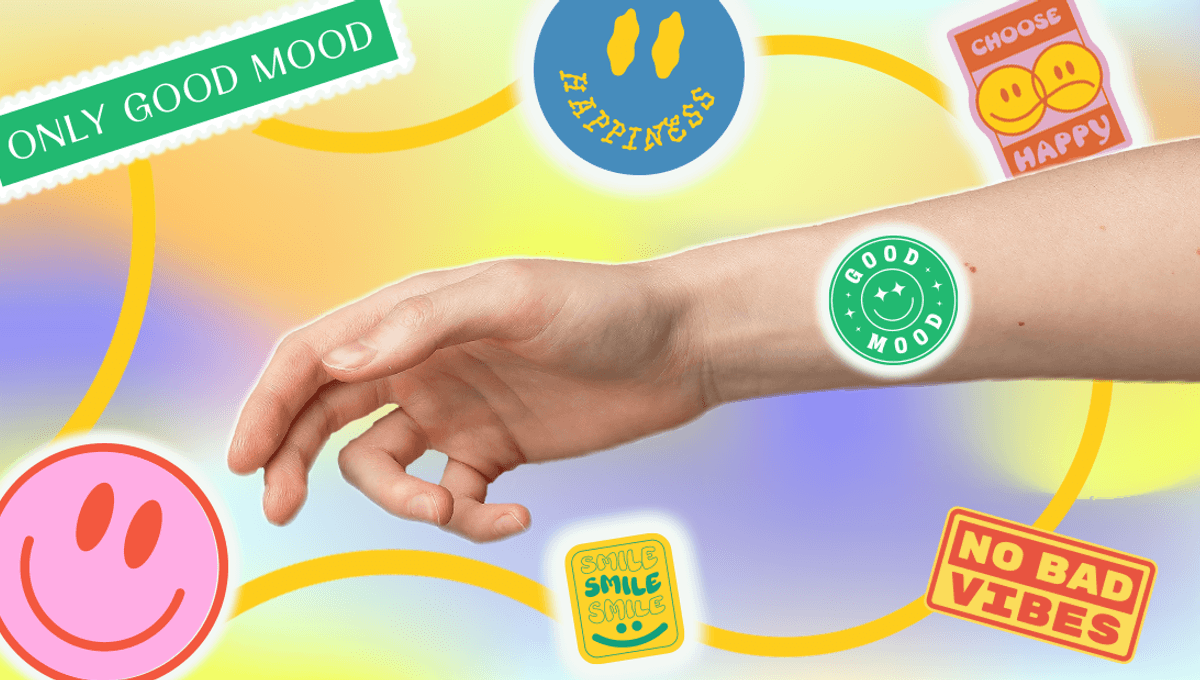
Not happy with the way you’re feeling? What if there were a simple solution, one where you could simply slap a sticker on your wrist, and lo and behold, your whole mood changes? It sounds like something from sci-fi (and you’ll know that it is if you’re familiar with Doctor Who), but there are companies out there purporting to have made fiction a reality, selling patches that claim to instantly alter your mood. But do they truly work?
Do a quick search for “mood patches”, and you’ll soon find that they can come in many forms. We’re going to focus on three types: “natural” patches, “frequency-emitting” patches, and pharmaceutical-containing patches that have been approved by the US Food and Drug Administration (FDA).
“Natural” patches
“Natural” patches are the ones that you might have seen advertised as containing “natural” ingredients – things like plant extracts (think ashwagandha, ginseng), vitamins, and minerals. Instead of containing pharmaceuticals, it’s these ingredients that are alleged to help manage stress and anxiety, or make it easier to concentrate.
Straight off the bat, it’s important to note that no such patches are FDA-approved, meaning they haven’t gone through the rigorous processing of providing the scientific evidence to demonstrate they actually do what they claim to do.
In fact, if you take a peek into the further details about these patches – for example, of the company Kind Patches’ “Stress Down Patches” – it’s stated that: “This product is not intended to diagnose, treat, cure, or prevent any disease or health condition.” Similar disclaimers are seen on the websites of other brands of patches too. That’s one way to avoid the need for FDA approval, but it’s also a pretty good indicator of whether or not these patches will work.
Even if we entertain the ingredients list for a second, there’s little to suggest they would be effective. For example, some anti-stress or anxiety patches contain ashwagandha. Though there have been clinical trials exploring its use as a treatment for chronic stress, the data is yet to back it up – and that’s just for when it’s taken orally, let alone in the form of a patch, which could change how much is absorbed by the body and how it is metabolized, thus how effective it is (or isn’t).
“Frequency-emitting” patches
“Frequency-emitting” patches first caught wider attention when Meghan Markle was spotted wearing one from company NuCalm. Known as “Biosignal Processing Discs”, the claim is that the patches “provide the neurochemistry to accelerate the onset of the relaxation response” by emitting particular frequencies.
If you think that sounds like a bunch of nonsense wrapped up in scientific terminology, you’re not wrong – it appears the patches are very likely just stickers. When Alaina Demopoulos of the Guardian asked NuCalm’s CEO Richard Poole how the patches worked, one claim he made was that they contained a Tesla coil and a “six-layer multi-wave oscillator” as the energy source for all that frequency emission. When Demopoulos cut the sticker in half, she reported that there was no coil to be seen.
NuCalm isn’t the first to have made claims of this kind. Back in 2017, Goop – Gwyneth Paltrow’s wellness company that has been called out multiple times for making unscientific claims – started selling “healing stickers” from the company Body Vibes that claimed to “rebalance the energy frequency in our bodies” and in doing so, target mood-related issues like anxiety.
Again, this was swiftly recognized as a load of bunk. As Dr Jen Gunter, a gynecologist well-versed in correcting scientific misinformation, told INSIDER: “This term ‘rebalance the energy frequency in our bodies’ makes no sense medically. There is no medical way to measure energy frequency.”
FDA-approved pharmaceutical patches
It might be beginning to sound like all patches that are claimed to affect our mood remain within the realm of science fiction – but there are actually some that are considered to be effective to the point that they have FDA approval.
One example is EMSAM, a skin patch that delivers an antidepressant called selegiline, which belongs to a class of antidepressants known as monoamine oxidase inhibitors (MAOIs). It was approved by the FDA back in 2006 as a treatment for major depressive disorder.
However, unlike the non-pharmaceutical patches described above, you can’t just grab an EMSAM patch off the shelf – it has to be prescribed by a doctor. There’s a good reason for that too; the antidepressant in it can interact with lots of other medications, and can also have side effects.
The bottom line
If people find that the non-pharmaceutical patches do make a difference to their mood, it could be down to the placebo effect. But does that really matter if the problem has been “solved”? It may well do.
“If someone believes that their bio-frequencies are out of whack, they might not address some of the actual underlying factors that might be driving their depression, insomnia, or pain,” Matthew Burke, a cognitive neurologist and assistant professor at the University of Toronto, told the Guardian.
There’s also still the risk of experiencing adverse effects, such as skin irritation or an allergic reaction.
In any case, if you’re feeling stressed out, anxious, or low, it’s best to chat with a doctor first before just whacking on a mood patch.
The content of this article is not intended to be a substitute for professional medical advice, diagnosis, or treatment. Always seek the advice of qualified health providers with questions you may have regarding medical conditions.
All “explainer” articles are confirmed by fact checkers to be correct at time of publishing. Text, images, and links may be edited, removed, or added to at a later date to keep information current.

Source Link: Mood Patches: Can A Sticker Really Make You Feel Better?
