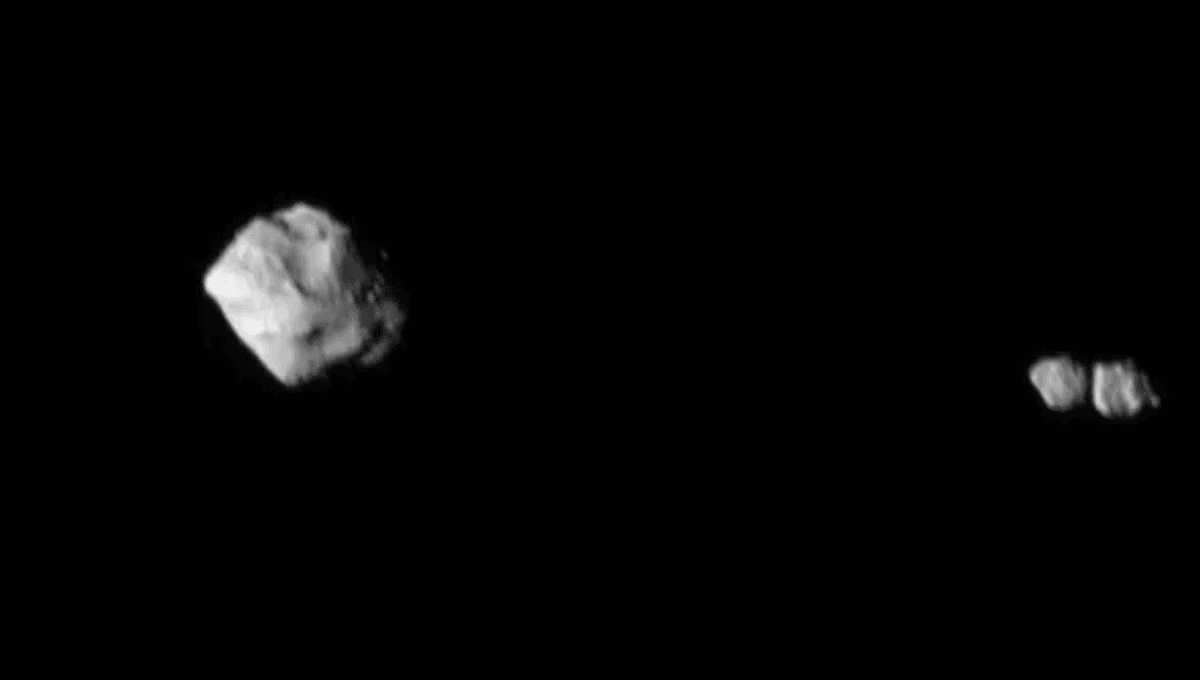
A great rule of thumb for the universe is accepting that everything is a lot more complicated than you expect. Take, for example, asteroid Dinkinesh, the first target of the NASA mission Lucy. As the spacecraft approached, the team were surprised to see an unexpected moon appear around the small asteroid. And they weren’t ready for what that moon was actually like – because they got a two-for-one.
The moon, now called Selam, is a contact binary object. It is made of two lobes of roughly the same size and is not dramatically smaller than its parent body. Dinkinesh is 720 meters (2,360 feet) across. The lobes of Selam are 210 and 230 meters (670 and 755 feet) across. Salem is just 3.1 kilometers (almost 2 miles) from Dinkinesh and it completes an orbit every 52.7 hours.
“There’s a lot more complexity in these small bodies than we originally thought,” co-author professor Jessica Sunshine, from the University of Maryland, said in a statement. “With the additional observations taken by the spacecraft, we were able to better analyze features such as Dinkinesh’s rotation speed and Selam’s orbit pattern. We also have a better understanding of what materials they’re possibly made of, bringing us a step closer to learning just how terrestrial bodies are created.”
The detailed analysis provided by Lucy revealed a prominent trough and ridge on the equator of Dinkinesh. One possibility is that Dinkinesh might have lost material, due to its rotations and maybe sunlight not reaching the soil evenly. The two lobes of Selam might have formed that way, and eventually, they collided at such a slow speed that they survived the celestial welding process.
The team is not sure if this is a certain scenario for the formation of Selam, but this work opens the door to comparing this small system to other binary systems. An important example is Didymos, which is among the 15 percent of all Near-Earth asteroids to possess a moon.
“I’m personally very excited to compare the Didymos binary system with this one, especially as they appear to share many similarities such as size, general shape and possibly composition despite being in totally different parts of the Solar System,” explained Sunshine.
Sunshine was involved with DART, the NASA mission that shot a projectile on Didymos’ moon Dimorphos. The test showed that humanity is capable of changing the trajectory of an asteroid using a kinetic impactor.
The fact that moons might be a common feature among asteroids in very different environments provides important insights into how asteroids evolve.
“The Didymos binary system is located in a near-Earth environment while the Dinkinesh system is located much farther away from Earth in the main asteroid belt,” Sunshine added. “They have very different features but we think they may have undergone similar processes to become what we know of them today.”
Lucy is named after the Australopithecus fossils of the same name because it is studying 11 different asteroids in the Solar System. Just like a fossil, these are remains of what the Solar System was like billions of years ago. They are the pieces from which planets formed so understanding them is understanding the past.
Dinkinesh is the Ethiopian name of the Lucy fossil – it means You are wonderful. Selam is the name of another Australopithecus fossil and it means peace. Dinkinesh and Selam are the first two of the 11 asteroids Lucy will study.
The spacecraft is actually currently coming back to Earth, reaching us in December. It will use our planet’s gravity to get more speed and fly back into the main asteroid belt to study asteroid Donaldjohanson in April 2025. It will then go beyond the main belt to reach the Trojan asteroids in the orbit of Jupiter in 2027.
“One of the things that’s critical to understanding how planets like Earth got here is understanding how objects behave when they hit each other, and to understand that we need to understand their strength,” said lead scientist Hal Levison of Southwest Research Institute, Boulder, Colorado, principal investigator for the Lucy mission.
“Basically, the planets formed when [smaller objects like asteroids] orbiting the Sun ran into each other. Whether objects break apart when they hit or stick together has a lot to do with their strength and internal structure.
A paper describing the results is published in the journal Nature.

Source Link: Moon Around Asteroid Dinkinesh Is Actually Two Asteroids Stuck Together
