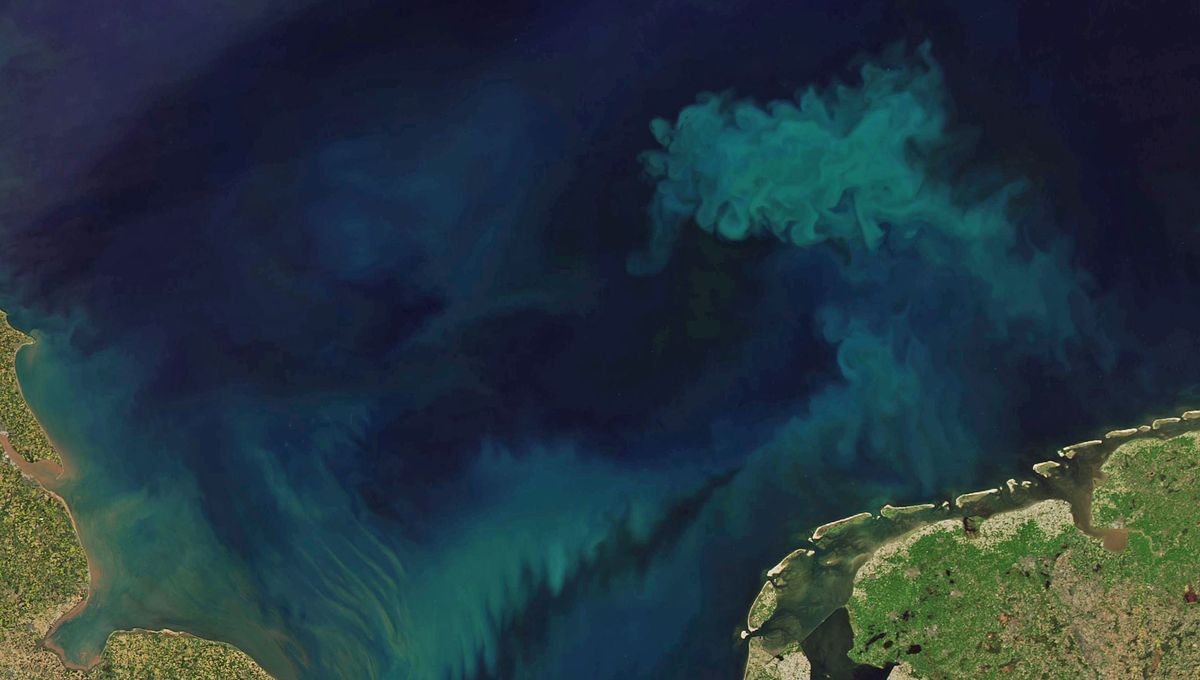
Dipping your toes in crystal clear blue waters might be a thing of the past, new research has revealed. By studying changes in surface ocean color, using satellites, for over 20 years, researchers have discovered that now 56 percent of our ocean is green, not blue. This represents a region that is greater than the total amount of land area on Earth. It is likely that human-induced climate change is to blame.
The change observed in the color is particularly prevalent in the tropical oceans near the equator. This suggests that something has changed in the ecosystems below the waves since the color of the ocean is a reflection of the flora and fauna within the waters. Even in lower latitudes, surface ocean ecosystems have become greener over the past 20 years. While the team cannot be 100 percent certain as to the cause of this green shift, they think human-induced changes to the climate are largely the force behind this.
“I’ve been running simulations that have been telling me for years that these changes in ocean color are going to happen,” said study co-author Stephanie Dutkiewicz, senior research scientist in MIT’s Department of Earth, Atmospheric and Planetary Sciences and the Center for Global Change Science, in a statement. “To actually see it happening for real is not surprising, but frightening. And these changes are consistent with man-induced changes to our climate.”
The researchers analyzed the color of the ocean using the Moderate Resolution Imaging Spectroradiometer (MODIS) aboard the Aqua satellite. The MODIS is capable of taking measurements in seven visible wavelengths, including two wavelengths associated with measuring chlorophyll.
Chlorophyll is the natural compound present in green plants and algae that gives them their green color, it is also present in photosynthesizing phytoplankton, a hugely important part of the ocean ecosystem, both in terms of the food web, but also carbon dioxide sequestration.
By tracking changes in the chlorophyll, the team can assess how the ocean’s color is changing over time. The researchers looked at both year-on-year changes and the bigger picture over a timeframe from 2002 to 2022. This helped to work out what was naturally occurring variation in the ocean color and what could be considered above the normal.
The results were then compared to two models created from previous work. Both models predicted changes in the ocean color, one without greenhouse gases present, and one with. The greenhouse gas model predicted that over a 20-year period over 50 percent of the world’s oceans would change color, almost exactly in line with what the more recent study has discovered.
“The color of the oceans has changed,” Dutkiewicz said. “And we can’t say how. But we can say that changes in color reflect changes in plankton communities that will impact everything that feeds on plankton. It will also change how much the ocean will take up carbon, because different types of plankton have different abilities to do that. So, we hope people take this seriously. It’s not only models that are predicting these changes will happen. We can now see it happening, and the ocean is changing.”
The study is published in Nature.

Source Link: More Than Half Of The Ocean Has Changed Color And We’re Probably To Blame
