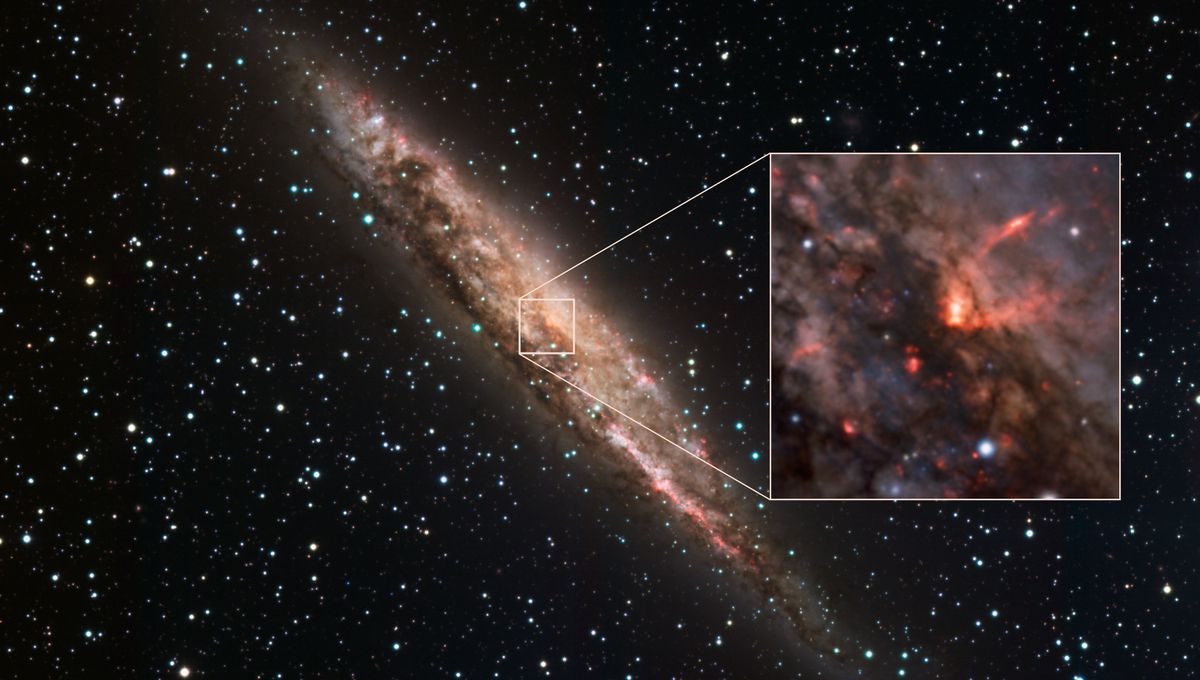
NGC 4945 is a well-known spiral galaxy, about 11 million light-years from us. It has an active supermassive black hole at its center, as well as a lot of new stars being born around it, a phenomenon known as a starburst. Among the many signals from the core of this galaxy, astronomers have found one that is both unique and perplexing. It does not match anything known.
The rest of this article is behind a paywall. Please sign in or subscribe to access the full content.
They are calling it Punctum, which is Latin for “dot,” and it was discovered using the Atacama Large Millimeter Array, ALMA. It is located less than 200 light-years from the supermassive black hole, and since in a handful of wavelengths, it emits 100 times more energy than a star like Sirius does across all wavelengths, it was definitely an object worth noticing.
“Outside of the realm of supermassive black holes, Punctum is genuinely powerful,” lead author Elena Shablovinskaia, from the Instituto de Estudios Astrofísicos at the Universidad Diego Portales, told Space.com.
“When you put it into context, Punctum is astonishingly bright — 10,000 to 100,000 times more luminous than typical magnetars, around 100 times brighter than microquasars, and 10 to 100 times brighter than nearly every known supernova, with only the Crab Nebula surpassing it among star-related sources in our galaxy.”
But the most curious aspect is the polarization of its light. Light is made of electromagnetic waves. The electric field and magnetic field in this wave oscillate at 90 degrees from each other. Staring down into this wave, you can imagine them oscillating as if they were moving on the segments of a plus sign or an X, or any orientation in between. Unpolarized light means that you can have pluses and Xs and all other rotations. But polarized light means that the light comes only in certain directions, as if it were made of all pluses.
Punctum has a polarization of around 50 percent. In the universe, there are certain objects that can produce such a polarization of light, often thanks to formidable magnetic fields. There are also objects that can produce the intense luminosity that Punctum possesses. The problem is that no object does both to this level.
A magnetar – a type of neutron star with incredible magnetic fields – would be the most obvious candidate, though they have much lower luminosity, especially in the light tracked by ALMA. Some supernova remnants can compete in terms of luminosity, as the Crab Nebula demonstrates, but they tend to have low polarization. There are magnetized strands of gas in galaxies (the so-called non-thermal filaments) that can produce this polarization, but they are much, much dimmer in millimeter light.
“Thus, Punctum cannot currently be associated with any known class of astrophysical source,” the authors wrote in the paper.
More observations will be needed to understand exactly what beast we are dealing with here, if it is something new or a new behavior from an established class of objects.
The study has been accepted for publication in Astronomy & Astrophysics, and is currently available on arXiv.

Source Link: Mysterious New Cosmic Source Is Up To 100 Times Brighter Than Almost All Supernova Remnants
