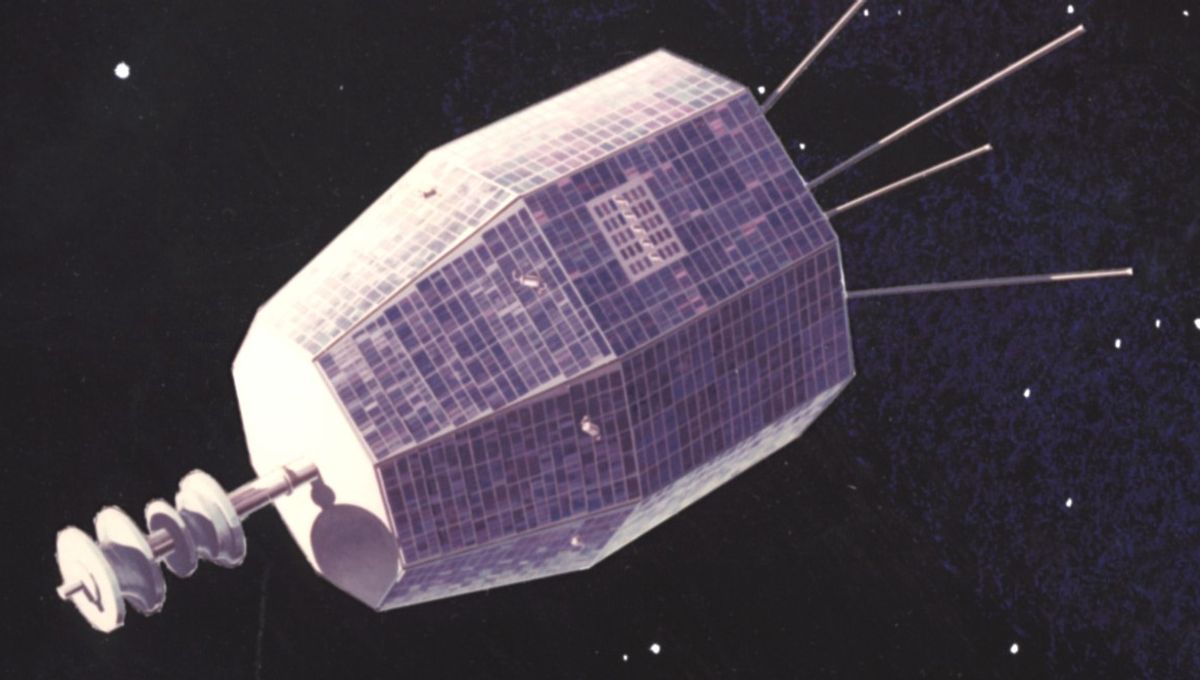
The dead speak! Humanity has heard a mysterious signal, but the origin is not a broadcast from Star Wars’ Emperor Palpatine – it is from another seemingly defunct object. The NASA Relay 2 satellite, which worked for several years in the 1960s, appears to have sent a radio pulse back to Earth. Is the satellite back to life? Scientists think that something else might be going on.
On June 13, 2024, researchers at the Australian Square Kilometre Array Pathfinder spotted a peculiar emission in the sky. It was less than 30 nanoseconds, and analysis showed that it did not come from deep space but from orbit. The location of the signal suggested that the source was an old and defunct NASA satellite, which was certainly unexpected.
Relay 1 and Relay 2 were experimental communication satellites funded by NASA. Relay 1, launched in 1962, was the first satellite to broadcast television from the United States to Japan and Europe, with the first transmission being the Kennedy Assassination. Relay 2 launched in 1964, but it operated for just a short time, ceasing operations in September 1965. Still, its transponders were functional until 1967, when it was no longer heard from.
It could be argued until now, but Clancy James at Curtin University in Australia and colleagues do not believe this is the case. Just like beauty, this event is skin-deep. One possibility is that the satellite accumulated electrostatic charge, and it finally released a discharge. These ESDs (electrostatic discharges) have previously been seen by the Arecibo telescope, but on longer timescales.
There is also another possible explanation. A micrometeoroid, like the one that stranded astronauts a few years back after hitting the Soyuz spacecraft, can release a cloud of plasma at impact. That could cause such a signal. If it is an ESD, studying it could help researchers protect spacecraft from these events. And while you can’t stop a micrometeoroid, measuring these events can help remove them from radio wave observations.
While it is not the case this time, there are multiple instances of zombie satellites, satellites that came back to life after years of inactivity. Sometimes, these devices lose their orbit or can’t power themselves up, or get to a point where the ground can no longer contact them. Then it’s usually clever people finding them, or occasionally, the satellites just say, “Guess what? I am back!”
Take, for example, Galaxy 15, a telecommunications satellite operated by Intelsat. It was launched in 2005, but in April 2010, it drifted out of its orbital slot and was lost. Well, the satellite knew where it was, and in December 2010, it rebooted itself. Intelsat was able to place it back into its original slot.
The record holder for zombie satellites is AMSAT-OSCAR 7, an amateur radio satellite launched in November 1974 and operated until 1981, when a battery failure ended the mission. Or so it seemed. On June 21, 2002, 21 years later, the satellite started communicating again.
A paper describing the new detection is accepted for publication in The Astrophysical Journal and is available to read on the ArXiv.
[H/T: New Scientist]

Source Link: Mysterious, Powerful Radio Pulse Traced Back To NASA Satellite That’s Been Dead Since 1967
