• Email Us: [email protected]
  • Contact Us: +1 718 874 1545
  • Skip to main content
  • Skip to primary sidebar

Medical Market Report

  • Home
  • All Reports
  • About Us
  • Contact Us

Mystery Of World’s Only Captive Brown And White Panda Solved With Genetics

March 5, 2024 by Deborah Bloomfield

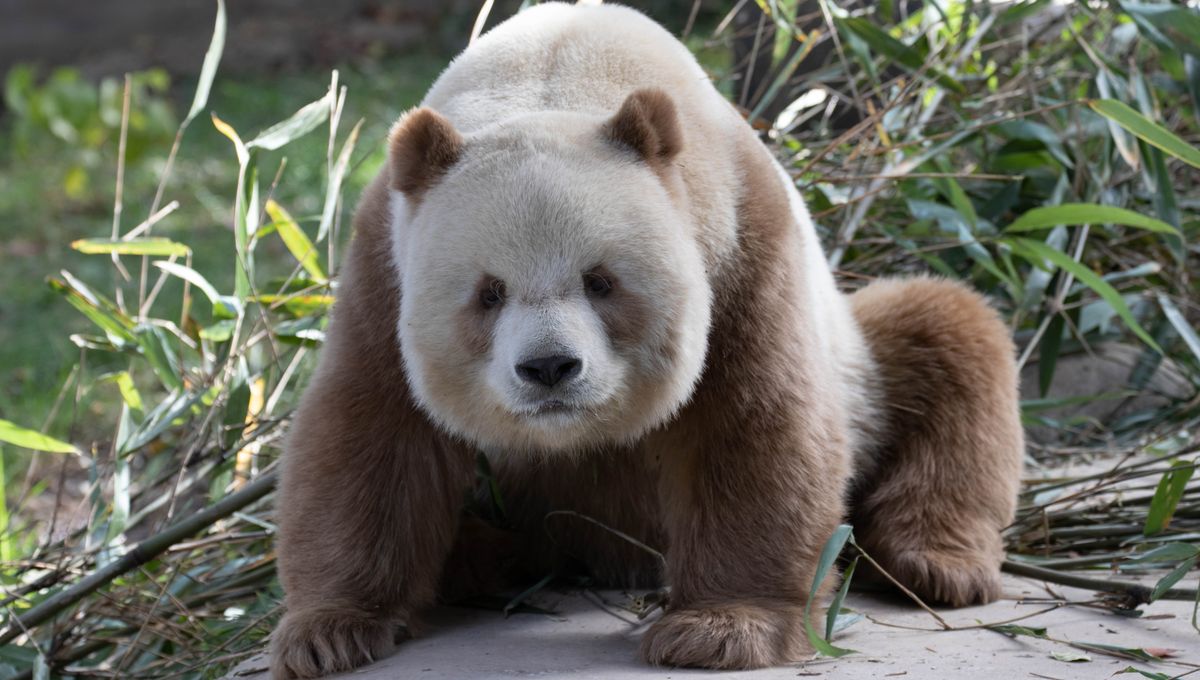
Meet Qizai: not only is he thoroughly friend-shaped, but he’s also quite the mystery man. The giant panda is one of just seven brown and white members of the species ever reported, and the only one in captivity. The reason for this unusual coloring had long eluded scientists – but with the help of genetics, the mystery now appears to be solved.

A team of researchers set out to determine whether any differences in the DNA of brown pandas could explain their unusual fur color. As part of this genetic detective work, they sequenced the genomes of 35 giant pandas; this included two brown pandas (one of whom was our boy Qizai), and the two family trios they belonged to, as well as regular black and white pandas.

Advertisement

In comparing the resulting sequences, the team identified what they believe to be the gene involved: Bace2. This gene encodes an enzyme that’s involved in chopping up amyloid precursor protein, a molecule perhaps best known for its role in Alzheimer’s disease.

The brown pandas were found to have two identical copies of a particular variant of Bace2, both missing 25 base pairs (the building blocks of DNA, often simply represented by letters), suggesting it could play a role in their fur color.

The researchers didn’t stop there though. In search of validation for their findings, they also sequenced the DNA of another 192 black and white pandas, with the analysis revealing that none had two copies of that same variation in Bace2. When they further created mice with the mutation, using a method called CRISPR-Cas9, the resulting mice had light fur. 

But how does this mutation lead to brown pandas like Qizai?

Advertisement

“Our investigation revealed that this mutation reduced the number and size of melanosomes of the hairs in knockout mice and possibly in the brown panda, further leading to the hypopigmentation,” the researchers write in their paper.

Melanosomes are specialized structures within cells – the fancy term being organelles – responsible for the production and storage of melanin, a type of pigment that can determine the color of skin and hair or fur. 

Thus, a mutation in Bace2 might affect melanosomes in pandas, and consequently give them brown and white fur instead of black and white. The next step for the researchers is to investigate this theory and figure out how it might work – Qizai is still keeping some cards close to his chest.

That being said, the current research is a pretty big first step in solving the puzzle of these rare pandas. Qizai the brown panda might have lost a bit of his mystery, but he’s definitely clawed something back in scientific progress.

Advertisement

The study is published in the journal PNAS.

Deborah Bloomfield
Deborah Bloomfield

Related posts:

  1. Paris ramps up security as jihadist attacks trial starts
  2. Cricket-‘Western bloc’ has let Pakistan down, board chief says
  3. Ancient Bison Found In Permafrost Is So Well Preserved Scientists Want To Clone It
  4. Where Inside Us Do We Feel Love?

Source Link: Mystery Of World’s Only Captive Brown And White Panda Solved With Genetics

Filed Under: News

Primary Sidebar

  • An Extremely Rare And Beautiful “Meat-Eating” Plant Has Been Found Miles From Its Known Home
  • Scheerer Phenomenon: Those White Structures You See When You Look At The Sky May Not Be “Floaters”
  • The Science Of Magic At CURIOUS Live: Psychologist Dr Gustav Kuhn On Using Magic To Study The Human Mind
  • Around 5 Percent Of Cancers Are Of “Unknown Primary”. Could A New Blood Test Track Them Down?
  • With Only 5 Years Left In Space, The International Space Station Just Hit A New Milestone
  • 7,000-Year-Old Atacama Mummies May Have Been Created As “Art Therapy”
  • In 1985, A Newborn Underwent Heart Surgery Without Pain Relief Because Doctors Didn’t Think Babies Could Feel Pain
  • Ancient Roman Military Officers Had Pet Monkeys, And The Pet Monkeys Had Pet Piglets
  • Lasting 29 Hours, The World’s Longest Commercial Scheduled Flight Is Set To Take Off This Week
  • What Is Christougenniatikophobia, And What Do I Do About It?
  • Sun’s Ancient Encounter With Two Hot Stars Left A Legacy In The Solar System’s Neighborhood
  • Defiant Stars And Unusual Objects Survive Against The Milky Way’s Supermassive Black Hole
  • A Wobbling Brown Dwarf Might Be A Sign Of The First Discovered “Exomoon” – A Moon Outside The Solar System
  • “Happy Molecule” Precursor Discovered In Extraterrestrial Material For The First Time
  • Why Do Seals Slap Their Belly?
  • Interstellar Comet 3I/ATLAS Appears To Be Experiencing “Cryovolcanism”, And Is Eerily Similar To Objects In The Outer Solar System
  • Catch The Last Supermoon Of The Year This Week
  • Why Does It Feel Like You’re Dropping Around 30 Seconds After A Plane Takes Off?
  • We Finally Understand Why We “Feel” It When We See Someone Get Hurt
  • The First Map Of America: Juan De La Cosa’s Strange Map Was Missing Until 1832
  • Business
  • Health
  • News
  • Science
  • Technology
  • +1 718 874 1545
  • +91 78878 22626
  • [email protected]
Office Address
Prudour Pvt. Ltd. 420 Lexington Avenue Suite 300 New York City, NY 10170.

Powered by Prudour Network

Copyrights © 2025 · Medical Market Report. All Rights Reserved.

Go to mobile version