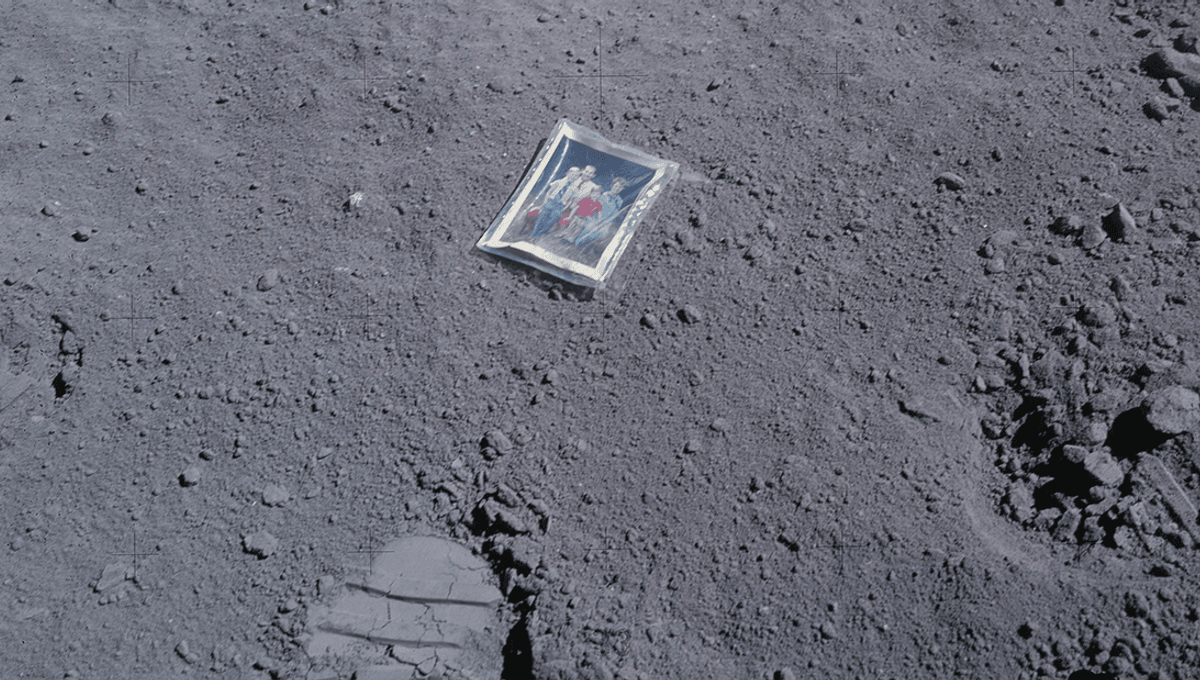
On April 23, 1972, Apollo 16’s Lunar Module and its crew of two NASA astronauts – John W. Young and Charles M. Duke – left the Moon’s surface to reconnect with the Command Module before returning to Earth. While they were 95 kilograms (209 pounds) of lunar rock heavier due to their scientific activities, Duke left behind a few objects on the Moon’s surface, and a message for whoever might come across them in the future.
While no means as bad as the problems with Apollo 13, Apollo 16’s journey to the Moon was far from uneventful. As the Command Module – designed to stay in orbit as the lander made its way down to the surface – separated from the lander, one of its engines malfunctioned.
The engine, you’ll perhaps be unsurprised to read, was pretty vital to the mission. Without it, Command Module pilot Ken Mattingly would be unable to keep the precise orbit above the Moon needed in order to collect Young and Duke following their time on the surface.
The crew was ordered by NASA to delay any attempt to land on the Moon, instead keeping close to each other as Mattingly attempted to fix the problem. Two years after the events of Apollo 13, they were keen not to have a similar disaster on their hands, though the crew was not believed to be in imminent danger. While out of radio contact, on the far side of the Moon, Mattingly was able to fire up the engine and enter the correct orbit above the lunar surface.
This left Young and Duke able to make their way down to set foot on the Moon, though one of their three planned excursions had to be canceled due to the unexpected delay, as well as the Moon Olympics.
“Due to lack of time, Young and Duke decided not to perform the Descartes Olympics – in tribute to 1972 being an Olympic year – a planned set of activities to demonstrate sports such as high jumps and long jumps in the low lunar gravity,” NASA explains.
However, they did have themselves a few informal Moon Olympic events, which nearly ended in disaster for Duke during the high jump.
“I decided to join in and made a big push off the moon, getting about four feet [1.2 meters] high,” Young explained in his book years later. “But as I straightened up, the weight of my backpack pulled me over backward. Now I was coming down on my back. I tried to correct myself but couldn’t, and as my heart filled with fear I fell the four feet [1.2 meters], hitting hard – right on my backpack.”
“Panic!” he continued. “The thought that I’d die raced across my mind. It was the only time in our whole lunar stay that I had a real moment of panic and thought I had killed myself. The suit and backpack weren’t designed to support a four-foot [1.2-meter] fall.
“Had the backpack broken or the suit split open, I would have lost my air. A rapid decompression, or as one friend calls it, a high-altitude hiss-out, and I would have been dead instantly! Fortunately, everything held together.”
Other than an engine malfunction and nearly dying like a space tortoise, the trip was a resounding success. Before the two returned to the Command Module and then the safety of the Earth’s atmosphere, the Lunar Module pilot left a few belongings on the Moon’s surface.
“Duke left a photo of his family, a piece of beta cloth with ’64-C’ written on it to commemorate his U.S. Air Force Aerospace Research Pilot School class, and a medallion commemorating the 25th anniversary of the founding of the U.S. Air Force,” NASA explains.
“This is the family of astronaut Charlie Duke from planet Earth who landed on the moon on April 20, 1972,” Duke wrote on the back of the family photograph.
The reason he took it to the Moon is, as you might expect of a family portrait, pretty sweet.
“Just to get the kids excited about what dad was going to do, I said ‘Would y’all like to go to the moon with me?'” Duke told Business Insider in 2015. “We can take a picture of the family and so the whole family can go to the moon.”
“I’d always planned to leave it on the moon,” he added. “So when I dropped it, it was just to show the kids that I really did leave it on the moon.”
It, like many flags and Neil Armstrong’s Moon poop, remains there to this day.

Source Link: NASA Astronaut Charles Duke Left A Touching Photograph And Message On The Moon In 1972
