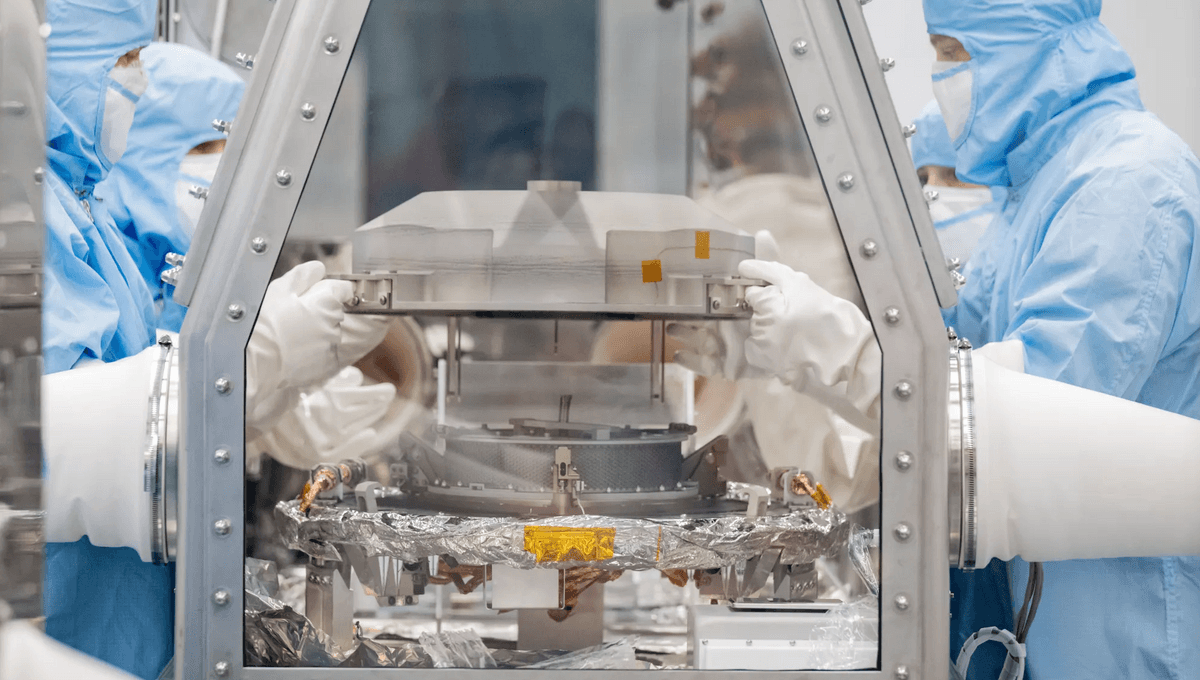
OSIRIS-REx dropped its priceless cargo – samples from asteroid Bennu – down to Earth a few weeks ago. The canister containing the material will be opened today in a livestream from NASA’s Johnson Space Center, where the precious material will be unveiled to the world. Obviously, the asteroid bits will be opened in a specially designed glovebox so that the Earth’s atmosphere does not contaminate the sample at all.
Showtime is 11 am EDT (4 pm BST) on Wednesday, October 11. This is the first asteroid sample collected by NASA. The capsule traveled for seven years and billions of kilometers to get in orbit around Bennu and back, and it has brought roughly 250 grams of pristine material from the space rock. This is the largest collection of cosmic material from beyond the Moon.
It’s not just what’s inside the Touch-and-Go Sample Acquisition Mechanism (TAGSAM). The TAGSAM is the instrument used to collect the material from Bennu’s surface and it requires a very intricate disassembly. It was designed with complexity and with a labyrinthine structure to avoid possible contamination with Earth. And this paid off twice.
The sample has remained protected and researchers ended up with the best possible problem during the last few weeks as they were taking it apart. They found asteroid material everywhere from the lid of the sample return capsule to the inside structure. It’s always good to have more.
“The very best ‘problem’ to have is that there is so much material, it’s taking longer than we expected to collect it,” deputy OSIRIS-REx curation lead Christopher Snead said in a statement. “There’s a lot of abundant material outside the TAGSAM head that’s interesting in its own right. It’s really spectacular to have all that material there.”
The opening of the TAGSAM will be the focus of the livestream and the whole procedure is designed to keep what is inside the canister as isolated as possible. The whole process, from the collection of the capsule in the Utah desert to the distribution of the sample to scientists, has been rehearsed many times over the last few months.
After today, the sample from Bennu will begin to be distributed to scientific teams. About 75 percent will be stored for future analysis. This is standard procedure. When Hayabusa2 brought back a sample of asteroid Ryugu in 2020, about 60 percent was put in storage.
Some of the Bennu material will be stored at the Johnson Space Center but part of it will be sent elsewhere, just in case something were to happen to the facility. And obviously, some of the samples will be out for analysis across the world, so researchers have to decide and rehearse how to transport the precious material.
“We’re going to hand carry them. So either me or a colleague will go over and collect them from the Johnson Space Center,” Professor Sara Russell, part of the OSIRIS-REx Sample Analysis Team from the Natural History Museum, London, told IFLScience. “But the Johnson Space Center is also happy to send them by courier as well. Actually, we had to rehearse this. Everything in this mission is so well rehearsed.”
The opening of the sample will be streamed on NASA TV, the NASA app, and the agency’s website.

Source Link: NASA Is Opening The OSIRIS-REx Cannister Live Today. Here’s How To Watch
