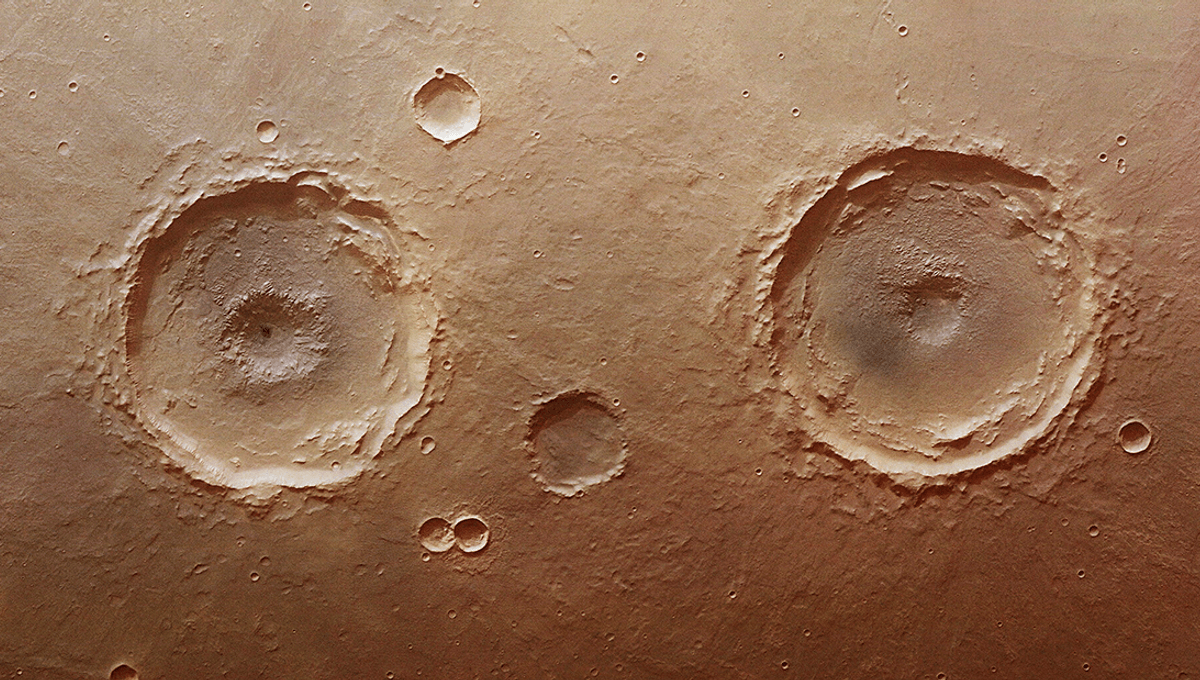
A team of researchers looking at seismic data from NASA’s InSight lander has found that around 280 to 360 objects that cause craters over 8 meters (26 feet) in diameter impact Mars every year.
Exoplanet scientists use meteoroid impact data from Mars and other planets to estimate the age of other bodies in the Solar System, the reasoning being that older bodies will have more impact craters than younger ones. Of course, you have to take into account factors such as the size of the object, its orbit, and the effect its atmosphere (should it be lucky enough to have a sizeable one) has on bodies entering it. But generally speaking, the more impacts you see, the older the moon or planet be.
“The current Martian cratering rate of craters <60>
Because satellite images are not high resolution enough, the rate of impacts of meteoroid impacts of smaller objects is more uncertain. The team attempted to refine estimates by looking at seismic data collected by an instrument deployed during NASA’s InSight mission.
While operational on the planet, the seismometer recorded a number of very high frequency (VF) marsquakes. Though the team could not rule out alternative causes for each recorded VF event, they determined that the events as a whole were likely the result of meteoroid impacts in the local area. Determining the size of the impact by looking at its seismic data, and then scaling the impacts in terms of area and time, they estimated that 280 to 360 craters over 8 meters (26 feet) in diameter are formed on the planet every year.
“This rate was about five times higher than the number estimated from orbital imagery alone,” Géraldine Zenhäusern, Professor of Seismology and Geodynamics at ETH Zürich and co-author on the paper, said in a statement. “Aligned with orbital imagery, our findings demonstrate that seismology is an excellent tool for measuring impact rates.”
Using this method could help us better estimate a solar system body’s age. Send a probe with a seismometer to the planet or moon, allow it to collect data on impacts, and then you could use this data and satellite data to get a better idea of its age. Of course, a lot more can be learned by deploying seismometers on the surface of alien worlds.
“To understand the inner structure of planets, we use seismology. This is because as seismic waves travel through or reflect off material in planets’ crust, mantle, and core, they change. By studying these changes, seismologists can determine what these layers are made of and how deep they are,” co-first author Dr Natalia Wojcicka, Research Associate at Imperial College London’s Department of Earth Science and Engineering explained in a second statement.
“On Earth, you can more easily understand the inner structure of our planet by looking at data from seismometers placed all around the globe. However, on Mars there has been only one – SEIS. To better understand Mars’ inner structure, we need more seismometers distributed across the planet.”
The study is published in the journal Nature Astronomy.

Source Link: NASA Lander's Seismic Data Reveals How Many Meteorites Impact Mars Per Year
