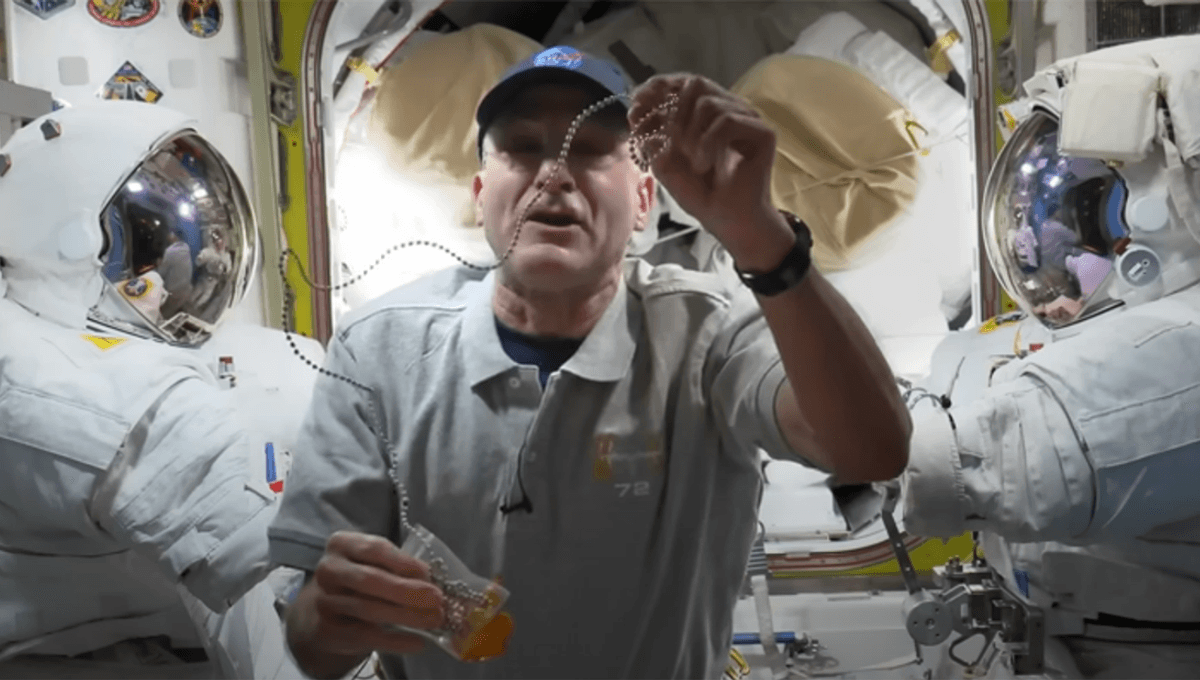
NASA astronaut Don Pettit has helped YouTuber Steve Mould with the final step in his “weird chain theory”: testing the idea in space.
In 2013, YouTuber and science communicator Steve Mould brought the “chain fountain”, an unsolved problem in physics, to the attention of the wider public. The effect, sometimes referred to as the “Mould effect” for his work on it, is strange to see. Simply put, place a long chain in a container, pull one end out, and let it fall to the floor. Now watch as the whole chain seems to jump up out of the glass, before falling towards the floor.
The effect, though independently found by Mould, was known about before, even if it was unexplained. Since the effect was popularized by Mould, he, Mehdi Sadaghdar of YouTube channel ElectroBOOM, and several academic studies have attempted to explain it. Mould has also set the record for the biggest chain fountain.
What is really puzzling about the effect is how the chain appears to rise out of the glass before starting its downward journey.
“Motivated by the fact that the chain has a maximum local curvature, and the fact that the phenomenon does not happen with a chain that does not have this maximum bending curvature, the chain was modelled as a sequence of freely joined rods,” a 2016 paper on the topic explains.
“When a rod is pulled from one end, the end attached to the part of the chain that is already moving, the rod tends to rotate around its center of mass; consequently, the other end will go down, towards the surface of beads, kicking the pile of beads. Finally, there is a reaction force to this kick that pushes the beads upwards.”
Mould’s explanation (see above for the full explanation, and an awesome chain fountain) is generally thought to be correct, after a long (and friendly) argument and experiments against ElectroBOOM (and further analysis by others).
“In short, the chain rises above the pot in a fountain because of an extra upward force coming from the pot,” Mould explains in his latest video, partly shot in space. “How strong does that force need to be, though? Well, it needs to be able to overcome the weight of this arc of chain that would obviously fall under gravity. And that’s it. That’s all you need.”
Unfortunately, in order to test his idea, Mould needed gravity to disappear. This is where NASA astronaut Don Pettit came in. Pettit, who had been intrigued by Mould’s videos, offered to test the behavior of chains on the International Space Station (ISS).
“According to the maths, that yanking of the chain has no influence on the ark at all. If gravity wasn’t a factor, the ark would be fixed there in space even though it was being yanked downwards at one end. Or at least that’s the theory,” Mould explained. “That’s what we want to test. We want to test the theory that a chain moving at constant speed will flow through its own shape so long as it isn’t acted on by an external force like gravity.”
In a phone call with Mould, Pettit attempted to tug on the chain and test whether the chain truly did flow through its own shape, supporting Mould’s idea, or whether it did something else. Unfortunately, it’s pretty difficult to get a chain to remain stationary in microgravity, with Pettit describing them as moving around like molecules.
Mould suggested that instead they put a chain into a loop, and stretch it out to make a rectangular shape. Then Pettit could grab the longer sides of the rectangle-ish chain and set them in motion, pushing the top one right and the bottom left, for example. If he was correct, the chain should flow through that rectangle shape, rather than spread out into a circle as you might expect.
The setup was not ideal, and the two were limited by the ISS passing out of reach of communication satellites. However, before the informal experiment ended, they did appear to set chains in motion that followed their own shape, seemingly adding evidence to Mould’s explanation for the effect.
“It was a great demonstration seeing it pass through the same path through the loop and your explanation about why it would eventually turn into a full circle due to friction was pretty adequate,” Sadaghdar said, adding that he wouldn’t have to embarrass himself by making another debunk video.
“Although you didn’t quite demonstrate if the path will remain the same if the chain wasn’t in a loop. Another simulation might be nice, but what would be better is to take 100m of chain into space and drag it behind you in a spacewalk. Do it.”

Source Link: NASA Lets YouTuber Steve Mould Test His "Weird Chain Theory" In Space
