• Email Us: [email protected]
  • Contact Us: +1 718 874 1545
  • Skip to main content
  • Skip to primary sidebar

Medical Market Report

  • Home
  • All Reports
  • About Us
  • Contact Us

NASA Shot Laser At Japanese Lunar Lander From Orbit In Major Test

August 1, 2024 by Deborah Bloomfield

There is no GPS on the Moon – so to find where things land and go, we have to rely on orbital observations. To make this work easier, NASA has developed an ingenious object that doesn’t require power to make its presence known: You put it on top of your lander and you are ready to be found, then you wait for NASA’s Lunar Reconnaissance Orbiter (LRO) to shoot a laser at you. It worked for the Vikram rover, and has now worked for Smart Lander for Investigating Moon (SLIM) too.

Advertisement

SLIM is a Japanese Aerospace Exploration Agency lander, and Vikram is a mission from the Indian Space Research Organisation. With these landers, the Asian nations became the fourth and fifth countries to land on the Moon. NASA Laser Retroreflector Arrays have hitched a ride on both of them so they can be tested out.

The device on SLIM is the size of a cookie, 5 centimeters (2 inches) across. It has eight quartz corner-cube prisms set into a dome-shaped aluminum frame. Thanks to those, it can reflect light coming from multiple directions. LRO can use its laser altimeter to hit it and record the light that bounces back.

“LRO’s altimeter wasn’t built for this type of application, so the chances of pinpointing a tiny retroreflector on the Moon’s surface are already low,” Xiaoli Sun, who led the team that built SLIM’s retroreflector at NASA’s Goddard Space Flight Center as part of a partnership between NASA and JAXA, said in a statement.

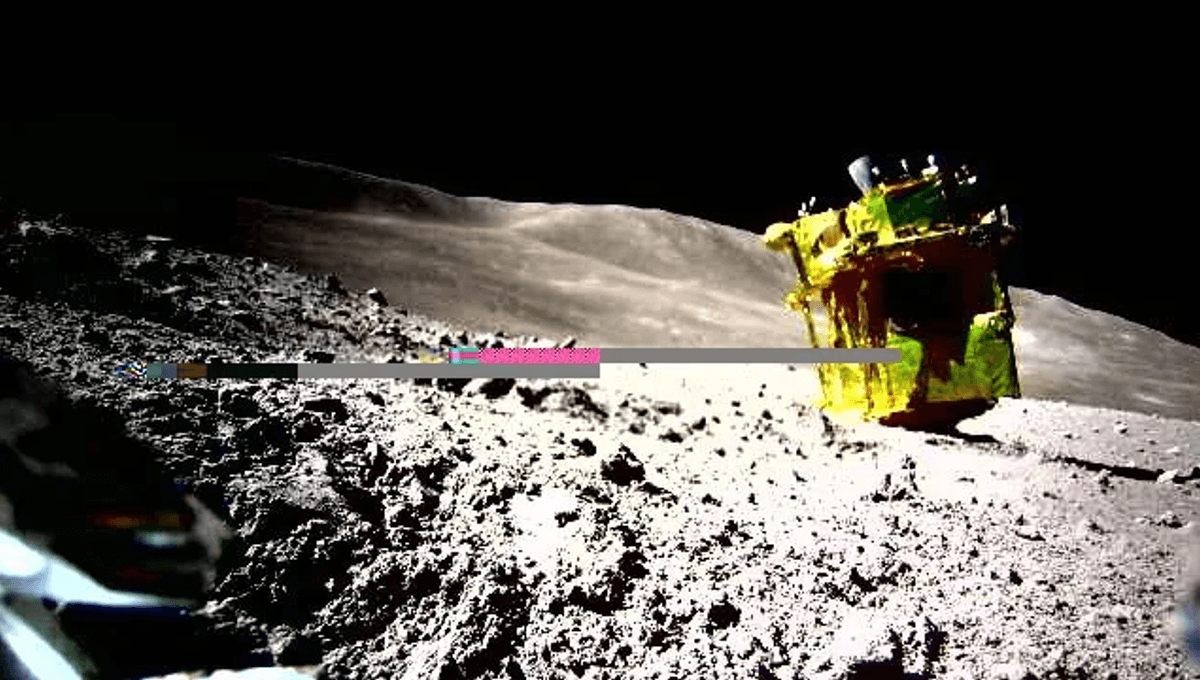
But there was a complication: SLIM landed on its side, so it wasn’t easy to actually get a ping from the retroreflector. The first eight attempts led to nothing. It was only the ninth and tenth attempts that resulted in a signal back. It took multiple attempts for Vikram as well, but there, the team didn’t have to make sure they knew exactly where the location of the lander was. To confirm the signal was from SLIM, that was necessary.

Still, it shows that the system works – even in unexpected conditions. A future system of positioning involving the retroreflectors would have an orbital partner actually designed to do such a job. LRO’s altimeter is not bespoke. So the fact that the system works even at an angle is great.  

Advertisement

“For the LRO team to have reached a retroreflector that faces sideways, instead of the sky, shows that these little devices are incredibly resilient,” Sun added.

The system could be used in future crewed and uncrewed missions to land closer to other spacecraft or objects already on the surface of the Moon.

Deborah Bloomfield
Deborah Bloomfield

Related posts:

  1. Sendoso nabs $100M as its corporate gifting platform passes 20,000 customers
  2. Caterpillar-Like Bacteria Can Cling To Your Mouth Thanks To Clever Evolution Trick
  3. Bright Yellow Daffodils Are Super Easy To Grow In Your Garden
  4. Do US Communities Have Distinct Personality Types?

Source Link: NASA Shot Laser At Japanese Lunar Lander From Orbit In Major Test

Filed Under: News

Primary Sidebar

  • Meet The Psychedelic Earth Tiger, A Funky Addition To “10 Species To Watch” In 2026
  • The Weird Mystery Of The “Einstein Desert” In The Hunt For Rogue Planets
  • NASA Astronaut Charles Duke Left A Touching Photograph And Message On The Moon In 1972
  • How Multilingual Are You? This New Language Calculator Lets You Find Out In A Minute
  • Europa’s Seabed Might Be Too Quiet For Life: “The Energy Just Doesn’t Seem To Be There”
  • Amoebae: The Microscopic Health Threat Lurking In Our Water Supplies. Are We Taking Them Seriously?
  • The Last Dogs In Antarctica Were Kicked Out In April 1994 By An International Treaty
  • Interstellar Comet 3I/ATLAS Snapped By NASA’s Europa Mission: “We’re Still Scratching Our Heads About Some Of The Things We’re Seeing”
  • New Record For Longest-Ever Observation Of One Of The Most Active Solar Regions In 20 Years
  • Large Igneous Provinces: The Volcanic Eruptions That Make Yellowstone Look Like A Hiccup
  • Why Tokyo Is No Longer The World’s Most Populous City, According To The UN
  • A Conspiracy Theory Mindset Can Be Predicted By These Two Psychological Traits
  • Trump Administration Immediately Stops Construction Of Offshore Wind Farms, Citing “National Security Risks”
  • Wyoming’s “Mummy Zone” Has More Surprises In Store, Say Scientists – Why Is It Such A Hotspot For Mummified Dinosaurs?
  • NASA’s Hubble Space Telescope Observations Resolve “One Of The Biggest Mysteries” About Betelgeuse
  • Major Revamp Of US Childhood Vaccine Schedule Under RFK Jr.’s Leadership: Here’s What To Know
  • 20 Delightfully Strange New Deep Reef Species Discovered In “Underwater Hotels”
  • For First Time, The Mass And Distance Of A Solitary “Rogue” Planet Has Been Measured
  • For First Time, Three Radio-Emitting Supermassive Black Holes Seen Merging Into One
  • Why People Still Eat Bacteria Taken From The Poop Of A First World War Soldier
  • Business
  • Health
  • News
  • Science
  • Technology
  • +1 718 874 1545
  • +91 78878 22626
  • [email protected]
Office Address
Prudour Pvt. Ltd. 420 Lexington Avenue Suite 300 New York City, NY 10170.

Powered by Prudour Network

Copyrights © 2026 · Medical Market Report. All Rights Reserved.

Go to mobile version