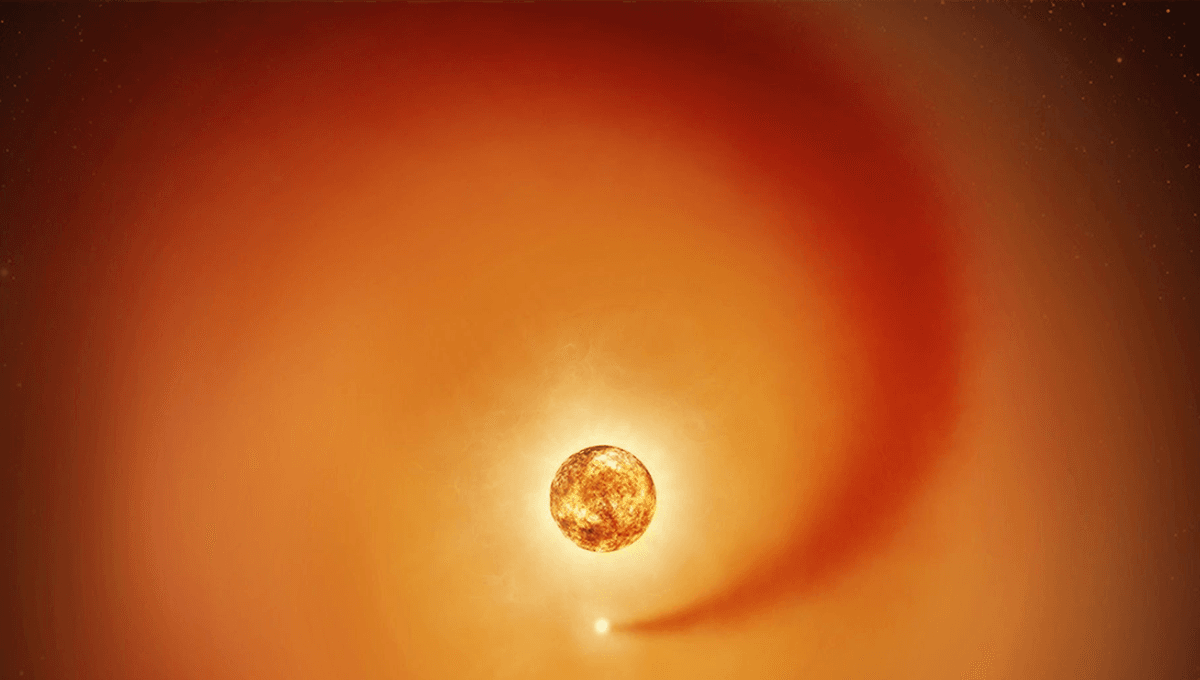
When Betelgeuse finally collapses, the star – currently a red supergiant – will likely shine as brightly as the Moon in the sky for about two weeks, and be visible during the daytime for 6-12 months after that.
It will be a spectacular event, but calculating when it will happen is a tricky business. Every now and then, in recent observations, Betelgeuse has grown dimmer or brightened, prompting speculation that the star may end up going supernova in a very short amount of time, measured in short human decades rather than astronomical timetables.
It’s still unclear when the star will undergo collapse into a supernova, and muddying the picture somewhat is that stars like Betelgeuse constantly expel dust and gas, which can obscure our observations and make it appear as though the star is dimming or getting brighter. To make it even more complicated, in 2024 and 2025, two independent teams concluded that a periodic dimming of the star once every ~2100 days was likely the result of a companion star, orbiting within Betelgeuse’s atmosphere, dubbed Siwarha.
“The name Betelgeuse means ‘Hand of al-Jawzā’,’ with ‘al-jawzā’’ being the name of an old Arabian female figure whose stars were largely consistent with Greek Orion,” the International Astronomical Union explains. “Given that alpha Ori A orbits the hand of al-Jawzā’, the discovery team suggested that the companion star be named سوارها (Siwarha), or ‘Her Bracelet’.”
Red giants like Betelgeuse have been found to have “long secondary periods“, or variations in brightness over long time periods. Long secondary periods have been put down to several causes, with the most favored hypothesis being that they are caused by companion stars. Based on observations of Betelgeuse, the teams proposed that it may actually be part of a binary system, explaining the “great dimming” event of 2019/2020.
In a new preprint study using observations from NASA’s Hubble Space Telescope and ground-based telescopes at the Fred Lawrence Whipple Observatory and Roque de Los Muchachos Observatory, which tracked changes in Betelgeuse’s light over eight years, a new team believes they have detected the wake of Siwarha as it moves through Betelgeuse’s atmosphere.
“It’s a bit like a boat moving through water. The companion star creates a ripple effect in Betelgeuse’s atmosphere that we can actually see in the data,” Andrea Dupree, an astronomer at the Center for Astrophysics | Harvard & Smithsonian, and the lead study author, explained in a statement. “For the first time, we’re seeing direct signs of this wake, or trail of gas, confirming that Betelgeuse really does have a hidden companion shaping its appearance and behavior.”
Until now, scientists have suspected that Betelgeuse had a companion, but these observations provide much more evidence for it. According to the statement, the work “resolves one of the biggest mysteries about the giant star”, explaining its dimming behavior every 2100ish Earth days.
“The idea that Betelgeuse had an undetected companion has been gaining in popularity for the past several years, but without direct evidence, it was an unproven theory,” Dupree added. “With this new direct evidence, Betelgeuse gives us a front-row seat to watch how a giant star changes over time. Finding the wake from its companion means we can now understand how stars like this evolve, shed material, and eventually explode as supernovae.”
Tracking the gas and dust in Betelgeuse’s atmosphere, and its direction and speed, the team concluded that the 2100-day variation was due to a transit of the companion star across Betelgeuse’s disk.
“The companion would gravitationally focus surrounding wind into its vicinity, forming a trailing wake, whose primary orientation would be along the direction of the orbital path,” the team explains in their paper. “Within this wake, denser, shocked gas would be swept up and accumulate behind the passing shockwave. We should expect this wake to be quite variable because of the multi-temperature turbulent gas it exists in, and because the turbulent velocity is larger than the mean sound-speed and a large fraction of the orbital speed.”
“The wake expands laterally at the sound speed, ∼6 km s-1,” the team adds. “Thus while it is small during transit of the companion across Betelgeuse’s disk, it widens and covers a larger fraction of the disk as the orbit progresses.”
Currently, the companion star is obscured by Betelgeuse’s disk, but astronomers are planning further observations when Siwarha emerges in August 2027.
The study is posted to the preprint server arXiv and has been accepted for publication in The Astrophysical Journal.

Source Link: NASA's Hubble Space Telescope Observations Resolve "One Of The Biggest Mysteries" About Betelgeuse
