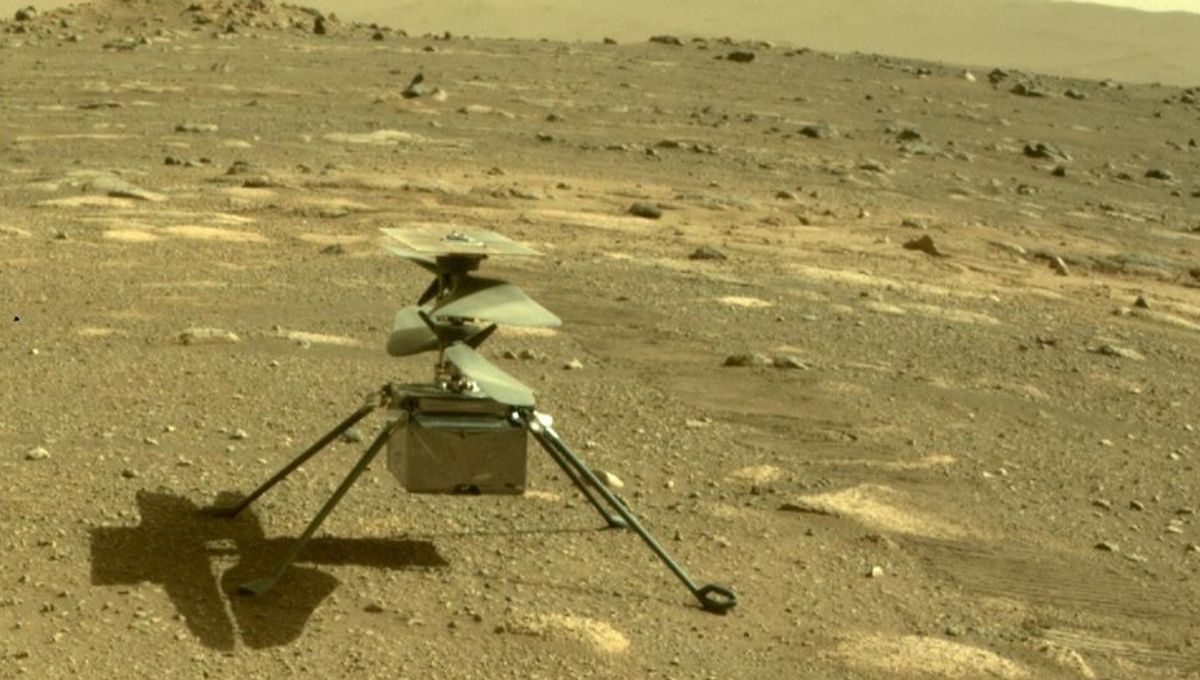
The designs for future Mars helicopters are currently being tested, and for the first time, researchers are using tests on two worlds to design the necessary improvements for the next generation of flying explorers. On Earth, new blade materials are being rotated to close to the speed of sound. And on Mars, Ingenuity is going faster and further than ever thought possible.
Let’s start on the Red Planet. NASA’s Ingenuity continues to be amazing, doing more than what the mission team had originally planned for it. Ingenuity was supposed to fly five times over the course of one month. It has now flown 66 times for 32 extra months.
On flight 61, Ingenuity reached its highest altitude yet at 24 meters (78.7 feet). On flight 62, it set a new speed record of 10 meters per second (22.4 miles per hour). It has also been testing a slower landing speed, 25 percent below the original design plan. And while doing all this, it was also helping the Perseverance rover by finding interesting science spots.
“Over the past nine months, we have doubled our max airspeed and altitude, increased our rate of vertical and horizontal acceleration, and even learned to land slower,” said Travis Brown, Ingenuity’s chief engineer at JPL, in a statement. “The envelope expansion provides invaluable data that can be used by mission designers for future Mars helicopters.”
Every bit of data from Ingenuity is a goldmine for the designers of the next-gen Mars helicopter. Currently, they are testing longer and stronger blades. These have a different design that should enable bigger and more capable Martian helicopters. However, they can also spin so fast that the tip of the blade approaches supersonic speeds, causing potentially dangerous vibration – hence the extensive testing.
“We spun our blades up to 3,500 rpm, which is 750 revolutions per minute faster than the Ingenuity blades have gone,” explained Tyler Del Sesto, Sample Recovery Helicopter deputy test conductor at JPL. “These more efficient blades are now more than a hypothetical exercise. They are ready to fly.”
The Sample Return Helicopter is designed to pick up the canisters collected by Perseverance and bring them back to a rocket that will carry them back to Earth. There are some major troubles for this mission, and some doubts about its future, but flying vehicles on other worlds has so much potential that this work can go beyond a single project.
“Our next-generation Mars helicopter testing has literally had the best of both worlds,” said Teddy Tzanetos, Ingenuity’s project manager and manager for the Mars Sample Recovery Helicopters. “Here on Earth, you have all the instrumentation and hands-on immediacy you could hope for while testing new aircraft components. On Mars, you have the real off-world conditions you could never truly re-create here on Earth.”

Source Link: NASA’s Next Martian Explorer Is First-Ever To Be Tested On Two Different Worlds
