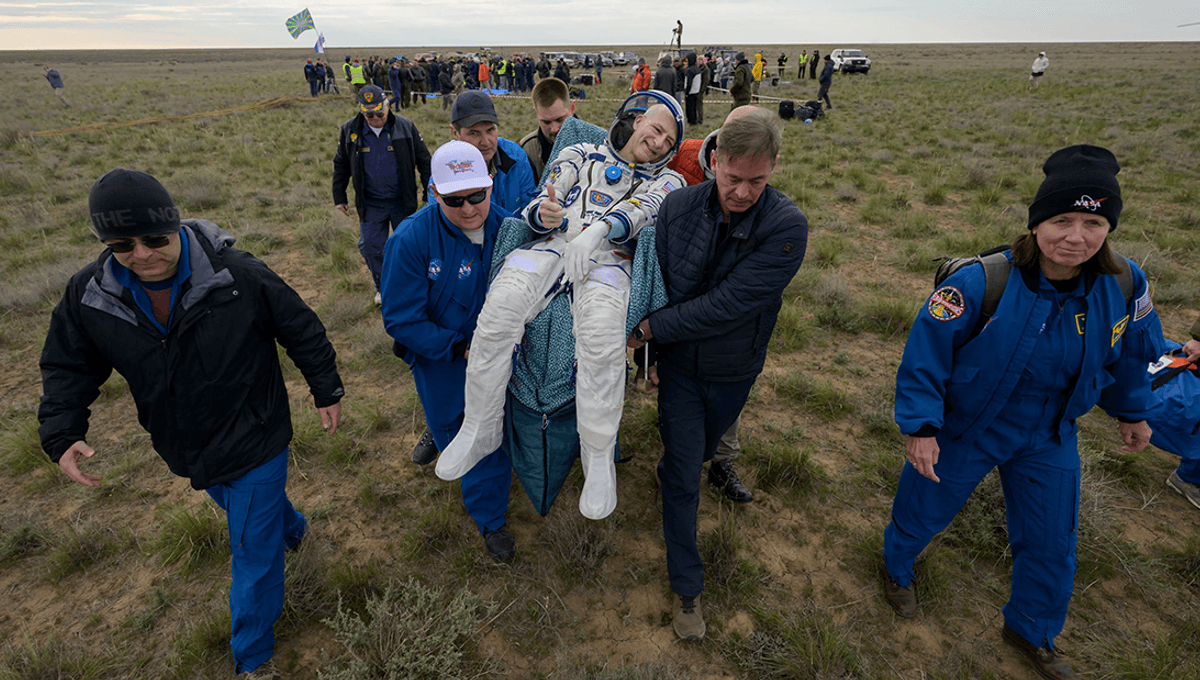
NASA astronaut and keen astrophotographer Don Pettit returned to Earth on his 70th birthday on Sunday, April 21, completing a 220-day stint on the International Space Station (ISS). While on board, he and Roscosmos cosmonauts Alexey Ovchinin and Ivan Vagner orbited the Earth 3,520 times, traveling 150.2 million kilometers (93.3 million miles) since they docked with the space station in September 2024.
“During his time aboard the space station, Pettit conducted research to enhance in-orbit metal 3D printing capabilities, advance water sanitization technologies, explore plant growth under varying water conditions, and investigate fire behavior in microgravity, all contributing to future space missions,” NASA said of Pettit completing his mission. “He also used his surroundings aboard the station to conduct unique experiments in his spare time and captivate the public with his photography.”
Unsurprisingly, the media has focused on Pettit’s age, as the astronaut turned 70 on the very day he returned to Earth. At this age, he is NASA’s oldest living astronaut. However, he is not the oldest NASA astronaut ever. That title goes to John Glenn, one of the original seven Mercury astronauts who spent nearly nine days on Discovery, aged 77.
If you include people who have been to space as astronauts, the oldest astronaut would be Star Trek actor William Shatner, who flew above the Kármán line on board Blue Origin’s first crewed flight in 2021.
Is there an age limit for becoming an astronaut?
Most working astronauts are well below the age of 70, but older astronauts are not ruled out by NASA.
“There are no age restrictions,” NASA explains in a myth-busting piece. “Astronaut candidates selected in the past have ranged between the ages of 26 and 46, with the average age being 34.”
While NASA is mainly interested in your qualifications, candidates do have to pass a long-duration flight astronaut physical, which may be more difficult with age-related health complications.
The European Space Agency (ESA), meanwhile, has a stricter age cutoff point for selecting new astronauts.
“The role of astronaut is physically and mentally demanding. To ensure each recruited astronaut can fulfil at least two missions during their employment with ESA prior to retirement, ESA is obliged to set a maximum age limit of 50 years,” ESA explains. “This means that applications from anybody older than 50 at the time of applying cannot be taken further in the selection process.”
Though China is less open about its taikonaut selection process, reports claim that candidates in China must be aged between 25 and 30 for initial training. Roscosmos, Russia’s space agency, has previously set cosmonaut limits of 35.
Now on the ground, landing in Karaganda, Kazakhstan, NASA’s oldest living astronaut underwent health checks, but was described as “doing well” ahead of his return to NASA’s Johnson Space Center in Houston.

Source Link: NASA's Oldest Astronaut Returns From Space. Is There An Age Limit For Astronauts?
