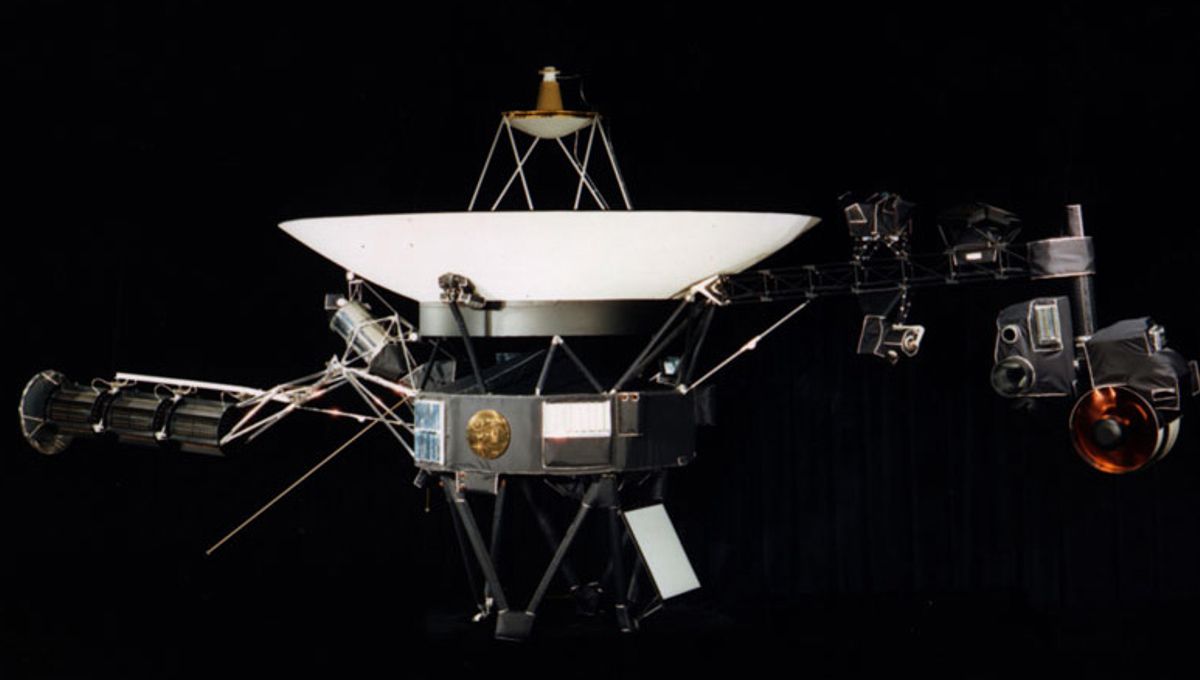
In 1977, NASA launched the Voyager probes to explore the outer reaches of the Solar System and the interstellar space beyond. Eventually, both spacecraft encountered a blazing “wall of fire” at the system’s boundary, recording temperatures between 30,000 and 50,000 kelvin (about 54,000 to 90,000 degrees Fahrenheit) as they passed through.
There are a few ways you could define the edge of the Solar System – for instance, where the planets end, or at the Oort cloud, the boundary of the Sun’s gravitational influence, where objects may still return closer to the Sun. One way is to define it as the edge of the Sun’s magnetic field, where it pushes up against the interstellar medium, known as the heliopause.
“The Sun sends out a constant flow of charged particles called the solar wind, which ultimately travels past all the planets to some three times the distance to Pluto before being impeded by the interstellar medium,” NASA explains. “This forms a giant bubble around the Sun and its planets, known as the heliosphere.”
It is beyond that where the heliopause lies.
“The boundary between solar wind and interstellar wind is the heliopause, where the pressure of the two winds are in balance. This balance in pressure causes the solar wind to turn back and flow down the tail of the heliosphere,” NASA continues.
“As the heliosphere plows through interstellar space, a bow shock forms, similar to what forms as a ship plowing through the ocean.”
On August 25, 2012, Voyager 1 became the first spacecraft to go beyond the heliosphere and cross the heliopause, followed by Voyager 2 in 2018. Prior to the Voyager spacecraft crossing the heliopause, scientists didn’t really know where the boundary would be, but the fact that the probes hit it at different distances helped support a few predictions about it.
“Scientists expected that the edge of the heliosphere, called the heliopause, can move as the Sun’s activity changes, sort of like a lung expanding and contracting with breath,” a NASA statement explains. “This was consistent with the fact that the two probes encountered the heliopause at different distances from the Sun.”
While not a hard edge, or a “wall” as it has sometimes been called, here both spacecraft measured temperatures of 30,000-50,000 kelvin (54,000-90,000 degrees Fahrenheit), which is why it is sometimes also referred to as a “wall of fire“. The craft survived the wall as, though the particles they measured were extremely energetic, the chances of collision in this particle-sparse region of space are so low that not enough heat could be transferred to the duo.
The Voyager spacecraft continue to send us data from beyond this “wall”, the only two probes that have crossed it so far, nearly 50 years after they were launched. Together, they have found several surprises on our first glimpse outside the Solar System.
“An observation by Voyager 2’s magnetic field instrument confirms a surprising result from Voyager 1: The magnetic field in the region just beyond the heliopause is parallel to the magnetic field inside the heliosphere,” NASA explained, shortly after one such surprise.
“With Voyager 1, scientists had only one sample of these magnetic fields and couldn’t say for sure whether the apparent alignment was characteristic of the entire exterior region or just a coincidence. Voyager 2’s magnetometer observations confirm the Voyager 1 finding and indicate that the two fields align.”
An earlier version of this article appeared in June.

Source Link: NASA's Voyager Spacecraft Found A 30,000-50,000 Kelvin "Wall" At The Edge Of Our Solar System
