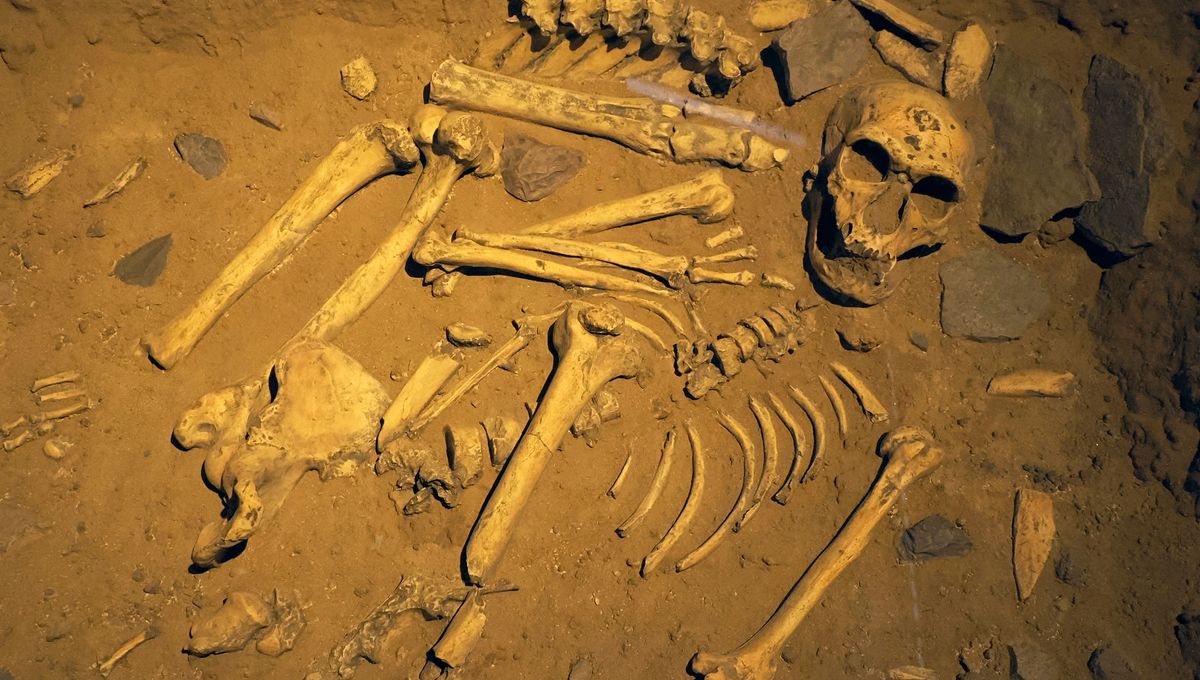
Did Neanderthals in Europe have funerary and death practices? The answer to this question in the context of the Iberian Peninsula has been elusive for some time, as there’s an absence of clear burial practices in the archaeological record. However, archaeologists have now discovered evidence of a remarkable diversity and complexity of Neanderthal funerary behaviors at sites scattered across the region, suggesting that we may need to reassess our understanding of these ancient humans.
The archaeologists reviewed the Neanderthal fossil record in the Iberian Peninsula for specimens dating from 400,000 to 40,000 years ago, when these humans disappeared. The results showed that, despite there not being any formal burials documented in the region, as with other places in Europe, there is evidence that the Neanderthal population intentionally deposited bodies in selected places inside caves, which may be an alternative practice that differs from others.
“The absence of formal burials in the Iberian Peninsula does not mean that the Neanderthal populations of this region lacked burial practices. On the contrary, the findings invite us to broaden our gaze and reconsider what we mean by funerary behavior,” Nohemi Sala, principal author of the new study, explained in a statement.
The Iberian Peninsula, a mountainous landmass that makes up Spain, Portugal, Andorra, and Gibraltar, plays an essential role in our understanding of Neanderthal populations. This is because it was a strategic region for different lineages of Neanderthals, as well as other ancient species of humans. It seems these populations were shaped by recurrent pressures introduced by climatic changes, but despite their significance, we are still not sure how they influenced their mortuary and funerary behaviors.
In their study, Sala and colleagues traced all known records of fossils of Neanderthals and their ancestors in the Iberian Peninsula to find out how their dead became deposited where they were. Was this due to carnivores carrying the bodies back to their dens? Was it accidental accumulation, or was this evidence of funerary practices?
“Once other contexts were ruled out, we analyzed what type of mortuary activity it was: formal burial, cannibalism practices or the intentional accumulation of corpses in specific places,” Sala said.
The results showed that there was a repeated and systematic accumulation of bodies in specific places across time. Although this does not meet the typical definition of a “burial”, it does constitute a funerary manifestation, they argue. These practices demonstrate that Iberian Neanderthals did, in fact, develop complex social behaviors related to death.
Although the team did assess the possible relationship between climate and ecological conditions and the manifestation of these funerary behaviors, they found no direct link. Surprisingly, it seems these important factors that shaped much of the Neanderthal population on the peninsula throughout the Pleistocene period did not necessarily shape their death practices.
In other sites across Europe or parts of Asia, Neanderthals have been found to have had a symbolic capacity for funerary behavior, including the practice of burying their dead. Although this is the most recognizable funerary practice in the fossil record, it is not the only one. In fact, the researchers argue that focusing on burials could cause evidence of other practices to be overlooked. They believe this work opens the door to considering broader funeral activities, which may in turn reflect cultural diversity among Neanderthals in southern Europe.
The study is published in the Journal of Archaeological Science: Reports.

Source Link: Neanderthals In Iberia Had Funerary Practices – They're Just Not What We Expected
