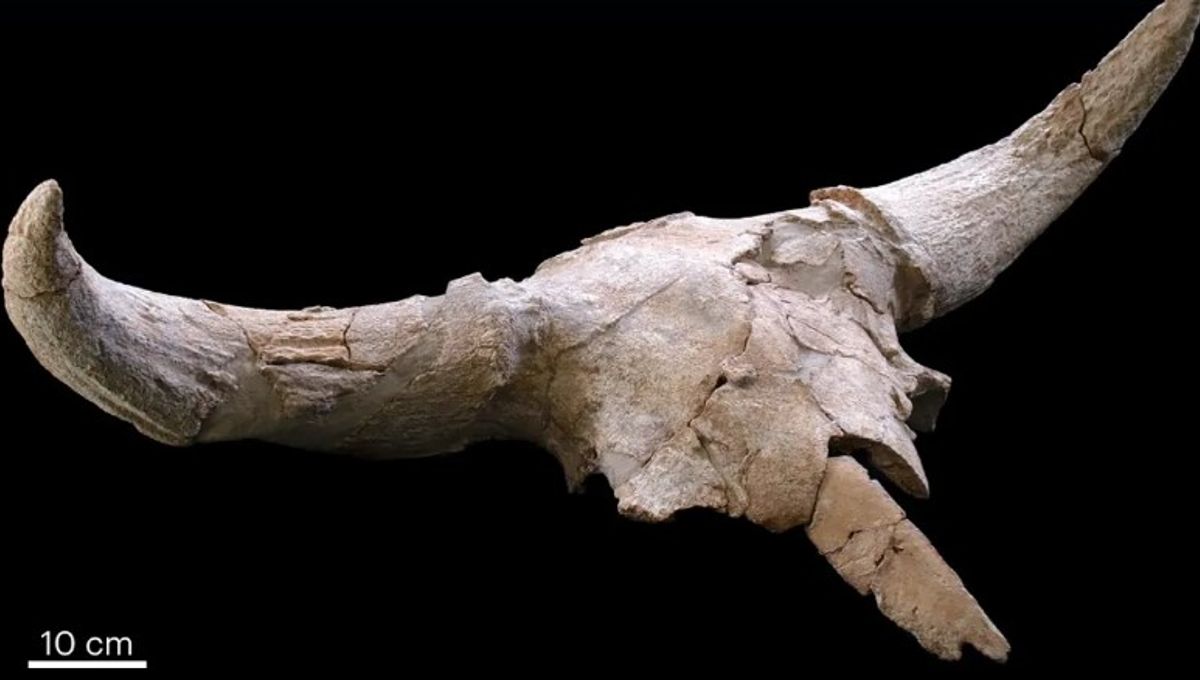
There’s a cave in Spain that seems to have held some sort of ritual significance to Neanderthals, though researchers have no idea why the site was so revered by these extinct hominins. What we do know, however, is that Neanderthals kept coming back to the cave to stash horned animal skulls, and that the practice was probably passed down through the generations for an extended period of time.
The rest of this article is behind a paywall. Please sign in or subscribe to access the full content.
Known as the Des-Cubierta cave, the site contains 35 crania belonging to creatures like aurochs and steppe rhinoceroses, as well as Neanderthal teeth and stone tools. There’s evidence that Neanderthals made fires in the cave, although the absence of any other faunal remains suggests that these animals were butchered elsewhere and only their heads were brought to the site.
This immediately hints at some sort of symbolic function for the animal skulls, whether as hunting trophies or as ritualistic items. And while we really have no idea exactly what purpose the horned crania served or how they were used, this unique collection indicates that Neanderthals were capable of abstract thought and symbolic behavior.
Unfortunately, all attempts to date the skulls have proved unsuccessful, so we don’t know exactly when they were stashed. However, uranium-series dating conducted on a piece of charcoal and a stalagmite inside the cave suggests that the crania were probably collected between about 135,000 and 50,000 years ago.
Moreover, the fact that the skulls are dispersed throughout a layer of sediment that is several meters thick suggests that they probably weren’t all placed in the cave at the same time, and that the weird habit of dumping animal heads at Des-Cubierta may have persisted for an extended period. To gain more insights into this chronology, researchers have now conducted a detailed geostatistical and spatial analysis of this sediment layer and the unusual artifacts contained within it.
Results show that the sediment built up due to successive rockfalls, although bands containing lower concentrations of boulders hint at recurring periods of relative calm in between subsequent avalanches. The fact that the animal skulls are interspersed by these gaps, therefore, provides evidence that they were assembled over a remarkably long time.
“This recurrent engagement with the confined space suggests that the introduction of crania formed part of a repeated, culturally motivated behavior – a transmitted practice extending over an undetermined but prolonged period,” write the study authors. Exactly how long the custom continued for is unclear, although it now seems obvious that the skull collection was added to by multiple generations of Neanderthals.
“The integration of geological, spatial, and taphonomic data demonstrates that the accumulation of large herbivore crania was not a single depositional event, but rather the result of repeated episodes embedded within a long-term process,” conclude the researchers. As for the nature of this process, they say only that it involved a “specific, non-subsistence purpose, the meaning of which remains uncertain.”
The study is published in the journal Archaeological and Anthropological Sciences.

Source Link: Neanderthals Repeatedly Dumped Horned Skulls In This Cave For An Unknown Ritual Purpose
