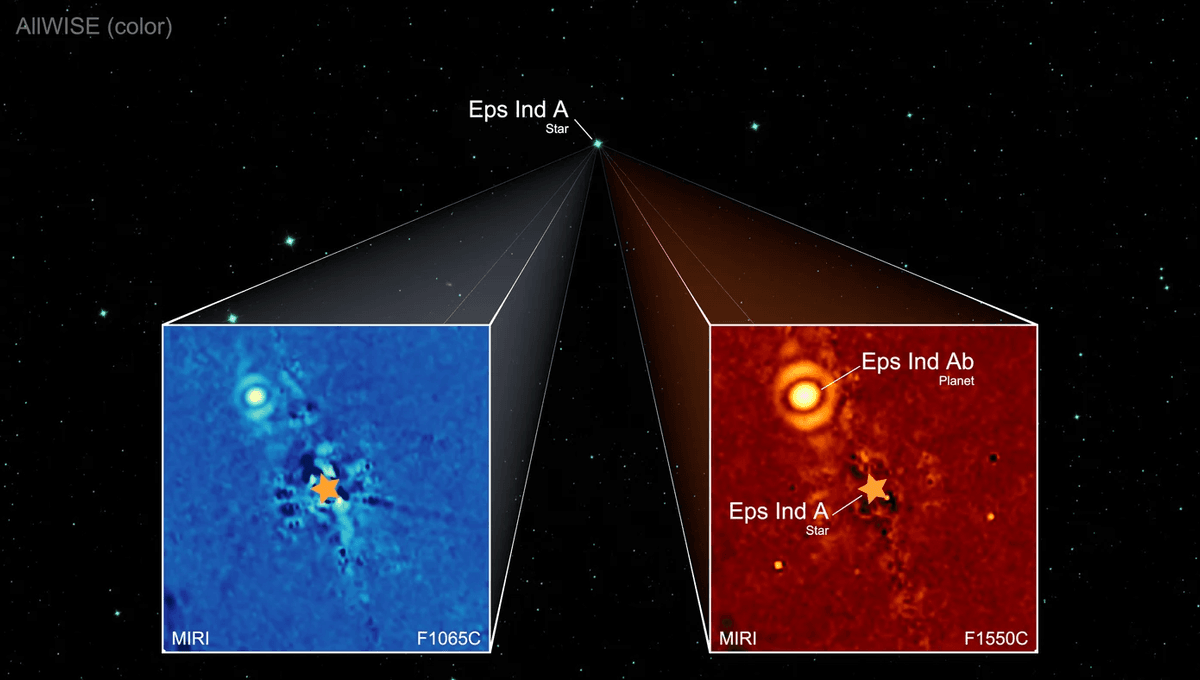
JWST has imaged a new planet directly and it is quite a fascinating object. It orbits one of the three stars in the Epsilon Indi system and it weighs six times the mass of Jupiter. This super-Jupiter is 20 to 40 times further from its star than Earth is from the Sun – so it is very cold.
It also doesn’t help that the star, Eps Ind A, is an orange dwarf smaller and cooler than the Sun. The planet, Eps Ind Ab, has an estimated temperature of around 0°C (32°F), much colder than the scorching hot Jupiters that have become a common feature of exoplanet research. The observations were possible thanks to the observations with JWST.
Since the system is just 12 light-years away, it was a perfect target for direct imaging. The issue here is the star would have been too bright for the planet to be revealed. The Mid-Infrared Instrument (MIRI) has a coronagraph, a tool to create an artificial eclipse and to allow us to spot what would be otherwise lost in the glare.
“We were excited when we realised we had imaged this new planet,” lead author Elisabeth Matthews, a researcher at the Max Planck Institute for Astronomy (MPIA), said in a statement. “To our surprise, the bright spot that appeared in our MIRI images did not match the position we were expecting for the planet. Previous studies had correctly identified a planet in this system but underestimated this super-Jupiter gas giant’s mass and orbital separation”
The location of the signal was so surprising that the team had to make sure it was really the planet. The glow of the planet as seen by the telescope is larger than the planet itself and it was important that they were not catching light from a more distant background object.
“It is always hard to be certain, but from the data, it seemed quite unlikely the signal was coming from an extragalactic background source,” explained Leindert Boogaard, another MPIA scientist and a co-author of the research article.
Based on the current observations, the planet has carbon-based molecules in its atmosphere such as methane, carbon dioxide, etc. Or it might be clouds. They will know more with follow-up observations of the planet with JWST.
“Our next goal is to obtain spectra which provide us a detailed fingerprint of the planet’s climatology and chemical composition,” said Thomas Henning, Emeritus Director at MPIA, co-PI of the MIRI instrument, and a co-author of the underlying article.
“In the long run, we hope to also observe other nearby planetary systems to hunt for cold gas giants that may have escaped detection,” added Matthews. “Such a survey would serve as the basis for a better understanding of how gas planets form and evolve.”
A research article discussing the findings is published in the journal Nature.

Source Link: Nearest Super-Jupiter Snapped By JWST – And It's A Freezing Cold Giant
