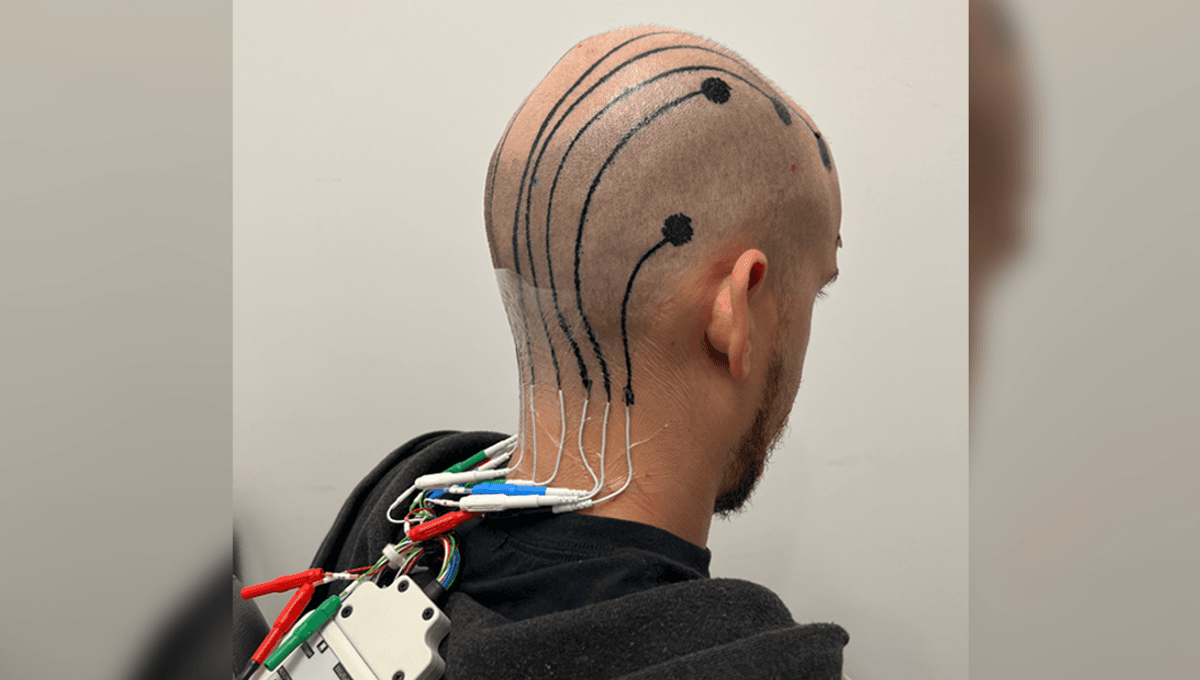
Recording the goings-on inside the human brain is no simple task, largely because there’s a skull in the way. Over the years, we’ve developed ways of capturing brain activity using electrodes, but a team of scientists just made a big leap forward by inventing a biocompatible liquid ink that can be used to print temporary “e-tattoo” sensors directly onto the scalp.
Tests like electroencephalography (EEG) are invaluable in diagnosing many different neurological conditions, but there’s no getting away from the fact that they can be time-consuming and uncomfortable for patients.
A typical EEG begins with a technician taking painstaking measurements of the patient’s scalp, pinpointing the precise spots where electrodes will be attached to the skin. These are connected via long wires to a data collection machine, which the patient must be tethered to until the test is done – sometimes for hours.
Now, a team led by scientists at the University of Texas at Austin is offering a new way forward. They’ve been developing e-tattoos, sensors that are applied directly to the skin to measure various bodily functions, including heart rate, blood pressure, and the concentrations of different compounds in sweat. While this technology has been progressing, there was a catch.
“Designing materials that are compatible with hairy skin has been a persistent challenge in e-tattoo technology,” explained co-corresponding author Nanshu Lu in a statement. Previous e-tattoos have been applied by transferring them to the skin via a thin adhesive layer, but for most people, this won’t work on the scalp due to the presence of hair.
So, Lu and the team came up with a new approach. They developed a liquid, biocompatible ink composed of conductive polymers. It’s able to reach the skin of the scalp even through hair, and once it dries it works as a biological sensor.
“Our innovations in sensor design, biocompatible ink, and high-speed printing pave the way for future on-body manufacturing of electronic tattoo sensors, with broad applications both within and beyond clinical settings,” Lu said.
To test their innovation, they printed e-ink electrodes onto the scalps of five volunteers with short hair. A sophisticated algorithm designed the electrodes, which were spray-painted onto the scalp in a thin layer using a digitally controlled printer. According to the researchers, it’s quick, painless, and cost-effective.
The e-tattoos were compared with conventional electrodes placed next to them, and their performance was found to be about the same. What’s more, they lasted longer – the conductive gel you use to adhere normal electrodes to the skin starts to dry out after a few hours, making data collection less accurate, whereas the e-tattoos remained stable for at least 24 hours.
They also printed e-ink “wires” running from the electrodes toward the base of the skull, meaning that much shorter physical wires could be used to connect the electrodes to the data collection device. One day, they hope, the whole process could be made completely wireless by tweaking the ink’s formula to include data transmitters as well.
That opens up the possibility of even more applications for this technology. Brain-computer interfaces are among the most exciting new technologies being developed right now, but you generally need some way of attaching the internal implant to an external device. With e-tattoos, it might be possible to print the electrical wiring directly onto the skin instead.
First, though, more tests are needed to optimize the technology for different hair types – the authors note that traditional EEG caps are often not suitable for those with very thick or curly hair, so this could be a welcome solution to that problem.
Having experienced using a marker pen to correctly position electrodes on the scalps of many real people – not to mention the fun of shampooing all the conductive gel out of your hair afterward – this writer can confirm that e-tattoos sound like a much more pleasant experience for all concerned!
The study is published in the journal Cell Biomaterials.

Source Link: New “E-Tattoos” Pick Up Brain Activity Through The Skull – Even With Hair In The Way
