


We are just days away from interstellar comet 3I/ATLAS’s closest approach to Earth, so it is not surprising that this fascinating space rock has gotten more attention. Observatories on Earth and in space have been able to study it without any risk of getting too close to the Sun, and new details and beautiful images keep pouring in.
The Gemini North telescope, for example, has just captured a new image of Comet 3I/ATLAS, and you might notice something immediately – the comet has a green tinge. It doesn’t appear as green as the three other comets that shone through the Solar System earlier this year (before one turned golden), but the new photo confirms something.
Just before the comet disappeared behind the Sun for weeks, it turned from its original reddish color to a greener hue. The green is believed to be caused by the release of several gases, among them diatomic carbon (C2). This is a very reactive molecule, and when excited, it emits light at green wavelengths.

The observations were made on November 26 when the interstellar comet was about 288 million kilometers (about 179 million miles) from Earth. The observations were conducted as part of a diversity, equity, and inclusion program called Shadow the Scientists, where members of the public can work with scientists on authentic scientific experiments, including using some of the cutting-edge telescopes to study incredible objects such as 3I/ATLAS.
“Sharing an observing experience in some of the best conditions available gives the public a truly front-row view of our interstellar visitor,” program lead Bryce Bolin, a research scientist from Eureka Scientific, said in a statement. “Allowing the public to see what we do as astronomers and how we do it also helps demystify the scientific and data collection process, adding transparency to our study of this fascinating object.”
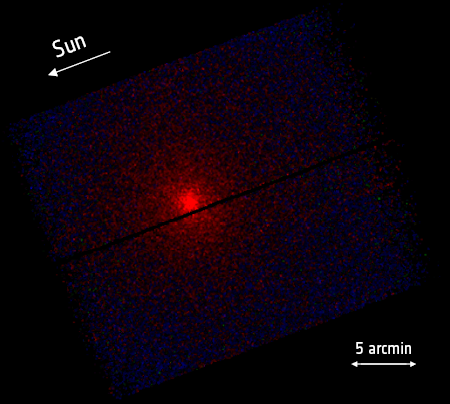
There’s a clear X-ray emission from Comet 3I/ATLAS.
Image credit: ESA/XMM-Newton/C. Lisse, S. Cabot & the XMM ISO Team
It is not just new optical observations that have been made lately. Fresh on the heels of the first X-ray observations from the XRISM telescope, the European Space Agency’s X-ray space observatory XMM-Newton also snapped 3I/ATLAS. The XRISM team was confident but not certain that they had found a true detection.
Many but not all comets have been seen in X-rays. The first two interstellar objects, 1I/’Oumuamua, discovered in 2017, and Comet 2I/Borisov in 2019, were not spotted in X-rays. The XMM-Newton observations show clearly how 3I/ATLAS shines in X-rays, from observations conducted on December 3, for around 20 hours, when the space rock was about 282–285 million kilometers (175-177 million miles) from the spacecraft.
X-ray emission is produced in comets when the gas escaping the cometary nucleus slams into the solar wind, the stream of charged particles from the Sun. X-rays can provide insight into different aspects of the composition of comets. It had been suspected that ‘Oumuamua was made of exotic nitrogen and hydrogen ices, but it couldn’t be proven. This might be the chance to discover if comets from other stars are made of different stuff.
Comet 3I/ATLAS is now moving out of the Solar System, but its closest passage to Earth is still a few days away. On December 19, 3I/ATLAS will be just 270 million kilometers (168 million miles) from us, and with a good telescope, anyone could snap it.


Source Link: New Full-Color Images Of Interstellar Comet 3I/ATLAS, As We Are Days Away From Closest Encounter