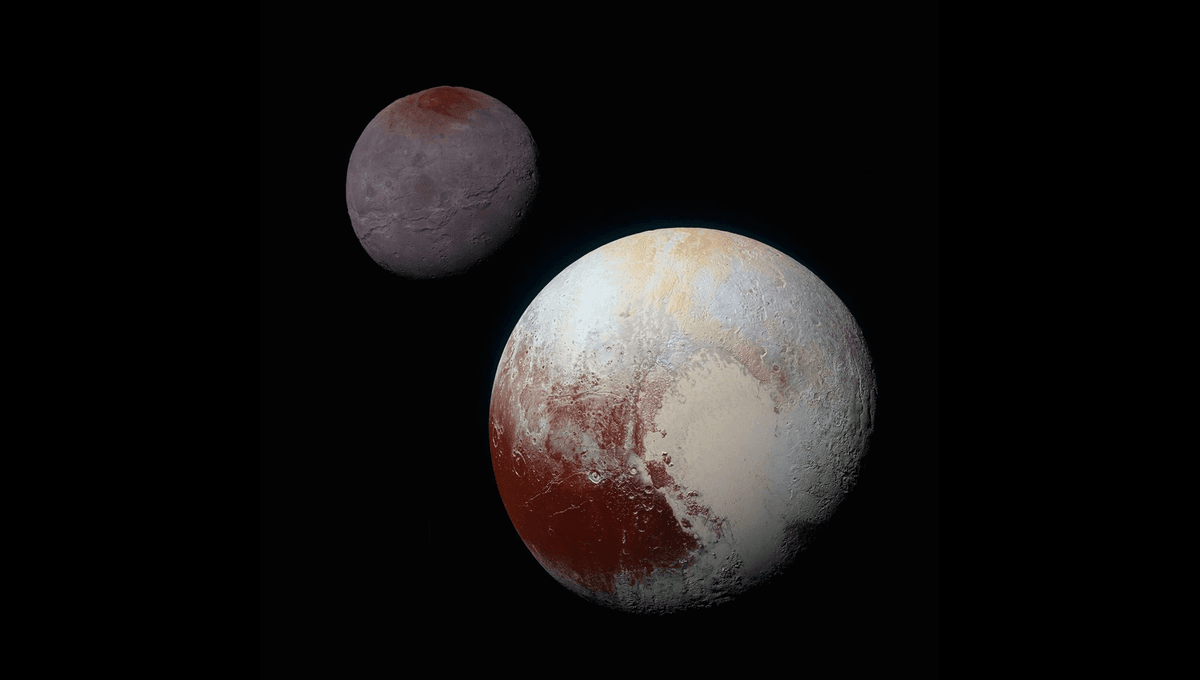
Our Moon is surprisingly massive compared to Earth, but that ratio is dwarfed if we consider Pluto and Charon. The latter is about 12 percent of the mass of Pluto and technically doesn’t orbit it. The pair of them orbit around a common center of mass outside of Pluto. They are dancing – and this dance might have started not with a collision, but with a “kiss”.
This is how planetary scientists are proposing the pair formed. This novel formation mechanism involves the proto-Charon colliding with Pluto without major changes, becoming stuck together in a snowman shape for a while before rotational forces pull them apart.
“Most planetary collision scenarios are classified as ‘hit and run’ or ‘graze and merge.’ What we’ve discovered is something entirely different – a ‘kiss and capture’ scenario where the bodies collide, stick together briefly and then separate while remaining gravitationally bound,” lead author Dr Adeene Denton, a NASA postdoctoral fellow who conducted the research at the University of Arizona, said in a statement.
The crucial understanding came from properly including the structural integrity of rock and ice in the models. It would not make sense to model Pluto and Charon like the collision that formed the Moon. When planetoid Theia hit Earth, it melted material and tossed it into orbit. It’s from that molten mess that the Moon came to be.
“Pluto and Charon are different – they’re smaller, colder and made primarily of rock and ice. When we accounted for the actual strength of these materials, we discovered something completely unexpected,” Denton added.
The team led by Denton created simulations of the impact using high-performance computing clusters. This revealed that Pluto and Charon did not merge and stretch like silly putty, they just touched and got stuck together. They remained mostly intact during their collision and subsequent interaction.
When they separated, the process would have delivered a lot of heat into both bodies, which could potentially sustain the subsurface ocean believed to exist under the famous heart of Pluto – and that is not all.
“The compelling thing about this study, is that the model parameters that work to capture Charon, end up putting it in the right orbit. You get two things right for the price of one,” said senior study author Erik Asphaug, a professor at the University of Arizona’s Lunar and Planetary Laboratory.
Pluto and Charon might not be the only ones that experience this either; Eris and its moon Dysnomia are also mutually tidally locked. Maybe they kissed as well.
The team plans to investigate this model further to refine it and see if some of the geological idiosyncrasies of Pluto can be explained with it.
“We’re particularly interested in understanding how this initial configuration affects Pluto’s geological evolution,” Denton said. “The heat from the impact and subsequent tidal forces could have played a crucial role in shaping the features we see on Pluto’s surface today.”
The study is published in the journal Nature Geoscience.

Source Link: New "Kiss and Capture" Mechanism Might Explain The Formation Of Pluto And Charon
