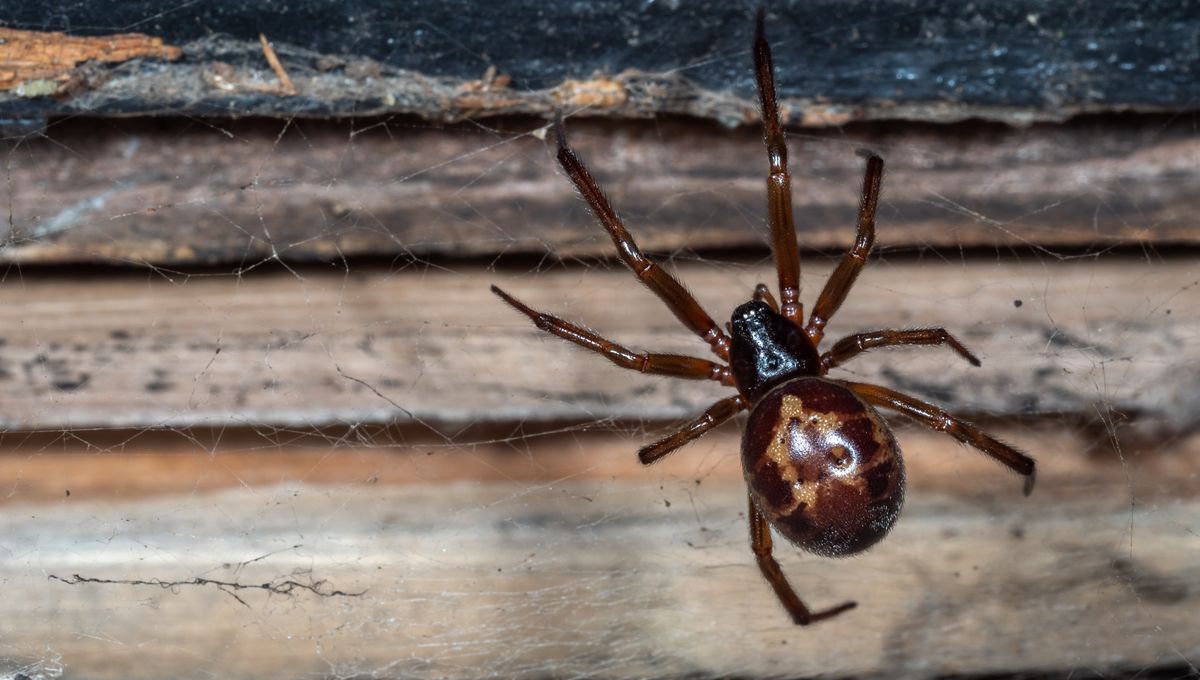
The noble false widow spider (Steatoda nobilis) is an invasive species that has come to populate much of Europe, western Asia, as well as North and South America. It was first formally described in 1875. The spider possesses a neurotoxin in its venom which, as well as giving humans a nasty bite, can allow it to consume prey much bigger than itself.
The rest of this article is behind a paywall. Please sign in or subscribe to access the full content.
What has made the noble false widow such a successful species is its cold tolerance, longevity, and ability to produce around 1,000 offspring in a single year – coupled with a bite that can cause neuromuscular paralysis, you can start to see what these spiders are capable of.
In southern England, a noble false widow spider was seen preying on a pygmy shrew (Sorex minutus). This represents only the third case of a noble false widow preying on a protected vertebrate species, the first case of a spider in the family Theridiidae preying on a shrew in the UK, and the first recorded case of a shrew being preyed on by a spider in the genus Steatoda.
On a Thursday morning in August 2022, the shrew was seen tangled in a spider’s web, and while seemingly alive it made only small movements. The noble false widow was seen moving up and down the web between the shrew and the rafters of the building, before the shrew was hoisted upwards approximately 25 centimeters (9.8 inches). The shrew was later wrapped in silk by the spider and then was found three days later on a window ledge.
“The noble false widow is a very intriguing spider, and we have much to learn about it still. We are very grateful to the members of the public who share their observations with us. This allows us to understand better how this invasive species may impact us and our environment,” said Dr John Dunbar, Irish Research Council Post-Doctoral fellow, Venom Systems Lab, Ryan Institute, University of Galway, and senior author of the study, in a statement at the time.
This compares to other recorded cases of Latrodectus and Steatoda species which have been seen hoisting prey higher to avoid secondary predators or kleptoparasites. In previous cases the spiders have preyed upon a gecko and a bat, suggesting that the combination of strong silk and potent venom gives these spiders power over prey much bigger than themselves.
In this case and the two previous cases all the spiders were adult females, suggesting that larger prey could present a good opportunity for energy storage during reproduction.
“In order to capitalize from a large vertebrate meal that requires expending energy to acquire, S. nobilis may spend several days feeding off the remains, and in the case presented here, the spider only released the shrew after three days, to which the remains of the shrew were nothing but fur, bones, and skin,” explain the authors in the paper.
The study is published in the journal Ecosphere.
An earlier version of this article was published in March 2023.

Source Link: New Nightmare Fuel Unlocked: Watch The First Known Capture Of A Shrew By A False Widow Spider
