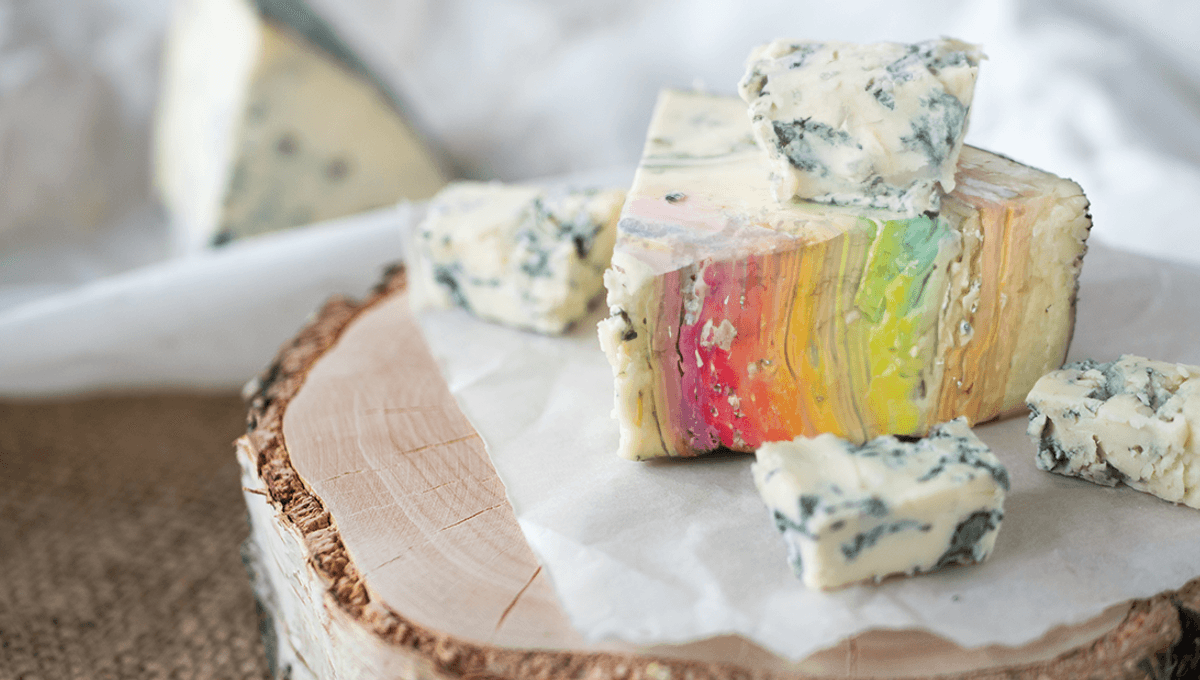
If you thought playing music to cheese or digging up 2,600-year-old halloumi was as wild as dairy-based research gets, boy have we got the study for you. Scientists at the University of Nottingham have – in their own words – broken “the mold” by discovering a way to make blue cheese in a whole new array of colors.
Blue cheese is a bit of an acquired taste. On the one hand, you’ve got your people who’ll slather their salads in the stuff and shove it in anything from soup, to pies, to mac and cheese; on the other hand, there are those of us who pick gingerly around the Roquefort in favor of the white Cheddar or Brie. But what is it that makes blue cheese so blue?
The answer is fungi, specifically a species called Penicillium roqueforti. It’s used in the manufacture of many blue-veined cheeses – its namesake Roquefort, as well as other familiar varieties like Stilton and Gorgonzola. As the fungus grows, it produces spores that contain a blue-green pigment.
For many years, we’ve all just kind of just accepted that cheese manufactured in this way will be blue. But Dr Paul Dyer and the team dared to dream of a different, more colorful future.
“We’ve been interested in cheese fungi for over 10 years and traditionally when you develop mould-ripened cheeses, you get blue cheeses such as Stilton, Roquefort and Gorgonzola which use fixed strains of fungi that are blue-green in colour. We wanted to see if we could develop new strains with new flavours and appearances,” said Dr Dyer, a professor of fungal biology, in a statement sent to IFLScience.
“The way we went about that was to induce sexual reproduction in the fungus, so for the first time we were able to generate a wide range of strains which had novel flavours including attractive new mild and intense tastes. We then made new colour versions of some of these novel strains.”
The researchers began by using bioinformatics and genetic analysis to pinpoint the biochemical pathway that gradually forms the blue pigment in P. roqueforti. The pigment actually starts off white, and progresses through shades of yellow-green, red-brown-pink, dark brown, and light blue before ending up at the classic hue we’ve all seen on our holiday cheeseboard.
By mutating genes within this pathway using a food-safe technique, they were able to produce different color variants that they could use for making cheese, after checking that there were no unintended effects that might compromise safety, such as an increase in fungal toxin production.
The new cheeses would certainly add some aesthetic flair to your charcuterie board, but what about flavor? When the team tested the cheeses using diagnostic instruments in the lab, “We found that the taste was very similar to the original blue strains from which they were derived,” Dr Dyer explained.
But when the cheeses were unleashed on the unsuspecting students and staff of the University of Nottingham, it was a slightly different story.
“The interesting part was that once we went on to make some cheese, we then did some taste trials with volunteers from across the wider University, and we found that when people were trying the lighter-coloured strains they thought they tasted more mild. Whereas they thought the darker strain had a more intense flavour. Similarly, with the more reddish brown and a light green one, people thought they had a fruity tangy element to them – whereas according to the lab instruments they were very similar in flavour. This shows that people do perceive taste not only from what they taste but also by what they see.”
If you’re dying to get your hands on some rainbow cheese, that may actually be possible in the near future. The researchers are working with a spinout company at the university called Myconeos, which is already trying to make the dream of marketing multicolored cheese a reality.
Dr Dyer even tentatively suggested that the makeover could persuade some blue-cheese newbies over to the dark side: “Personally, I think it will give people a really satisfying sensorial feeling eating these new cheeses and hopefully might attract some new people into the market.”
The study is published in the journal NPJ Science of Food.

Source Link: New Rainbow Of Blue Cheese Colors Created In Tasty Breakthrough
